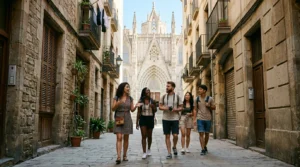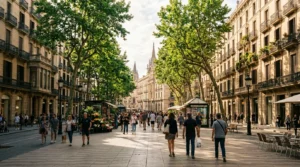
El Raval is the half of Barcelona's old town that lies west of La Rambla, between the boulevard and the Paral·lel. It holds the MACBA, the CCCB, the Gothic courtyards of the Antic Hospital de la Santa Creu, Gaudí's Palau Güell and Botero's Cat. By day it is busy and easy to walk; at night, stick to the main streets.
Key takeaways
- El Raval runs from the west side of La Rambla to the Rondas and the Avinguda del Paral·lel, so La Boqueria, the Liceu and Palau Güell all sit on its edge.
- The upper (northern) half around the MACBA, the CCCB and Carrer del Doctor Dou is the easiest part to explore for a first visit. The lower half around the Rambla del Raval and Sant Pau del Camp is more residential, and quieter after dark.
- Botero's Cat is a large bronze sculpture standing on the Rambla del Raval.
- Palau Güell is in El Raval, on Carrer Nou de la Rambla, a few steps off La Rambla.
- Two to three hours covers the main sights on foot. A guided walk that crosses El Raval on the way up Montjuïc takes 4 or 6 hours in total.
- Safety is mostly common sense: keep bags zipped and phones in front pockets, and use the wider, well-lit streets after dark.
- The Barcelona Old Town, Montjuic Castle and Cable Car tour (€95 per person, 4h, max 15) and its Magic Fountain show version (€105 per person, 6h, max 15) both walk through El Raval.
Where is El Raval, and where does it meet La Rambla?
El Raval is one of the four neighbourhoods of Ciutat Vella, Barcelona's old town district. The other three are the Barri Gòtic, La Barceloneta and Sant Pere, Santa Caterina i la Ribera (which includes El Born).
The neighbourhood is a rough rectangle. La Rambla forms its eastern side. The Ronda de Sant Antoni and the Ronda de Sant Pau form the western side, and the Avinguda del Paral·lel closes it off to the south, running down towards the port and the foot of Montjuïc. Plaça de Catalunya sits just beyond its northern corner.
Where it meets La Rambla matters for visitors. Everything on the right-hand side as you walk down La Rambla towards the sea is El Raval, including La Boqueria market and the Gran Teatre del Liceu opera house.
A short history: from hospital district to Barri Xinès to museum quarter
The name comes from the Arabic-derived word arrabal, meaning a suburb outside the walls. In the Middle Ages this land lay outside Barcelona's earlier wall line, and it held orchards, convents and the institutions the city preferred to keep at a distance, the main hospital among them.
When a later wall enclosed the area, El Raval filled up, and in the 19th century it became a crowded industrial quarter of textile workshops and workers' housing.
In the early 20th century, journalists began calling the lower part of the neighbourhood the Barrio Chino (Barri Xinès in Catalan). The name had nothing to do with a Chinese community: it was a label for a poor port district known for bars and cabarets, and it stuck for decades.
In the late 20th century the city set out to change the neighbourhood. Blocks were cleared, the Rambla del Raval was opened through the lower half, and the MACBA and the CCCB were placed in the upper half.
Today El Raval is one of Barcelona's most mixed neighbourhoods: Catalan families, Pakistani, Filipino and North African communities, students and artists share the same streets. That mix is the reason to come.
What to see in El Raval, stop by stop
The order below runs roughly north to south, which is the easiest way to walk the neighbourhood if you start near Plaça de Catalunya.
MACBA and Plaça dels Àngels
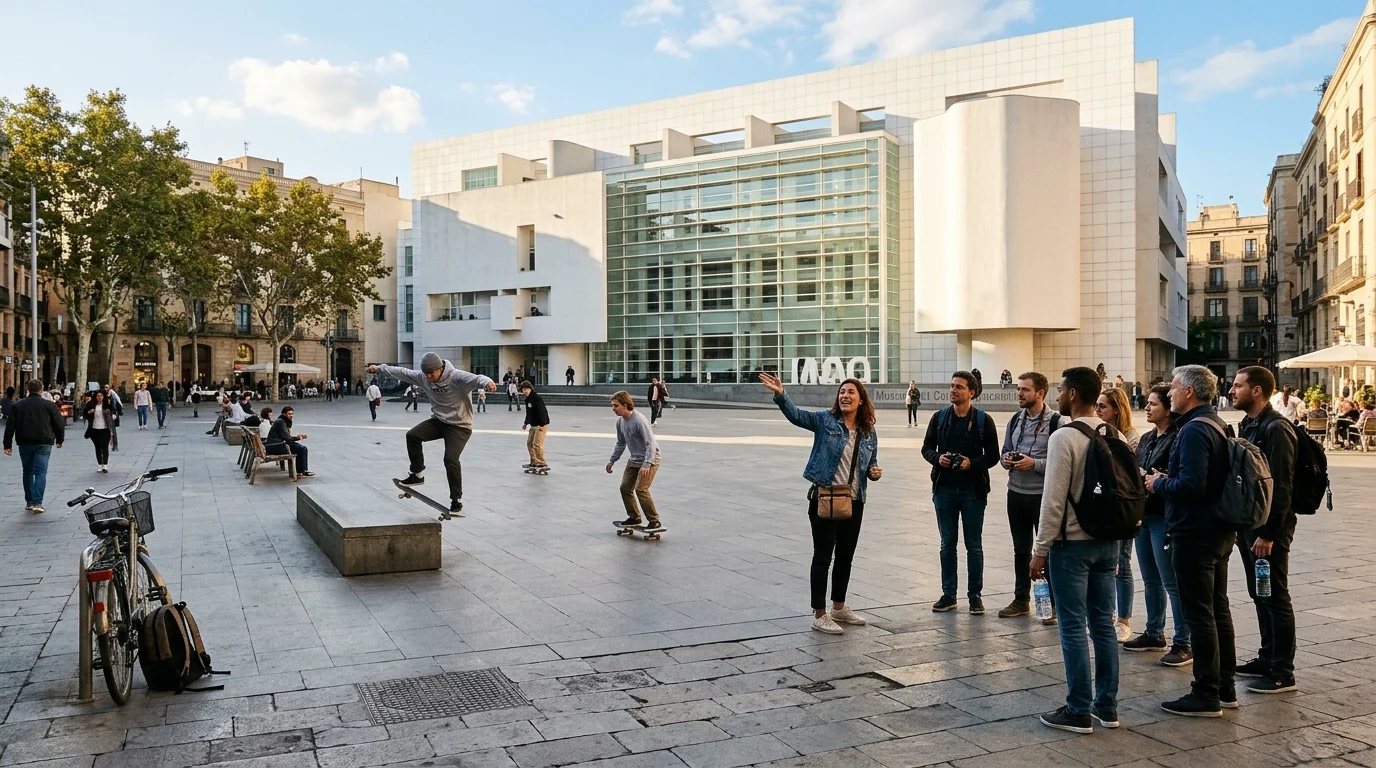
The Museu d'Art Contemporani de Barcelona (MACBA) is the large white building by the American architect Richard Meier, opened in the last decade of the 20th century. Even without going inside, the square in front, Plaça dels Àngels, is worth a stop: skateboarders use its smooth paving all day, and the bright facade against the older buildings shows the neighbourhood's two faces in one view.
CCCB (Centre de Cultura Contemporània de Barcelona)
Just behind the MACBA, the CCCB occupies a former charity house, the Casa de la Caritat. Its courtyard has a striking glass wall that tilts outward at the top and reflects the rooftops of the city. Its programme of exhibitions and talks changes through the year.
Antic Hospital de la Santa Creu
This is one of the quietest and most rewarding corners of El Raval. The Gothic hospital complex dates back to the 15th century and served as Barcelona's main hospital for around five hundred years. Antoni Gaudí died here, days after being hit by a tram.
Today the buildings hold the Biblioteca de Catalunya. The courtyard garden, planted with orange trees and edged by stone arches, is a calm place to sit between busier streets.
La Boqueria, at the neighbourhood's edge
The Mercat de Sant Josep de la Boqueria faces La Rambla but backs onto El Raval, and its rear entrances open onto the neighbourhood's small squares. The La Boqueria market guide covers what to eat and when to go.
Gran Teatre del Liceu
Barcelona's opera house stands on La Rambla, on the El Raval side. For a walker it is a useful landmark: Palau Güell is only a short way further down and to the right.
Palau Güell
Yes, Palau Güell is in El Raval. Gaudí built this townhouse for his patron Eusebi Güell on Carrer Nou de la Rambla, a narrow street that runs off La Rambla into the neighbourhood. It is one of his early works and part of a UNESCO World Heritage listing for Gaudí's buildings.
From the street you see the two parabolic entrance arches and the iron work above them. The rooftop chimneys, covered in broken-tile mosaic, are mostly visible only from inside. The Palau Güell guide to what you see inside and from the street explains the difference between viewing the facade and going in.
Rambla del Raval and Botero's Cat
The Rambla del Raval is a wide, palm-lined avenue cut through the lower part of the neighbourhood around the turn of the millennium. It has benches, cafe terraces and a slower pace than La Rambla.
Botero's Cat (El Gat de Botero) stands near its lower end. This is a large, rounded bronze sculpture of a cat by the Colombian artist Fernando Botero, with the full, inflated shapes that mark his work. The cat had several homes around the city before settling here. It stands in the open, so you can see it at any time.
Sant Pau del Camp
At the southern end of El Raval, close to the Paral·lel, stands the Romanesque monastery of Sant Pau del Camp. It is one of the oldest surviving buildings in Barcelona, with a small cloister of carved double columns. Its name, "of the field", is a reminder that it once stood in open country outside the city.
Streets worth wandering
Carrer del Doctor Dou and Carrer d'Elisabets, near the MACBA, have small galleries, bookshops and cafes. Carrer dels Tallers is known for its record shops, and Carrer de Joaquín Costa for bars that fill up in the evening. The side streets off the Rambla del Raval show the everyday side: corner grocers and laundry on balconies.
Is El Raval safe?
El Raval is a lived-in, working neighbourhood in the centre of a large city, and most visitors walk it without trouble. It asks for the same street sense as the rest of the old town, with a little more care in a few places and at late hours.
El Raval by day
In daylight, the upper half around the MACBA, the CCCB, the Antic Hospital and the streets near La Boqueria is busy with students, families, shoppers and other visitors. The Rambla del Raval is also lively during the day, with people on the benches and terraces.
Practical habits that help:
- Keep bags zipped and worn in front of you in crowded spots, especially around La Boqueria and the Liceu, where La Rambla's crowds spill over.
- Keep phones in a front pocket rather than on a cafe table or in a back pocket.
- Carry only the cash and cards you need for the day, and leave passports in your accommodation if you do not need them.
El Raval at night
After dark, the neighbourhood changes street by street. The bars on Carrer de Joaquín Costa and around the MACBA are busy and sociable, while some narrow lanes in the lower half are quiet and less pleasant late at night.
For an evening out:
- Use the main, well-lit streets: the Rambla del Raval, Carrer de l'Hospital, Carrer del Carme and the streets around the MACBA.
- Walk in company if you can, and avoid cutting through empty side lanes late at night.
- Know your route back before you leave, or book a taxi to the door.
What to wear and carry
Nothing special. Comfortable shoes matter most on the stone paving, and a cross-body bag that closes fully is better than an open tote.
El Raval vs Gothic Quarter: which suits a first visit?
Both neighbourhoods are part of Ciutat Vella and lie on either side of La Rambla. They are very different in feel.
| El Raval | Gothic Quarter (Barri Gòtic) | |
|---|---|---|
| Where | West of La Rambla, to the Rondas and the Paral·lel | East of La Rambla, around the Cathedral |
| Character | Mixed, residential, multicultural, artistic | Medieval, polished, heavily visited |
| Main sights | MACBA, CCCB, Antic Hospital de la Santa Creu, Palau Güell, Botero's Cat, Sant Pau del Camp | Barcelona Cathedral, Plaça del Rei, Roman walls, Plaça de Sant Jaume |
| Streets | Grid of narrow streets opened up by squares and the Rambla del Raval | Tight medieval lanes and small squares |
| Best for | Contemporary art, street life, local food shops, evening bars | Roman and medieval history, first look at the old town |
| At night | Lively in parts, quieter and rougher in a few lanes | Busy and well walked until late |
| Guided option | Montjuïc walking tours at €95 or €105 per person cross it | Barcelona Old Town and Gothic Quarter Walking Tour, €55 per person, 3h, max 15 |
For a very first visit with limited time, most people start with the Gothic Quarter, because it holds the Roman and medieval core of the city. The street-by-street Gothic Quarter guide covers that side.
El Raval suits you better if you have already seen the Cathedral area, or if you want modern art, Gaudí's early work and everyday Barcelona. The two fit into the same day, with only La Rambla between them.
How long do you need in El Raval?
A focused walk through the main sights takes two to three hours: the MACBA square, the CCCB courtyard, the Antic Hospital garden, the back of La Boqueria, Palau Güell from the street and the Rambla del Raval with Botero's Cat. Add an hour or more if you go inside a museum or Palau Güell, or stop for a long lunch.
A half day that links El Raval, the Liceu and Palau Güell
A practical plan for a morning or afternoon:
- Start at Plaça de Catalunya and walk into El Raval along Carrer dels Tallers or Carrer d'Elisabets.
- Spend time at Plaça dels Àngels in front of the MACBA, then look into the CCCB courtyard.
- Walk down to the Antic Hospital de la Santa Creu and sit in the orange-tree garden.
- Cut through to the back of La Boqueria and walk out onto La Rambla.
- Continue down La Rambla past the Liceu, then turn right into Carrer Nou de la Rambla for Palau Güell.
- Finish on the Rambla del Raval with Botero's Cat, then walk south to Sant Pau del Camp if you still have energy.
Do any guided tours walk through El Raval?
Yes. Two walking tours cross El Raval on their way from La Rambla to Montjuïc. Both list La Rambla, La Boqueria Market, the Gran Teatre del Liceu, Palau Güell and El Raval as stops before the climb to the castle.
Barcelona Old Town, Montjuic Castle and Cable Car (€95 per person, 4h)
The Barcelona Old Town, Montjuic Castle and Cable Car tour starts on La Rambla, passes La Boqueria and the Liceu, stops at Palau Güell and then walks through El Raval. From there the group rides the Montjuïc funicular and the cable car up to Montjuïc Castle and its tower, with views across the city and the sea, before taking the cable car back down. It costs €95 per person, lasts 4 hours and takes a maximum of 15 people. Botero's Cat is not listed as a stop on this version.
Barcelona Old Town, Montjuic Castle, Cable Car and Magic Fountain show (€105 per person, 6h)
The Magic Fountain show version of the Montjuïc tour follows the same route through La Rambla, La Boqueria, the Liceu, Palau Güell and El Raval, and adds a photo stop at Botero's Cat. After the castle it stops at the Olympic Stadium and Palau Sant Jordi and ends with the Magic Fountain evening show. It costs €105 per person, lasts 6 hours and takes a maximum of 15 people.
The Magic Fountain show is run by the city council. It is seasonal and can be paused for maintenance or wind. If the show is not on, the rest of the tour still goes ahead.
Other walking tours near El Raval
Two more walking tours touch the edge of El Raval without crossing it:
- The Barcelona Old Town and Gothic Quarter Walking Tour (€55 per person, 3h, max 15) walks the Gothic Quarter and ends on La Rambla at La Boqueria Market, right on the neighbourhood's eastern edge.
- La Boqueria and Santa Caterina Markets with Food and Tapas Small Group (€135 per person, 4h, max 15) visits La Boqueria with 3 pintxos, tapas, a dessert and drinks with the tastings.
Tours that pass El Raval, compared
| Tour | Price basis | Duration | Max group | Passes in or near El Raval |
|---|---|---|---|---|
| Barcelona Old Town, Montjuic Castle and Cable Car | €95 per person | 4h | 15 | La Rambla, La Boqueria, Liceu, Palau Güell, El Raval |
| Barcelona Old Town, Montjuic Castle, Cable Car and Magic Fountain show | €105 per person | 6h | 15 | La Rambla, La Boqueria, Liceu, Palau Güell, El Raval, Botero's Cat |
| Barcelona Old Town and Gothic Quarter Walking Tour | €55 per person | 3h | 15 | Las Ramblas and La Boqueria Market, on El Raval's edge |
| La Boqueria and Santa Caterina Markets with Food and Tapas Small Group | €135 per person | 4h | 15 | La Boqueria Market, on El Raval's edge |
All four are walking tours. They meet in central Barcelona and use no vehicle or hotel pick-up.
What the walking tours do and do not include
The Palau Güell stop on the Montjuïc tours is seen from the street: interior entry is not listed as included, so plan a separate visit for the rooms and the rooftop. Entry to the MACBA, the CCCB and other museums is not part of any tour.
Walking alone or with a guide
El Raval is easy to explore on your own with the route above. A guided walk is worth it if you want the history explained as you go, prefer the busier streets in a small group, or want to link El Raval with Montjuïc Castle and the cable car without planning the connections. With only a morning, a self-guided walk through El Raval and then the Gothic Quarter is simpler.
Cancelling or changing your date
Every Barcelona tour can be cancelled for free, or moved to another date for free, up to 96 hours before it starts. Refunds go back to the original payment method within a few business days. A no-show is not refunded.
Practical notes before you go
- Getting there. Liceu metro station on La Rambla and Sant Antoni and Paral·lel stations on the western and southern edges put you inside or next to El Raval. Plaça de Catalunya is a short walk from its northern corner.
- Shoes. The streets are stone-paved and uneven in places. Flat, comfortable shoes are best.
- Food. El Raval has market counters at La Boqueria and Pakistani, Filipino and Catalan kitchens on the side streets.
- Photographs. Be respectful when photographing residents and their homes.
- Opening times. Museum and monument hours change through the year, so check each one's own information before you go.
Conclusion
El Raval is worth a few hours for anyone who wants to see Barcelona beyond the Gothic Quarter: contemporary art at the MACBA, the quiet hospital courtyard, Gaudí's Palau Güell and Botero's Cat, with ordinary street sense and a little extra care at night. To walk it with a local guide on the way up Montjuïc, see the tour pages above or contact us on WhatsApp or by phone at +34 632 93 79 41, or by email at info@citytourinbarcelona.com, and we will help you pick a date.