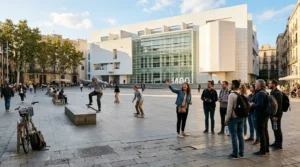
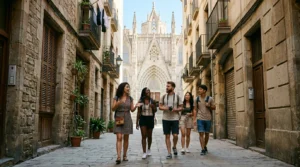
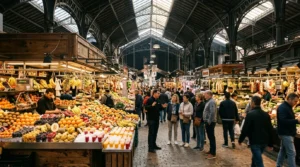
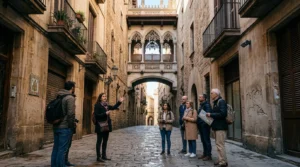
Barceloneta is the old fishermen's quarter on Barcelona's waterfront, and what to see there is simple: a tight grid of narrow streets with laundry on the balconies, the neighbourhood market, a long sandy beach with a promenade, the marina along Passeig de Joan de Borbo and the Museum of the History of Catalonia. Half a day covers it well.
Key takeaways
- Barceloneta is worth a visit even if you never touch the sand: the street grid, the market and the seafood restaurants are the real neighbourhood.
- Two to four hours is enough for a walk and a meal; add a beach afternoon in summer if you want one.
- It sits right next to the Gothic Quarter and El Born, so most people reach it on foot from the Old Town.
- None of the guided tours on this site walk through Barceloneta. The Barcelona Old Town Port and Boat trip (€80 per person, 4 hours, max 15) walks the Gothic Quarter and Las Ramblas, then takes a harbour cruise to Moll de Llevant and back, so you see the port from the water.
- The beach is busy and relaxed, but bags left alone on the sand are an easy target. Keep valuables to a minimum.
- In winter the beach is for walking, not swimming, and the neighbourhood is quieter and more local.
What is Barceloneta, and why does it look so different?
Barceloneta looks nothing like the winding lanes of the Gothic Quarter because it was planned on paper. In the 18th century, a large part of the old Ribera district was cleared to build the Ciutadella fortress, and many families lost their homes. The answer was a new quarter on the strip of reclaimed land between the port and the sea, laid out by military engineers as long, narrow blocks of identical low houses.
That grid is still there. Walk any street and you will notice how thin the blocks are, how the balconies face each other across a few metres, and how the light comes in from both ends. Over time the original low houses were built up with extra floors and split into very small flats for fishermen, dockers and their families.
For most of its history Barceloneta was a working neighbourhood. Fishing boats, the port, small workshops and later industry shaped daily life. On the far end, a settlement called Somorrostro grew along the shore, and today one of the beaches carries that name. The waterfront you see now, with its wide promenade and clean sand, is the result of a large clean-up of the city's coast in the late 20th century. Before that, the beaches were hidden behind rail lines and warehouses.
The restaurants on the edge cater to visitors, but two streets in you are back where people hang washing and chat on doorsteps.
Is Barceloneta worth visiting if you are not going to the beach?
Yes. The beach is the reason most visitors come, but it is the least distinctive part of Barceloneta. Plenty of cities have a sandy shore. Very few have a planned 18th century fishermen's grid sitting right behind it.
If you skip the sand, spend your time on three things:
- The streets of the grid. Wander the inner streets slowly, ideally in the morning when the shutters are going up. Look up at the balconies, the tiled doorways and the small corner bars.
- The market. Mercat de la Barceloneta is the neighbourhood's food hall, smaller and more local than the big markets on La Rambla.
- The marina and the Museum of the History of Catalonia. Passeig de Joan de Borbo runs along the harbour side, with yachts on one side and restaurants on the other, and the museum sits in a restored warehouse at the city end.
That makes a full visit without a towel.
How long do you need in Barceloneta?
It depends on what you want from it:
- One to two hours: a loop through the grid, a look at the market and a walk along the promenade.
- Half a day: the same loop plus a long seafood lunch and the Museum of the History of Catalonia.
- A full day in summer: a morning walk, lunch, and an afternoon on the sand.
Most first-time visitors are happy with half a day. Barceloneta works best as one part of a day that also includes the Old Town, for example a guided walk in the Gothic Quarter in the morning and Barceloneta for lunch and the late afternoon.
What to see in Barceloneta, stop by stop
This is a simple walking order that starts at the city end and works out toward the sea. You can reverse it if you arrive from the beach.
Passeig de Joan de Borbo and the marina
Start where Barceloneta meets the old port. Passeig de Joan de Borbo is the long, wide avenue along the harbour, lined with restaurant terraces on one side and moored boats on the other. It is the most visited street in the neighbourhood and the easiest place to orient yourself.
The terraces here are aimed squarely at visitors, so save your appetite for the streets behind.
Museum of the History of Catalonia
At the city end of the avenue, in a large restored brick warehouse known as the Palau de Mar, is the Museum of the History of Catalonia. It tells the story of Catalonia from prehistory to recent times, and it gives useful context for everything you see elsewhere in Barcelona and on day trips across the region.
Check the museum's official site for opening days and admission.
The grid of narrow streets
Turn into the neighbourhood itself. The inner streets run in long, parallel lines toward the sea, crossed by shorter streets every few blocks. This is the heart of Barceloneta: washing lines, potted plants on tiny balconies, neighbours talking across the street.
Keep your voice down and your camera polite. These are homes, and residents have long been vocal about crowds.
Mercat de la Barceloneta
Near the middle of the grid is the neighbourhood market, housed in a historic structure that was renovated with a modern roof. Inside you will find fish counters, fruit and vegetable stalls and a few bars where you can eat at the counter.
Morning is the liveliest time. Check the market's official information for opening days and hours.
The main square and the local bars
Around the market and the small squares nearby you will find the classic Barceloneta bars: small, busy, often standing room only. This is where locals stop for a vermouth before lunch, and where you will find some of the best tapas in the area without the waterfront mark-up.
The beaches and the promenade
Walk to the sea end of the grid and the beach opens up. Barcelona's city beaches run in a line here:
- Sant Sebastia, at the southern tip, near the port entrance.
- Sant Miquel, a calmer stretch next to it.
- Barceloneta, the central and busiest beach.
- Somorrostro, at the northern end, named after the old shoreline settlement.
The promenade behind the sand is wide and flat, popular with runners, cyclists and walkers. Along the way you will pass public sculptures, including a tall stack of rusted cubes that has become one of the beach's informal landmarks.
The Port Cable Car tower
At the southern end of the beach, near Sant Sebastia, a tall steel tower carries the Port Cable Car. It crosses the harbour toward Montjuic, high above the water. It is a separate attraction run by its own operator, so check its official site for times and fares before you plan around it.
Can you walk from the Gothic Quarter or La Rambla to Barceloneta?
Yes, and it is the best way to arrive. Barceloneta is a short walk from the Old Town. There are three easy routes:
- From the bottom of La Rambla: walk to the Columbus monument at the port end, then follow the waterfront east along the old harbour until you reach Passeig de Joan de Borbo. Our guide to what to see along La Rambla covers that street in detail.
- From the Gothic Quarter: head downhill toward the sea, cross the wide coastal road, and you are at the harbour.
- From El Born: walk down past Pla de Palau and you enter Barceloneta at its city end. If you have not explored it yet, our El Born walking guide pairs naturally with this one.
Public transport serves the neighbourhood too, but from the centre you will rarely need it.
Does a guided tour go to Barceloneta, or only past the harbour?
This is worth being clear about. None of the guided tours sold on this site walk through Barceloneta, its beach or its market.
The closest is the Barcelona Old Town Port and Boat trip. It is €80 per person, lasts 4 hours and takes up to 15 people. You walk the Gothic Quarter and Las Ramblas with a guide, then board a harbour cruise to Moll de Llevant and back. From the water you see the port, the waterfront and the edge of the city from a different angle, but the boat does not stop in Barceloneta and the tour does not walk its streets.
That makes the two complementary rather than overlapping:
- The tour gives you the Old Town story with a guide and the harbour from the sea.
- Barceloneta on your own gives you the grid, the market, the food and the beach at your own pace.
A good plan is the tour first, then a walk into Barceloneta for a late lunch, since you will already be in the Old Town when the tour ends. Like all walking tours here, it meets in central Barcelona; there is no vehicle and no hotel pick-up.
Walking tours near the waterfront and Old Town
If you want a guide for the parts of the city around Barceloneta, these are the walking tours that cover the Old Town and its surroundings. All are priced per person and meet in central Barcelona.
| Tour | Price | Duration | Max group | What it covers |
|---|---|---|---|---|
| Barcelona Old Town and Gothic Quarter Walking Tour | €55 per person | 3 hours | 15 | The Gothic Quarter on foot |
| Barcelona Old Town Port and Boat trip | €80 per person | 4 hours | 15 | Gothic Quarter and Las Ramblas, then a harbour cruise to Moll de Llevant and back |
| Barcelona Old Town, Montjuic Castle and Cable Car | €95 per person | 4 hours | 15 | Old Town, then Montjuic Castle by cable car |
| Barcelona Old Town, Montjuic Castle, Cable Car and Magic Fountain show | €105 per person | 6 hours | 15 | As above, ending at the Magic Fountain show (seasonal, set by the city council) |
| Barcelona Old Town Walking tour with Tapas and Flamenco Show | €105 per person | 3 hours | 8 | Gothic Quarter and La Rambla, tapas bar stops, live flamenco in a tablao |
The Barcelona Old Town and Gothic Quarter Walking Tour is the shortest and simplest way to get the Old Town story before you walk down to the sea on your own.
Barceloneta vs the Gothic Quarter and El Born
All three are old neighbourhoods within walking distance of each other, but they feel very different.
The Gothic Quarter is the medieval core: Roman remains, the cathedral, narrow winding lanes and small squares. It is dense with history and with visitors, and it rewards a guide more than any other part of the city, because so much of what matters is not signposted.
El Born is the old merchants' and craftsmen's district, with medieval streets, independent shops, cocktail bars and the market hall that now shelters archaeological remains of the old Ribera. It is a little more relaxed than the Gothic Quarter and good for an evening stroll.
Barceloneta is newer, planned and residential, with a straight grid instead of a maze. It is less about monuments and more about everyday life, food and the sea.
If you only have one day in the centre, see the Gothic Quarter with a guide, wander El Born afterwards and end in Barceloneta for food by the water. If you have more time, give Barceloneta its own morning so you see the market at its busiest.
What to eat in Barceloneta
Barceloneta's food is built around the sea. In general terms, look for:
- Rice dishes cooked in a wide pan, including seafood rice and black rice coloured with squid ink. These are usually made to order for two or more people, so expect to wait.
- Fideua, a close cousin of paella made with short noodles instead of rice.
- Simple grilled or fried fish and seafood, from small fried fish to squid and prawns.
- Tapas in the inner-street bars, including the bomba, a fried potato ball with a meat filling and spicy sauce that Barceloneta claims as its own.
- A vermouth before lunch, a long-standing local habit.
Three practical tips. First, the further you are from the beachfront and the marina terraces, the better the value tends to be. Second, locals eat lunch late, so arriving early gets you a table more easily. Third, a rice dish that appears instantly was probably not cooked for you.
For a wider look at Catalan dishes and how tapas work in Barcelona, see our guide to what to eat in Barcelona.
Barceloneta beach in winter vs summer
In summer, the beach is full from late morning to sunset. The water is warm enough for most people, lifeguards and beach services operate in the season, and the promenade is busy into the night. Go early for space on the sand.
In winter, the beach becomes a place to walk. On a clear day the light is soft and the promenade is pleasant, with runners, dog walkers and a few hardy swimmers. Restaurant terraces stay open on sunny days, and the neighbourhood feels much more local.
Can you swim in winter? You can, and some locals do, but the sea is cold and most visitors find it too chilly for more than a quick dip. Lifeguard cover is seasonal, so check the city council's official beach information before swimming out of season.
Spring and autumn sit in between, with mild days and fewer people.
Is Barceloneta safe?
Barceloneta is a lively, normal city neighbourhood, and most visits pass without trouble. The main risk, as in much of central Barcelona, is petty theft rather than anything violent.
A few habits make a difference:
- On the beach, do not leave phones, wallets or bags unattended while you swim. Bring only what you need, and if you are in a group, take turns in the water.
- On the promenade and terraces, keep phones off the table edge and bags on your lap or looped around a chair leg.
- In crowds, such as busy summer evenings, use a bag that closes and carry it in front.
- Be wary of distractions, such as someone asking you to look at a map or sign something while another person is close by.
Treat the beach the way you would any busy public space and you will be fine.
Accessibility
The promenade is flat and wide, which makes it one of the easier places in the city for wheelchairs and pushchairs. The inner grid streets are narrow, with uneven pavements in places and cars parked close, so they are slower going. Some beaches have accessible walkways and assisted bathing points in season; check the city council's official information for current details.
Is the Port Cable Car the same as the Montjuic cable car?
No. They are two different cable cars. The Port Cable Car starts from the tower near Sant Sebastia beach in Barceloneta and crosses the harbour high above the water toward Montjuic.
The cable car on the Barcelona Old Town, Montjuic Castle and Cable Car tour is a separate line on Montjuic itself. If you book that tour, you are not riding the Port Cable Car, and the tour does not start from Barceloneta. If you want to ride the Port Cable Car as well, plan it on your own and check its operator's official site for times and fares.
A simple Barceloneta day plan
Here is one easy way to combine Barceloneta with the Old Town:
- Morning: join a guided walk in the Old Town, or the Barcelona Old Town Port and Boat trip if you also want the harbour from the water.
- Early afternoon: walk down to Barceloneta, through the grid to the market area, and sit down for a seafood rice lunch.
- Late afternoon: walk the promenade along the beaches, then return along Passeig de Joan de Borbo as the light drops over the marina.
- Evening: head back into El Born for a drink, or continue north along the shore toward the Ciutadella area.
Plan your Barcelona tours
Barceloneta is best explored at your own pace, while the Old Town and the harbour are easier with a guide who can tell you what you are looking at. You can browse all tours and book online, with free cancellation up to 96 hours before the start. For questions, call or WhatsApp +34 632 93 79 41 or email [email protected].