El Born is the old waterfront quarter of Barcelona, just east of the Gothic Quarter across Via Laietana. In two to three hours on foot you can see Santa Maria del Mar, Carrer de Montcada, Passeig del Born, the Born CCM and Parc de la Ciutadella. No guided tour stops inside El Born, but several end a short walk away.
Key takeaways
- El Born is the popular name for La Ribera, the southern half of the district officially called Sant Pere, Santa Caterina i la Ribera, inside Ciutat Vella.
- It is not the Gothic Quarter. Via Laietana splits the two, and crossing takes a couple of minutes.
- The core sights are Santa Maria del Mar, Carrer de Montcada and the Picasso Museum, Passeig del Born, the Born CCM, Parc de la Ciutadella and the Arc de Triomf, with Santa Caterina Market and the Palau de la Música Catalana on the northern edge.
- None of our tours lists El Born as a stop. Santa Caterina Market, on its northern edge, is a stop on La Boqueria and Santa Caterina Markets with Food and Tapas Small Group (€135 per person, 4h, max 15).
- Allow two to three hours for the streets and exteriors, more if you go inside a museum.
- Every tour can be cancelled or moved to a new date free of charge up to 96 hours before it starts.
Where does El Born start and end?
El Born sits in Ciutat Vella, the old city district that also holds the Gothic Quarter, El Raval and Barceloneta. Its western edge is Via Laietana, the wide straight road running up from the port. Its eastern edge is Parc de la Ciutadella. To the south it runs down towards the Estació de França railway station and the port.
The northern line confuses people. Carrer de la Princesa, running from Jaume I towards the park, is usually taken as the top of El Born; north of it are Sant Pere and Santa Caterina. Locals and most maps use "El Born" for the whole area. Here the core is La Ribera, with Santa Caterina Market and the Palau de la Música Catalana as the northern edge.
The name comes from Passeig del Born, the promenade at the heart of the quarter. La Ribera means "the shore": this was the medieval city nearest the sea, home to sailors, merchants, porters and workshops. Street names still recall the trades, such as Carrer de l'Argenteria (silversmiths) and Carrer de la Vidrieria (glassmakers).
The easiest arrival points are Jaume I on metro line 4, at the Gothic Quarter side, and Arc de Triomf on line 1, at the northern end. From the Gothic Quarter you need no transport: just cross Via Laietana.
Is El Born the same as the Gothic Quarter?
No, though the change between them is easy to miss. Both are medieval and both sit inside Ciutat Vella. The Gothic Quarter grew around the Roman town and became the seat of the Church, the Crown and the city government. El Born grew outside the oldest walls as the merchant and maritime quarter.
That difference still shows. The Gothic Quarter has Barcelona Cathedral, Plaça del Rei, the Roman walls and Plaça de Sant Jaume. El Born has a church built by its own residents, the palaces of merchant families, and a promenade once used for jousts and markets. Today it is known more for independent shops, design studios and wine bars than for official buildings.
| Gothic Quarter | El Born | |
|---|---|---|
| Where | Between La Rambla and Via Laietana | Between Via Laietana and Parc de la Ciutadella |
| Character | Roman and medieval core: church, royal and civic buildings | Medieval merchant and maritime quarter |
| Headline sights | Barcelona Cathedral, Plaça del Rei, Roman walls, Plaça de Sant Jaume | Santa Maria del Mar, Carrer de Montcada, Picasso Museum, Born CCM |
| Green space | Very little | Parc de la Ciutadella on the eastern edge |
| Our guided tours | Covered by several walking tours | No tour stops inside; Santa Caterina Market on the edge is a food tour stop |
For the other side of Via Laietana, read our guide to the Gothic Quarter street by street. The two fit easily into one day.
What to see in El Born, stop by stop
This loop takes two to three hours at an easy pace from Jaume I. Every stop can be seen from the street.
1. Carrer de l'Argenteria
From Jaume I, walk down Carrer de l'Argenteria, the old silversmiths' street. It runs on a slight diagonal straight to the side of Santa Maria del Mar, so the church appears at the end as you walk.
2. Santa Maria del Mar
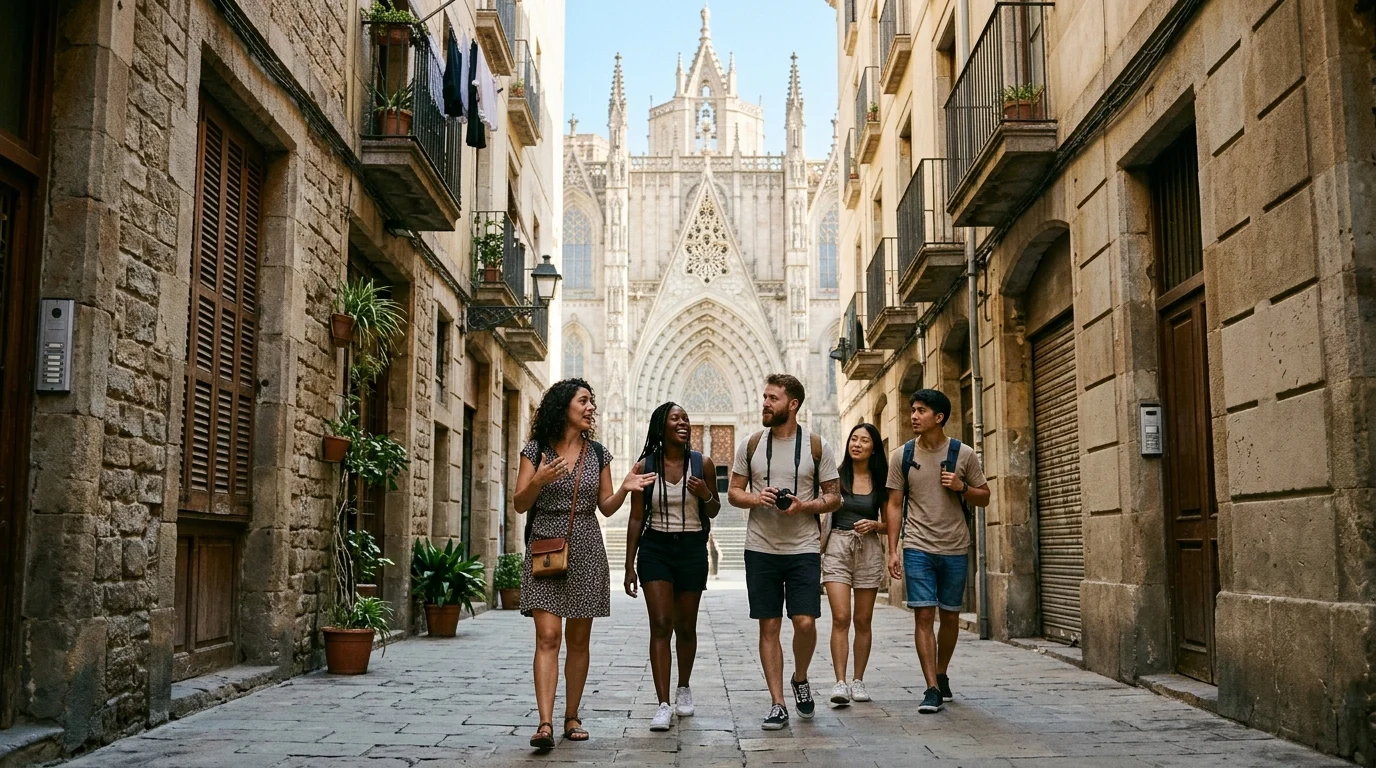
Santa Maria del Mar is the reason most people come to El Born. It is a 14th-century church in the Catalan Gothic style, built unusually quickly for its size, which gives it one consistent design inside: a wide nave, slim octagonal columns and a great deal of open space. The people of La Ribera paid for it, and the bastaixos, the porters who carried goods between ships and shore, carried stone for its walls. You can find them shown on the main doors.
From Plaça de Santa Maria you can look up at the plain west front and its rose window. For going inside or up to the roof terraces, check the church's official information for visiting times and any charge.
3. Fossar de les Moreres
On the eastern side of the church is a small sloping square with a curved red memorial and a flame. The Fossar de les Moreres stands on an old parish cemetery where defenders of the city were buried after the siege of Barcelona in the early 18th century.
4. Carrer de Montcada and the Picasso Museum
Walk north to Carrer de Montcada, a narrow street of stone palaces built by merchant and noble families, many with courtyards and external staircases. The Picasso Museum fills a group of these palaces and focuses mainly on Picasso's early years and his link to Barcelona. The Moco Museum, with modern and contemporary art, is on the same street.
Both need a ticket: check their official websites for times and prices, and book the Picasso Museum ahead at busy times. The street and its courtyards are worth the walk even without going in.
5. Passeig del Born
At the bottom of Carrer de Montcada you reach Passeig del Born, the promenade that gave the quarter its name. In the Middle Ages it hosted jousts, festivals and markets. Today it is a broad pedestrian space lined with bars, linking Santa Maria del Mar with the old market hall. Side streets such as Carrer del Rec hold many independent design shops.
6. Born CCM
At the eastern end of the promenade stands the 19th-century iron and glass hall of the old Born market, now El Born Centre de Cultura i Memòria. When the building was restored, excavations uncovered the streets and house foundations of the neighbourhood demolished after the siege to make way for a military fortress. You can look down over those remains from inside the hall. Check the centre's official website for what is open and what needs a ticket.
7. Parc de la Ciutadella
Across the road is Parc de la Ciutadella, laid out on the land of that same fortress once it was taken down in the 19th century. It has the large Cascada fountain, a boating lake, the Catalan Parliament building and wide paths that make a welcome change from the narrow streets.
8. Arc de Triomf
Leave the park on its northern side and walk up Passeig de Lluís Companys to the Arc de Triomf, the red brick arch built as the main entrance to Barcelona's Universal Exhibition in the late 19th century. It is free to walk through and around.
9. Palau de la Música Catalana
Cut back west through the streets of Sant Pere to the Palau de la Música Catalana, a concert hall by the architect Lluís Domènech i Montaner and one of the major buildings of Catalan Modernisme. The street front, with its mosaic columns and sculpture, is free to see. The inside can only be seen on a ticketed visit or at a concert; check the official website for both.
10. Santa Caterina Market
Finish at Santa Caterina Market, known for its wave-shaped roof of coloured ceramic tiles. It is a working neighbourhood market, smaller and quieter than La Boqueria and used more by locals. From here it is a short walk back to Via Laietana and Jaume I.
How long to spend in El Born?
For the streets, squares and exteriors above, allow two to three hours with a coffee stop. Going inside adds time: a short visit for Santa Maria del Mar, a good part of a morning or afternoon for the Picasso Museum plus any queue, and a separate booked slot for the Palau de la Música Catalana. For most visitors, half a day in El Born with one museum is the sensible plan, or a two-hour walk combined with a guided tour on the Gothic Quarter side.
What can you see for free?
A large part of El Born costs nothing: the outsides of Santa Maria del Mar and the Palau de la Música Catalana, the Fossar de les Moreres, Carrer de Montcada, Passeig del Born, Parc de la Ciutadella, the Arc de Triomf and the stalls of Santa Caterina Market. The museums, Palau visits and concerts, Born CCM exhibitions and any paid access at Santa Maria del Mar are set by each venue, so check their official websites for times and prices.
Which tours pass near El Born, and which do not?
To be clear: none of our tours lists El Born as a stop. Several end in the old town a short walk away, which makes El Born an easy self-guided add-on. Our walking tours meet in central Barcelona and use no vehicle.
| Tour | Price | Duration | Max group | How it relates to El Born |
|---|---|---|---|---|
| Barcelona Old Town and Gothic Quarter Walking Tour | €55 per person | 3h | 15 | Covers the Gothic Quarter across Via Laietana; El Born is a short walk east |
| La Boqueria and Santa Caterina Markets with Food and Tapas Small Group | €135 per person | 4h | 15 | Santa Caterina Market, on El Born's northern edge, is a stop |
| Barcelona Old Town Walking tour with Tapas and Flamenco Show | €105 per person | 3h | 8 | Gothic Quarter, La Rambla, tapas bars and a live flamenco show; El Born is a walk before it |
| Barcelona Old Town Port and Boat trip | €80 per person | 4h | 15 | Gothic Quarter and Las Ramblas, then a harbour cruise to Moll de Llevant and back |
The small-group tours with hotel pick-up do not enter El Born either. Its streets are too narrow for vehicles, and those tours cover sights spread across the city, such as Sagrada Familia (where a ticket is included, it is always subject to availability) and Park Guell.
Pairing El Born with the market food tour
The natural pairing is La Boqueria and Santa Caterina Markets with Food and Tapas Small Group: 4 hours, €135 per person, a maximum of 15. It visits La Boqueria, stops at a pintxos bar for 3 pintxos, goes on to Santa Caterina Market and ends at a restaurant near it for Spanish and Catalan dishes. Tapas, a traditional dessert and drinks with the tastings are included.
Because it finishes near Santa Caterina, you are already at the top of El Born. Walk down Carrer de Montcada to Santa Maria del Mar and Passeig del Born in a few minutes and the afternoon becomes a food tour followed by a self-guided walk.
Pairing El Born with an evening tapas and flamenco walk
For an evening plan, walk El Born in the late afternoon, then join the Barcelona Old Town Walking tour with Tapas and Flamenco Show: €105 per person, 3 hours, a maximum of 8. It walks the Gothic Quarter and La Rambla, stops at tapas bars and ends at a live flamenco show in a tablao. El Born is not on its route, so see it first while there is still light on Passeig del Born.
A guided walk first, then El Born on your own
The Barcelona Old Town and Gothic Quarter Walking Tour costs €55 per person for 3 hours, with a maximum of 15. It covers Plaça del Rei, Barcelona Cathedral, the Roman walls and Plaça de Sant Jaume, then Las Ramblas, ending near La Boqueria. That Roman and medieval background makes El Born easier to read when you cross Via Laietana later.
Is El Born worth visiting?
For most visitors, yes, for half a day. Within a short walk you get a major Catalan Gothic church, a street of medieval palaces, the Picasso Museum, a market hall with excavated ruins inside, and a large park. It also feels calmer than the Gothic Quarter, with fewer large groups and more small shops.
With only one day in Barcelona and the Gaudí buildings as your priority, it can wait. Sagrada Familia, Park Guell and the Gothic Quarter make a fuller first day. With two days or more, El Born fits easily alongside the Gothic Quarter.
Is El Born safe in the evening?
El Born is busy and lived-in, with people on the streets into the evening, and most visitors walk it at night without trouble. The practical risks are the same as across Ciutat Vella: pickpocketing in crowds and on terraces, and the occasional distraction trick.
- Keep your phone and wallet in a front pocket or closed bag, never on the café table.
- On terraces, keep bags on your lap or between your feet.
- Late at night, stick to lit, busier streets such as Passeig del Born and Carrer de la Princesa.
- Enjoy Parc de la Ciutadella in daylight, and check its closing times if you plan to cross it later.
El Born is residential too, so keep the noise down in the narrow streets late at night.
El Born or El Raval for an evening?
Both are in Ciutat Vella and close to the Gothic Quarter. El Born, east of Via Laietana, is the easier pick for a relaxed evening: wine bars, tapas places and terraces around Passeig del Born and Santa Maria del Mar. El Raval, west of La Rambla, has a rougher edge, a younger and more mixed crowd, and its own landmarks such as the Botero cat. Some of its streets call for more care at night. Read our guide to El Raval and whether it is safe to walk before you decide.
Which stops work on a rainy day?
El Born suits a wet day because so many of its sights are under a roof: Santa Maria del Mar, the Picasso Museum, the Moco Museum, the Born CCM hall and Santa Caterina Market. The narrow streets give some shelter between them. Skip Parc de la Ciutadella and the Arc de Triomf in heavy rain. For guided options in bad weather, see our guide to Barcelona rainy day tours.
Cancelling or changing your date
Every Barcelona tour and Catalonia day trip can be cancelled, or moved to a new date, free of charge up to 96 hours before it starts. Refunds go back to the original payment method within a few business days, and a no-show is not refunded. The full terms are on our cancellation policy page.
Practical notes before you go
- Footwear: the stone paving can be slippery after rain, so wear comfortable flat shoes.
- Timing: mornings are quieter around Santa Maria del Mar and Carrer de Montcada; evenings are livelier around Passeig del Born.
- Markets and churches: Santa Caterina is a working market with its own trading days, and Santa Maria del Mar is an active church. Check official information before you plan around either, and dress respectfully inside the church.
- Meeting points: our walking tours meet in central Barcelona, and the exact meeting point is confirmed when you book.
- Private option: private Barcelona tours, with a guide and vehicle for your group only, are priced per group of up to 6, from €549 for The Essence of Barcelona: Discover its Icons on an Exclusive Tour (5h). That price covers the whole group.
Conclusion
El Born is the quieter, more local half of Barcelona's old town, from Santa Maria del Mar to Parc de la Ciutadella. No guided tour stops there, but a Gothic Quarter walk or the market food tour leaves you a few minutes away.
To book a tour that ends near El Born, or to ask which one fits your day, call or WhatsApp us on +34 632 93 79 41. You can also email info@citytourinbarcelona.com and we will reply with the options for your dates.