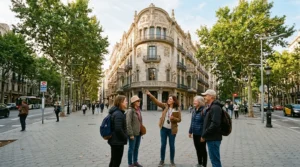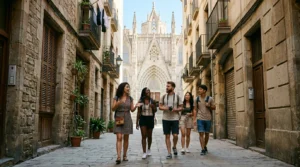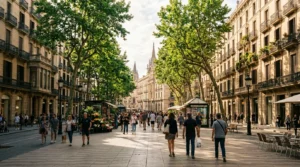
The Gothic Quarter (Barri Gòtic) is the medieval core of Barcelona, squeezed between La Rambla and Via Laietana and running down from Plaça Nova towards the waterfront. In two to three hours on foot you can see Barcelona Cathedral, Plaça del Rei, Plaça de Sant Jaume, the Roman walls, El Call and Plaça Reial.
Key takeaways
- The Gothic Quarter is small. Its edges are La Rambla to the west, Via Laietana to the east, the area around Plaça Nova and the Cathedral to the north and Passeig de Colom near the port to the south.
- Santa Maria del Mar and the Picasso Museum are in El Born, across Via Laietana. Palau Güell is in El Raval, across La Rambla. Many guides blur these lines.
- Plan two to three hours for the core sights at a relaxed pace, or half a day if you add lunch and a museum.
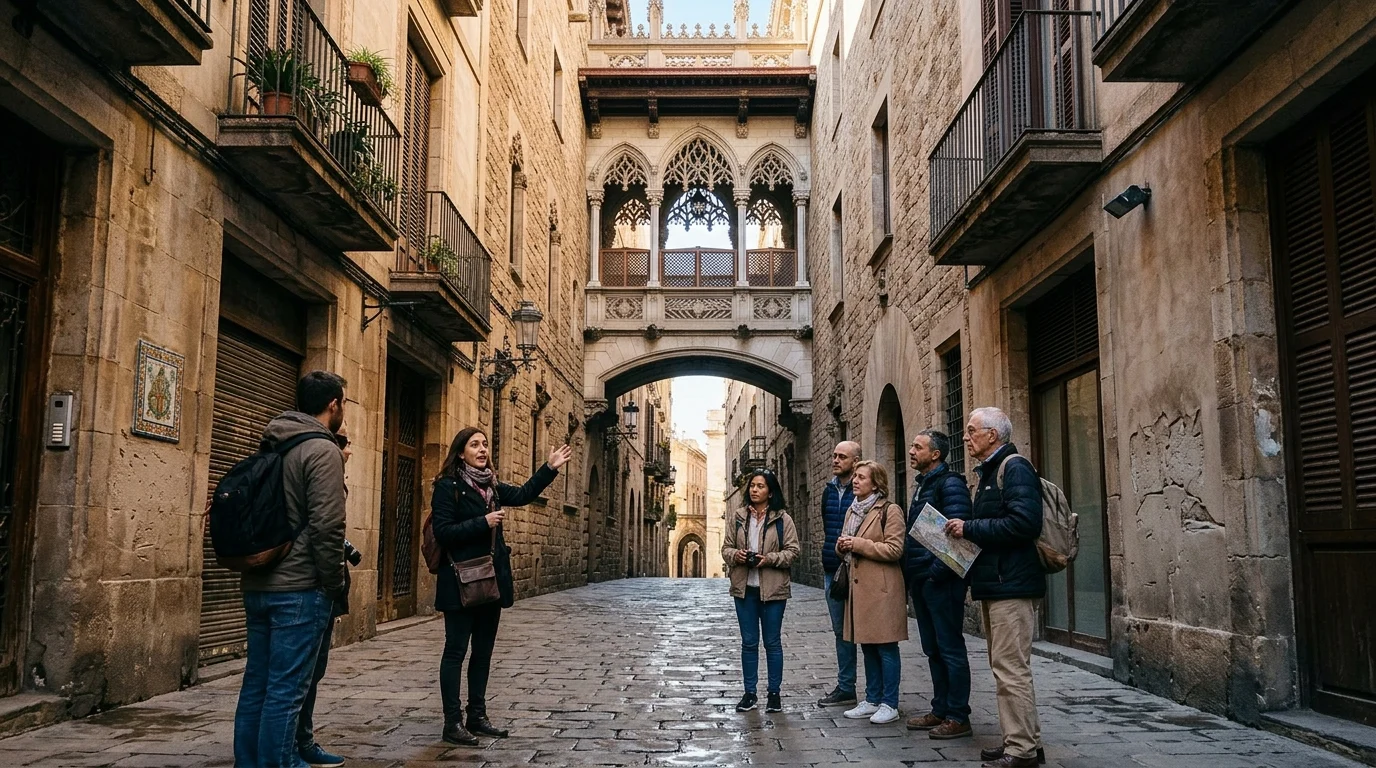
- Much of the "Gothic" look is newer than it seems. The Pont del Bisbe on Carrer del Bisbe was built in the 20th century, and the Cathedral's main facade was finished centuries after the rest of the building.
- Daytime is for the squares and monuments. The evening is for the lanes, tapas and live flamenco.
- The €55 Barcelona Old Town and Gothic Quarter Walking Tour (3h, max 15, per person) covers the core on foot. The €115 Barcelona Highlights and Gothic Quarter tour (5h, max 8, per person) adds hotel pick-up and much less walking.
Where is the Gothic Quarter, and where does it end?
The Gothic Quarter is one of the neighbourhoods that make up Ciutat Vella, Barcelona's old town district. It sits on the low rise the Romans chose for the town of Barcino, and the street plan still follows that settlement in places. The Cathedral, the two government buildings on Plaça de Sant Jaume and the old royal palace on Plaça del Rei all stand on or close to that Roman core.
The edges are easier to read than most visitors expect.
West: La Rambla. The long promenade forms the western border. Everything on the far side, including the Liceu side streets, the Boqueria back lanes and Palau Güell, belongs to El Raval. Plaça Reial is on the Gothic Quarter side, a few steps off La Rambla.
East: Via Laietana. This wide, straight avenue was cut through the old town in the early 20th century, and it splits the Gothic Quarter from El Born and Sant Pere. Cross it and you are in a different neighbourhood, with Santa Maria del Mar, the Picasso Museum on Carrer de Montcada and the Santa Caterina Market.
North: Plaça Nova and the Cathedral. The square in front of the Cathedral, with its surviving Roman towers and the line of the old wall, marks the top of the quarter. Beyond it lies Plaça de Catalunya and the Eixample.
South: towards the port. The lanes flatten out as you walk down Carrer d'Avinyó or Carrer Ample and meet Passeig de Colom, the road that runs along the old harbour.
Gothic Quarter vs El Born: what is the difference?
The Gothic Quarter is the Roman and medieval civic centre: the Cathedral, the royal palace, the Catalan government and the city council. El Born grew as the merchants' district by the sea, centred on the church of Santa Maria del Mar, and has more independent shops and bars. With one morning, the Gothic Quarter gives you more history per step. With a full day, cross Via Laietana in the afternoon.
What to see in the Gothic Quarter, street by street
This route runs from the Cathedral down to Plaça Reial. Walked without stopping, it takes well under an hour, so the time goes on the stops.
Plaça Nova and the Roman walls
Start in front of the Cathedral at Plaça Nova. Two round towers flank the start of Carrer del Bisbe, part of the old Roman gate, and fragments of a Roman aqueduct are set into the wall nearby. Walk round towards Plaça de Ramon Berenguer el Gran and you reach a long surviving stretch of Roman wall, with medieval palace walls built on top. These are real Roman stones, not markers.
Barcelona Cathedral and its cloister
The Cathedral of the Holy Cross and Saint Eulalia is the anchor of the quarter. The main facade is the part that looks "Gothic", yet it is the newest part of the building, finished in the 19th century to a neo-Gothic design. Inside, the cloister has a garden courtyard with geese, a long-standing tradition tied to Saint Eulalia. We cover what you see inside and outside, and which tours pass it, in our guide to Barcelona Cathedral. Check the Cathedral's own website for visiting times and any entry charge before you go.
Casa de l'Ardiaca and the turtle mailbox
Next to the Cathedral's side door, the Casa de l'Ardiaca has a small courtyard with a palm tree and a fountain. On its outer wall is a carved marble letterbox with swallows and a turtle, a common photo stop on guided walks.
Carrer del Bisbe and the Pont del Bisbe
Carrer del Bisbe runs from the Cathedral to Plaça de Sant Jaume. Halfway along, the stone Bishop's Bridge crosses overhead, joining the Palau de la Generalitat to the Casa dels Canonges. It looks medieval, but it was built in the 20th century in a neo-Gothic style. Much of what visitors call Gothic was in fact restored, rebuilt or added in the late 19th and early 20th centuries. Knowing that makes the street more interesting, not less.
Plaça de Sant Felip Neri
A narrow passage off Carrer del Bisbe leads to Plaça de Sant Felip Neri, a small square with a fountain and a church facade pitted with marks from bombing during the Spanish Civil War. A school uses part of the square, so keep your voice low.
Plaça de Sant Jaume
This square has been the civic heart of Barcelona since Roman times, when the forum stood here. Today two buildings face each other across it: the Palau de la Generalitat, seat of the Catalan government, and the Ajuntament, Barcelona's City Hall. Public gatherings, festivals and the human towers (castells) often take place here.
The Temple of Augustus
On Carrer del Paradís, a short walk from Plaça de Sant Jaume, four tall Roman columns from a temple dedicated to Augustus stand inside the courtyard of a building. They are easy to miss from the street. Look for the small entrance and the sign for the temple.
Plaça del Rei
Plaça del Rei is a closed medieval square framed by the old royal palace, the Palau Reial Major, with its great hall known as the Saló del Tinell, and the tower of King Martin. Underneath it, the Barcelona History Museum (MUHBA) shows excavated streets and buildings of Roman Barcino. Even if you do not go in, the square is worth a few minutes.
El Call, the medieval Jewish quarter
West of Plaça de Sant Jaume, the lanes around Carrer del Call formed the medieval Jewish quarter. It is a tight warren of streets with a small interpretation centre, and it is a residential area as much as a historic one.
Carrer d'Avinyó and Plaça Reial
Head south down Carrer d'Avinyó, a street with independent shops and old facades, then cut west to Plaça Reial. This arcaded 19th-century square has palm trees, a central fountain and a pair of lamp posts designed by a young Antoni Gaudí, one of his earliest works in the city. It is lively day and night, with terraces under the arcades. From here, La Rambla is a few steps away, and our La Rambla guide picks up the story on the other side.
How long to spend in the Gothic Quarter
The answer depends on how you use the time.
- One to two hours: a quick loop of the Cathedral, Carrer del Bisbe, Plaça de Sant Jaume, Plaça del Rei and Plaça Reial, with photos and no museums.
- Two to three hours: the full street-by-street route above, at an easy pace, with time in Plaça de Sant Felip Neri, the Roman walls and El Call. This is what most visitors need, and it matches the length of a guided walk.
- Half a day: the full route plus one museum (the Barcelona History Museum or the Cathedral interior), a coffee stop and lunch in or near the quarter.
- A full day: the Gothic Quarter in the morning and El Born or the harbour in the afternoon.
The quarter is compact, so the time goes on getting lost, which is part of the appeal. Use the Cathedral and Plaça de Sant Jaume as fixed points when a map app struggles in the tight lanes.
Is the Gothic Quarter better by day or in the evening?
Both, for different reasons.
By day the squares are open and readable, the Cathedral and museums are accessible, and you can see the stonework, the Roman remains and the carvings in good light. Mornings are calmer than afternoons in the busiest lanes around the Cathedral and Carrer del Bisbe.
In the evening the quarter changes. The squares fill with terraces, the lanes glow under street lamps and the tapas bars get busy. This is when the Barcelona Old Town Walking tour with Tapas and Flamenco Show makes sense: a 3-hour walk through the Gothic Quarter and along La Rambla, a tapas bar stop and a live flamenco show in a tablao, for €105 per person with a maximum of 8 people.
Is the Gothic Quarter safe at night?
The main squares stay busy well into the evening. The real risk in the old town, day or night, is pickpocketing in crowds, so keep your phone in a front pocket and your bag across your body. Late at night, stick to the lit streets between the squares if the back lanes feel empty.
Which tours walk the Gothic Quarter?
Several City Tour in Barcelona tours walk through the quarter, but they spend very different amounts of time there. All the prices below are per person. Walking tours meet in central Barcelona and use no vehicle. Pick-up tours collect you from your hotel in an air-conditioned vehicle.
| Tour | Price (per person) | Duration | Max group | How it uses the Gothic Quarter |
|---|---|---|---|---|
| Barcelona Old Town and Gothic Quarter Walking Tour | €55 | 3h | 15 | The full core on foot: lanes and squares, Plaça del Rei, the Cathedral, the Roman walls, Plaça de Sant Jaume, then Las Ramblas and La Boqueria |
| Barcelona Old Town Port and Boat trip | €80 | 4h | 15 | The Gothic Quarter and Las Ramblas on foot, then a harbour cruise to Moll de Llevant and back |
| Barcelona Old Town Walking tour with Tapas and Flamenco Show | €105 | 3h | 8 | An evening walk through the Gothic Quarter and La Rambla, tapas bar stops and a live flamenco show in a tablao |
| La Boqueria and Santa Caterina Markets with Food and Tapas Small Group | €135 | 4h | 15 | The two markets on either edge of the old town, with 3 pintxos, tapas, a dessert and drinks with the tastings |
| Barcelona Old Town, Montjuic Castle and Cable Car | €95 (4h) or €105 with the Magic Fountain show (6h) | 4h or 6h | 15 | The La Rambla and El Raval side of the old town, then Montjuic by funicular and cable car |
| Barcelona Highlights and Gothic Quarter | €115 | 5h | 8 | Hotel pick-up, Montjuic, the waterfront, a guided Gothic Quarter stop, Passeig de Gràcia and Hospital de Sant Pau. No Sagrada Familia |
Two notes. The Montjuic tour's old town section focuses on La Rambla and El Raval rather than the Gothic Quarter lanes, so pick it for the castle and the views, not for the quarter. And the Magic Fountain show at the end of the €105 version is run by the city council. It is seasonal and can be paused for maintenance or wind, while the rest of the tour goes ahead.
Guided or self-guided?
You can walk the Gothic Quarter on your own with a map, and many people do. The squares are free to stand in, and the route above is short.
A guide earns its place if you want the stories behind the stones (which walls are Roman, which bridge is 20th-century, what happened in Plaça de Sant Felip Neri), if it is your first day and you want the layout before exploring alone, or if you want to add something harder to arrange yourself, such as the harbour cruise or a flamenco show.
The €55 Barcelona Old Town and Gothic Quarter Walking Tour is the direct option for the core sights in 3 hours, in a group of up to 15. If you are still deciding whether a guide is worth it for this neighbourhood at all, we weigh that up in Is a Barcelona Gothic Quarter Walking Tour Worth It?. For a group that wants the old town to itself, this guide to private Gothic Quarter walking routes sets out how those routes run.
Combining the Gothic Quarter with other areas
The quarter sits in the middle of the old town, so it pairs easily with its neighbours.
With the harbour. Walk south to Port Vell and see the city from the water. The €80 Barcelona Old Town Port and Boat trip does this in 4 hours, ending with a cruise past the marina and working docks and a guided stop at Moll de Llevant.
With the markets. La Boqueria is on La Rambla, at the western edge, and Santa Caterina is across Via Laietana. The €135 La Boqueria and Santa Caterina Markets with Food and Tapas Small Group tour links the two in 4 hours with tastings.
With Montjuic. The hill rises above the port to the south-west. Spend the morning in the quarter, then take the cable car up in the afternoon, or book the €95 Barcelona Old Town, Montjuic Castle and Cable Car tour, which handles both.
With El Born. Cross Via Laietana for Santa Maria del Mar and the medieval Carrer de Montcada. It is a natural afternoon after a Gothic Quarter morning.
With the Gaudí sights. Sagrada Familia and Park Guell are a ride away in the Eixample and Gràcia, so many visitors give Gaudí and the old town a day each.
Is the Gothic Quarter manageable for seniors and families?
Yes, with some planning. The ground is mostly flat, but the lanes are paved in stone, some are narrow and uneven, and there are a few steps in places. Pushchairs and wheelchairs work on the main streets and squares, while some of the smaller passages are tight.
For travellers who want to see the quarter without a long walk, the €115 Barcelona Highlights and Gothic Quarter tour is the lighter option. It collects you from your hotel in an air-conditioned vehicle, takes up to 8 people over 5 hours and makes the Gothic Quarter one guided stop among several, with the vehicle covering the distance between Montjuic, the waterfront, Passeig de Gràcia and Hospital de Sant Pau.
Visiting the Gothic Quarter with kids
Children tend to like the geese in the Cathedral cloister, the turtle on the mailbox and the Roman columns hidden in a courtyard. Keep the loop short and plan a break in Plaça Reial or Plaça de Sant Jaume.
Does the Gothic Quarter work on a rainy day?
Partly. The narrow lanes give some shelter, and the Cathedral, the Barcelona History Museum and the cafes under the Plaça Reial arcades make good indoor stops. The stone paving gets slippery in the wet, so wear shoes with grip.
How do you get to the Gothic Quarter from your hotel?
Most central hotels are within walking distance. By metro, Jaume I (L4) is on Via Laietana, Liceu (L3) is on La Rambla and Drassanes (L3) is near the port end. Plaça de Catalunya is a short walk from the Cathedral.
On a walking tour, you make your own way to the meeting point in central Barcelona. On the €115 Barcelona Highlights and Gothic Quarter tour, you are collected from your hotel and dropped back afterwards.
Planning notes before you book
- Wear comfortable shoes with grip. The old stone paving is uneven.
- Check monument visiting times and entry charges on the official websites. Entry is only included where a tour's page says so.
- Book the evening tapas and flamenco walk early if you are travelling in a group, since it takes a maximum of 8 people.
- Every tour on this site has free cancellation or a free date change up to 96 hours before it starts. Refunds go back to the original payment method within a few business days, and a no-show is not refunded. The full terms are on the cancellation policy page.
Conclusion
The Gothic Quarter rewards a slow walk. Give it two to three hours, start at the Cathedral, end at Plaça Reial, and know where its edges are so you can cross into El Born or onto La Rambla on purpose. Go by day for the squares and history, and come back in the evening for tapas and flamenco.
To compare every option, you can browse all tours on the site. For questions about dates or which tour fits your group, message City Tour in Barcelona on WhatsApp or call +34 632 93 79 41, or write to info@citytourinbarcelona.com.