The Eixample is Barcelona's planned grid district, laid out by the engineer Ildefons Cerdà north of the old city, with octagonal blocks, cut-off corners and wide avenues. It is known for its modernist houses on Passeig de Gràcia, including Casa Batlló and Casa Milà. You can walk its best stretch in about three hours.
Key takeaways
- The Eixample starts at Plaça de Catalunya and spreads north of the Gothic Quarter. It is where Barcelona's modernist architecture is concentrated.
- The corners of almost every block are cut off at an angle, so each crossroads opens into a small octagonal square. That was Cerdà's idea for light, air and traffic.
- The richest part for architecture is the Quadrat d'Or around Passeig de Gràcia, with Casa Lleó i Morera, Casa Amatller and Casa Batlló on a single block.
- Most facades are free to look at from the pavement. Going inside the famous houses needs a separate ticket.
- Gaudi's Modernist Legacy Walking Tour covers the district in 3 hours for €50 per person, in a group of up to 15. It shows the facades from outside and does not include entry tickets.
- Several hotel pick-up tours pass along Passeig de Gràcia, and Barcelona Highlights and Gothic Quarter ends at Hospital de Sant Pau, the Eixample's other great modernist site.
What is the Eixample known for?
The Eixample (Catalan for "the extension") is the district that let Barcelona grow beyond its medieval walls. Once the walls came down, the city needed a plan for the open land between the old town and the villages around it, such as Gràcia and Sant Martí. Cerdà's plan won, and the result is the long, regular street grid you see on any map of Barcelona.
Three things give the Eixample its reputation:
- The grid itself. Straight streets, repeated blocks and wide pavements make it one of the most recognisable city plans in Europe.
- Modernisme. The Catalan version of Art Nouveau flourished here, because the new district was where wealthy families built their homes. Antoni Gaudí, Lluís Domènech i Montaner and Josep Puig i Cadafalch all worked on Eixample streets.
- Everyday city life. Beyond the landmarks, it is a lived-in district of apartment blocks, cafés, shops and schools, with plane trees on almost every street.
The Eixample is usually split into smaller neighbourhoods: the Dreta de l'Eixample (the right side, which holds most of the famous houses), the Antiga and Nova Esquerra (the left side), Sant Antoni, Fort Pienc and the Sagrada Família neighbourhood around the basilica. When people talk about "the Eixample" as a sightseeing area, they usually mean the Dreta and the streets on either side of Passeig de Gràcia.
Why are the Eixample's street corners cut off?
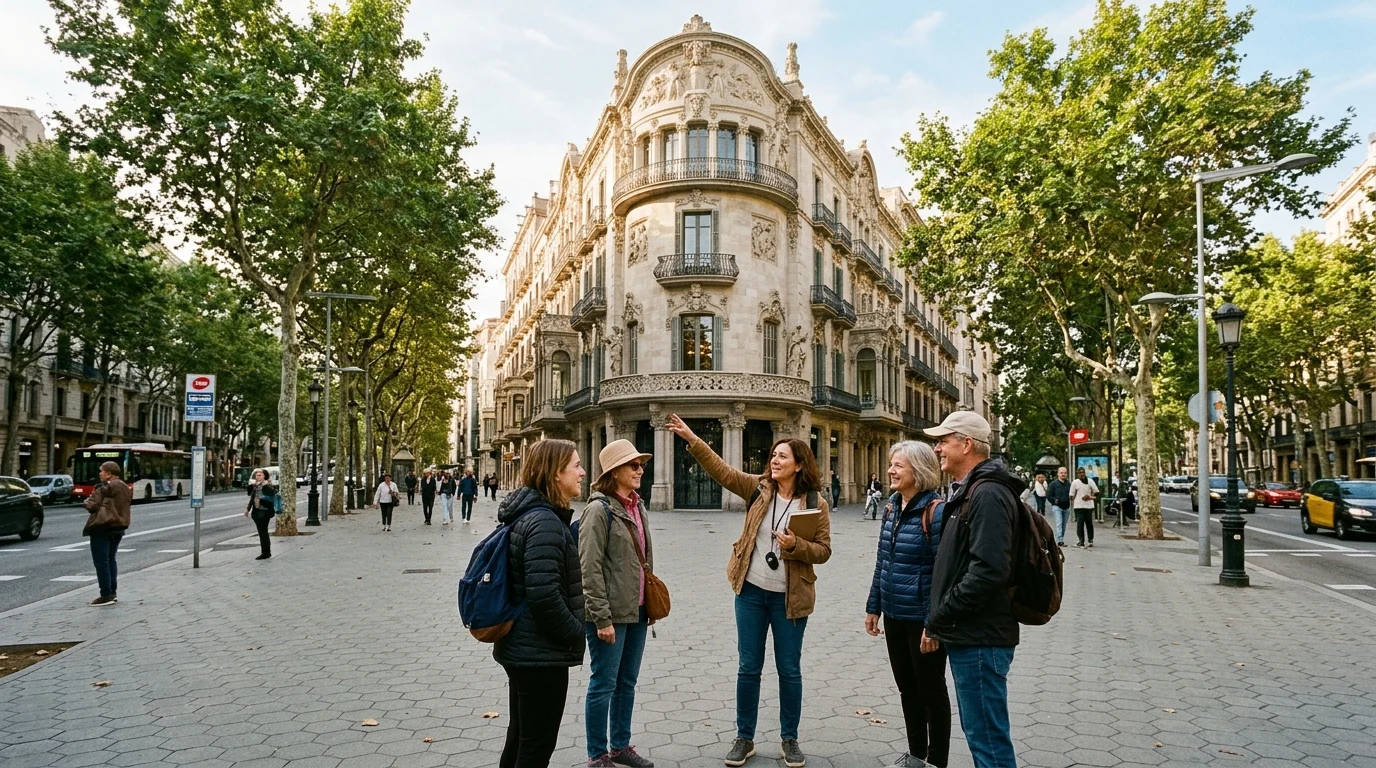
Walk to any crossroads in the Eixample and you will notice that the buildings do not meet at a sharp right angle. Each corner is sliced off diagonally, which turns every junction into a small eight-sided open space. In Catalan this cut corner is called a xamfrà.
Cerdà had practical reasons for it:
- Light and air. He was worried about the cramped, unhealthy conditions inside the old walled city. Wider junctions let more sun and air into the streets.
- Turning space. The angled corners gave carriages, and later trams and cars, room to turn and see oncoming traffic.
- Room to pause. The small squares at each junction give space for loading, café tables and simply standing still, which you will appreciate on a guided walk.
Each block is close to square, roughly 113 metres on a side, so the pattern repeats with a steady rhythm. The original plan also imagined that only two or three sides of each block would be built on, leaving the inside as a shared garden. In practice, most blocks were built up on all four sides and the inner courtyards were filled over time. A number of these courtyards have since been reopened as small public gardens, reached through a gate between two buildings. If you see an open passage in the middle of a block, it is often worth a look.
Where is the Eixample in relation to the Gothic Quarter?
Plaça de Catalunya is the hinge between the two. South of the square, towards the sea, lies the old city: the Gothic Quarter, La Rambla and El Born, with narrow, winding lanes and Roman and medieval buildings. North of the square, the street plan changes at once into the straight grid of the Eixample.
This makes the two areas easy to combine in one day. You can spend a morning in the old lanes and then walk up from Plaça de Catalunya onto Passeig de Gràcia without needing transport. For a street-by-street look at the old side, the Gothic Quarter guide on this blog walks it lane by lane.
Eixample or Gothic Quarter: which should you see first?
If you only have half a day, choose by what you enjoy most:
- Choose the Eixample if architecture is your main interest. The modernist facades are the reason most visitors come, and the wide pavements are easy to walk.
- Choose the Gothic Quarter if you prefer history, small squares and the feeling of an old Mediterranean town.
With a full day, do both. The old town first, then the Eixample in the afternoon, is a natural order, because you finish closer to Sagrada Família.
A walking route through the Quadrat d'Or
The Quadrat d'Or ("golden square") is the part of the Eixample with the highest number of modernist buildings, centred on Passeig de Gràcia. The order below follows the stops of Gaudi's Modernist Legacy Walking Tour, which runs from the lower end of Passeig de Gràcia up towards the Diagonal and ends at Sagrada Família.
Casa Lleó i Morera
At the corner of Passeig de Gràcia and Carrer del Consell de Cent, this building by Domènech i Montaner is the first of three neighbours on what is often called the "Block of Discord". Look up for the carved floral stonework, the rounded corner pavilion and the stained glass. It is a good place to start, because it shows that modernisme was never only about Gaudí.
Casa Amatller
A few doors along, Puig i Cadafalch's Casa Amatller has a stepped gable that recalls northern European town houses, decorated with tiles and sculpted figures. Standing on the opposite pavement lets you see the whole facade, along with its neighbours on each side.
Casa Batlló
Next door is Gaudí's Casa Batlló, with its wavy facade, mosaic of broken glass and ceramic, and balconies that many people compare to masks or bones. The roof, with its scaled ridge, is easiest to see from across the avenue. If you are deciding whether to go in here or at La Pedrera, our comparison of Casa Batlló and Casa Milà covers what each interior offers.
Casa Milà (La Pedrera)
Further up Passeig de Gràcia, at the corner with Carrer de Provença, Casa Milà rises like a cliff of rippling stone. Its nickname, La Pedrera, means "the stone quarry". The wrought-iron balconies look like seaweed, and the building wraps around the cut-off corner in one continuous curve, a good example of how architects used Cerdà's chamfered corners as a stage.
Casa de les Punxes
Turning east along the Avinguda Diagonal, you reach Casa de les Punxes, Puig i Cadafalch's "house of spikes". Its pointed towers and brick walls make it look more like a castle than an apartment block. The building fills a whole triangular plot where the Diagonal cuts across the grid, so you can walk around much of it.
Sagrada Família (exterior)
The walk closes at Sagrada Família, which stands inside its own Eixample block. Seeing it at the end, after the earlier houses, makes Gaudí's progression easier to follow. On the walking tour you see it from outside. The basilica's three facades, Nativity, Passion and Glory, each tell a different story, and a guide can point out which is which from the street.
Which Eixample houses are worth going inside?
This is one of the most common planning questions, and the honest answer depends on your time and budget. Every building on the route above can be enjoyed from the street, at no cost. Going inside is a separate decision for each one.
- Casa Batlló and Casa Milà both run ticketed interior visits. If you only go inside one Gaudí house, choose between these two.
- Sagrada Família needs a ticket for the interior. If seeing the inside matters, book it in advance or choose a tour that includes it (see the table below).
- Casa Amatller, Casa Lleó i Morera and Casa de les Punxes are mainly enjoyed from outside. Visiting arrangements for their interiors vary, so check the official website of each building before you plan around them.
- Hospital de Sant Pau has a ticketed visit to its modernist pavilions and gardens.
Opening days, times and ticket prices for these houses are set by each building and change during the year. Check them on the official websites before you go. Gaudi's Modernist Legacy Walking Tour does not include any monument entry tickets, so you can add the interiors you care about on another day.
A practical approach that works for many visitors is to do the facade walk first and then go inside one or two buildings you liked most. Once a guide has explained what you are looking at, it is easier to decide which interior is worth the time.
Can you see the Eixample in 3 hours on foot?
Yes, if you focus on the Quadrat d'Or and the route above. Three hours is enough to walk Passeig de Gràcia with time at each facade, cross to Casa de les Punxes and finish at Sagrada Família. That is the length of Gaudi's Modernist Legacy Walking Tour.
What three hours will not cover is the interiors, or the outer neighbourhoods such as Sant Antoni and Fort Pienc. Add time for any building you plan to enter.
How long does it take to walk Passeig de Gràcia?
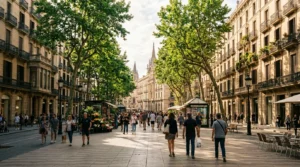
The section between Plaça de Catalunya and the Diagonal is a pleasant walk on its own. Allow longer than the distance suggests, because you will stop at almost every block. The pavements are wide and even, with benches and the distinctive hexagonal paving tiles underfoot, so it is one of the easier parts of Barcelona to walk.
How to join the Eixample to Sant Pau and Sagrada Família without retracing your steps
The grid makes a one-way route simple. Start at the bottom of Passeig de Gràcia, walk north past the Block of Discord to Casa Milà, then head east along the Diagonal to Casa de les Punxes and on towards Sagrada Família. From the basilica, Avinguda de Gaudí runs as a diagonal pedestrian avenue to Hospital de Sant Pau, so you finish at the second big modernist complex without walking back the same way.
Sant Pau was designed by Domènech i Montaner, the architect of Casa Lleó i Morera, so ending there closes the loop nicely. We cover what to expect there in our post on Hospital de Sant Pau and how it fits a city tour.
If that is too much walking for one day, split it: the Passeig de Gràcia houses one morning, and Sagrada Família with Sant Pau another time.
Which tours pass through the Eixample?
You can see the Eixample on foot, from a small-group tour with hotel pick-up, or on a private tour. The table compares the main options. Walking and pick-up tours are priced per person. Private tours are priced per group of up to 6, so the two cannot be compared on the same basis.
| Tour | Format | Price | Duration | Group size | Eixample content |
|---|---|---|---|---|---|
| Gaudi's Modernist Legacy Walking Tour | Walking, meets in central Barcelona | €50 per person | 3h | Up to 15 | Passeig de Gràcia, Casa Lleó i Morera, Casa Amatller, Casa Batlló, Casa Milà, Casa de les Punxes, Sagrada Família (exterior). No entry tickets |
| Barcelona Highlights and Gothic Quarter | Hotel pick-up, air-conditioned vehicle | €115 per person | 5h | Up to 8 | Passeig de Gràcia, ends at Hospital de Sant Pau. No Sagrada Família stop |
| Barcelona Highlights and Sagrada Familia Guided Exterior Half Day Tour | Hotel pick-up, air-conditioned vehicle | €124 per person | 5h | Up to 8 | Passeig de Gràcia facades, guided exterior visit of Sagrada Família. Interior ticket not included |
| Barcelona Highlights and Sagrada Familia Half Day Tour | Hotel pick-up, air-conditioned vehicle | €150 per person | 5h | Up to 8 | Passeig de Gràcia, Sagrada Família ticket included, subject to availability |
| Highlights and Park Guell (private) | Private, hotel pick-up | €799 per group | 5h | Up to 6 | Passeig de Gràcia and the Eixample district, ends with skip-the-line Park Güell |
The Eixample on foot or from a pick-up tour
The walking tour is the deeper option for the district itself. It spends all 3 hours in the Eixample, stops at each facade and costs €50 per person. It meets in central Barcelona and uses no vehicle, so you make your own way to the start.
The pick-up tours treat the Eixample as one part of a wider city tour. Barcelona Highlights and Gothic Quarter at €115 per person passes Casa Batlló and La Pedrera on Passeig de Gràcia and closes at Hospital de Sant Pau, after Montjuïc, the waterfront and the Gothic Quarter. The €124 and €150 half days add Sagrada Família. They suit visitors who want the whole city in one morning, with hotel pick-up and drop-off, rather than a slow look at each house.
Private options for a group of up to 6
For families or friends travelling together, the private Highlights and Park Guell tour costs €799 for the whole group of up to 6. Shared by 6 people, that is €133.17 each. It collects you from your hotel, includes Passeig de Gràcia and the Eixample, and ends with skip-the-line entry to Park Güell. The private Essence of Barcelona tour is €549 per group of up to 6, which is €91.50 each for a group of 6.
Is the Eixample tour price worth it?
At €50 per person for 3 hours, the walking tour is the lowest price on the site, and it is built around the district rather than passing through it. What you pay for is the guide's explanation of the buildings and the order of the route. What you do not get is entry to any house, food, drinks or hotel pick-up. If you plan to go inside Casa Batlló or Casa Milà, budget for that ticket separately.
If Sagrada Família's interior is a priority, the €150 half day includes the ticket, subject to availability. If tickets sell out for your date, that tour still goes ahead with a guided exterior visit and €26 per person is refunded.
Practical notes before you book
- Wear comfortable shoes. The Eixample is mostly level, with a gentle climb northwards, and a facade walk involves a lot of standing and short walks between blocks.
- Look up, then cross the street. Many facades are best seen from the opposite pavement, where you can take in the whole building.
- Check opening days for interiors. Days and times differ between houses and change during the year. Use each building's official website. The facades can be seen on any day.
- Bring water in summer. The avenues have shade from plane trees, but the open junctions can be hot in the middle of the day.
- Free cancellation. Every tour can be cancelled free of charge or moved to another date up to 96 hours before it starts. Refunds go back to the original payment method within a few business days, and a no-show is not refunded. The full terms are on the cancellation policy page.
Conclusion
The Eixample is best understood on foot, with someone who can explain why the corners are cut and who built each house. Gaudi's Modernist Legacy Walking Tour covers the Quadrat d'Or in 3 hours for €50 per person, and the pick-up and private tours add Passeig de Gràcia to a wider day. To book or ask a question, message City Tour in Barcelona on WhatsApp or call +34 632 93 79 41, or book the Gaudi walking tour online.