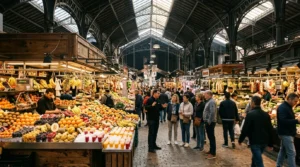
Santa Caterina Market (Mercat de Santa Caterina) is a working food market in Barcelona's old town, a short walk from the Cathedral and El Born. It is known for its wavy, multicoloured roof by the EMBT studio, its fresh produce stalls and its bar counters. It is quieter and more local than La Boqueria, and it is closed on Sundays.
Key takeaways
- Santa Caterina is a neighbourhood market where people still do their weekly shop, so it feels calmer than La Boqueria on Las Ramblas.
- The roof is the reason many visitors come: a rippling canopy of coloured ceramic pieces designed by Enric Miralles and Benedetta Tagliabue's EMBT studio.
- The market stands on the site of a former convent, and remains of the old building can be seen inside.
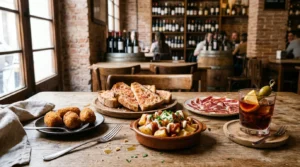
- Eat at the bar counters or buy small portions from stalls: cured meats, cheese, olives, fruit in season.
- The market is closed on Sundays. Hours vary by stall and season, so check the market's official website before you go.
- The La Boqueria and Santa Caterina Markets with Food and Tapas Small Group tour visits both markets in 4 hours for EUR 135 per person, with 3 pintxos, tapas, a dessert and drinks.
What is Santa Caterina Market known for?
Three things: the roof, the food and the feel. The roof is the most photographed part, and it is visible from the streets around the market and from higher windows nearby. The food is a full market range: fruit and vegetables, fish and seafood, meat and charcuterie, cheese, dried goods, olives and bread. The feel is what surprises most visitors who have already seen La Boqueria. Santa Caterina has fewer tour groups pushing through the aisles, more shoppers with trolleys, and stallholders who are serving regulars rather than selling cups of cut fruit to passers-by.
It is no secret, and on a busy morning you will hear plenty of languages. But here visitors are guests in a market that runs for the neighbourhood, and that is the experience worth coming for.
Where is it?
Santa Caterina sits in the Sant Pere, Santa Caterina i la Ribera area of Ciutat Vella, the old town. It is on the edge of El Born, a few minutes on foot from Barcelona Cathedral and from Via Laietana, the wide street that splits the Gothic Quarter from El Born. If you are walking from the Cathedral, you cross Via Laietana and are there quickly. From El Born you walk up through narrow streets. It is also a short walk from the Palau de la Musica Catalana.
Who designed the roof, and why is it wavy?
The roof was designed by the architects Enric Miralles and Benedetta Tagliabue of the EMBT studio as part of a major renovation of the old market. Miralles died before the project was finished, and Tagliabue completed the work. The renovated market reopened in the early years of this century.
The idea behind the roof is simple to see once you know it. The ceramic pieces come in the colours of fruit and vegetables: oranges, reds, yellows, greens and purples. From above, the surface reads like a huge, abstract display of produce, laid over the market like a cloth. The waves give the building a softer outline than the straight streets around it, and they let the roof sit over the long, open hall underneath without boxing it in.
Underneath, the structure is a mix of the old and the new. The renovation kept the older market walls on the main front and set the new roof over them on a framework of wooden and steel arches. Inside, the hall is bright and open, with the stalls laid out in long rows.
How to see the roof properly
The roof is hard to take in from street level right beside the market, because you see only its edges. A few practical tips:
- Stand back. Walk to the far side of the square in front of the main entrance, where you can see the curve of the front and some colour above it.
- Look for higher views. Upper floors of nearby buildings look down on the full pattern.
- Go on a bright day, when the colours are richer.
What was here before the market?
The market stands on the site of the old convent of Santa Caterina, a religious house that was demolished long before the market was built. When the market was renovated, archaeological work uncovered remains of the convent and earlier buildings. Part of those remains was kept and can be seen inside the market, at the back of the hall, behind glass and with information panels.
It is easy to miss if you go straight to the food stalls, and it shows how many layers of the city sit under this part of the old town.
Santa Caterina was one of the first covered markets in Barcelona. Covered markets brought traders in from the open streets and squares, and they became the centre of neighbourhood life. Barcelona still has a network of municipal markets across the city, and Santa Caterina is one of the oldest of them.
What to eat at Santa Caterina Market
Santa Caterina is a shopping market first, so most of what you see is raw produce meant for home kitchens. You can still eat well here if you know where to look.
At the bar counters
Several bars inside the market serve food at the counter. This is where market workers and shoppers eat, and where you get the most local version of the market. Expect cooked dishes based on what the stalls sell that day, often seafood, grilled vegetables, eggs, meat and sandwiches. Catalans have a tradition called esmorzar de forquilla, a "fork breakfast": a proper hot plate eaten in the late morning, rather than a pastry. A market bar counter is a natural place to try it.
There is also a restaurant attached to the market. Prices and menus change, so look at the board when you arrive rather than relying on a list in a guide.
Small tastings from the stalls
Many stalls will sell you a small amount if you ask politely. Good things to try in small quantities:
- Embotits (cured meats): fuet, a thin dry sausage, and llonganissa, a larger cured sausage, are both Catalan classics. Jamon is sliced at many charcuterie stalls.
- Cheese: look for Catalan cheeses alongside the better-known Spanish ones. Ask the stallholder which are local.
- Olives and pickles: there is usually a stall with a wide range of olives, pickled vegetables and anchovies.
- Fruit in season: buy one or two pieces rather than a bag. Spanish fruit in season tastes very different from fruit that has been shipped and stored.
- Bread and sweets: a small bakery item or a sweet is an easy snack to carry.
What is in season
Seasons show clearly at a market like this. In autumn, wild mushrooms (bolets in Catalan) appear, and they are a big part of the Catalan kitchen at that time of year. In late winter, calçots, a long, sweet green onion grilled over flames, are a Catalan favourite. Summer brings stone fruit and tomatoes. If you want more context on what to order once you leave the market, our guide to Catalan dishes covers the main ones.
Santa Caterina vs La Boqueria: which should you visit?
Both, if you have time. They are different experiences, and they are close enough to combine in one morning. If you only have time for one, the table below should help.
| Santa Caterina | La Boqueria | La Boqueria and Santa Caterina Markets with Food and Tapas Small Group | |
|---|---|---|---|
| Where | Edge of El Born, near the Cathedral | Just off Las Ramblas | Starts in central Barcelona, covers both markets |
| Feel | Local, calmer, weekly shopping | Busy, famous, more aimed at visitors | Guided, with tastings at set stops |
| Best for | Seeing a working neighbourhood market, the roof | Variety, energy, the classic market image | Eating your way through both with context |
| Architecture | Wavy, multicoloured EMBT roof, convent remains | Iron and glass hall with a decorated entrance | Both buildings, explained by a guide |
| Food | Bar counters, small purchases from stalls | Bar counters, ready-to-eat snacks, many visitor stalls | 3 pintxos, tapas, a dessert and drinks |
| Price | Free to walk in, pay for what you eat | Free to walk in, pay for what you eat | EUR 135 per person |
| Duration | As long as you like | As long as you like | 4h |
| Group size | On your own | On your own | Max 15 |
| Sundays | Closed | Check the official website | Check availability on the tour page |
For a closer look at the other market, read our La Boqueria market guide, which covers what to eat there and how to avoid the busiest times.
Is Santa Caterina worth visiting if you have seen La Boqueria?
Yes, for most people. La Boqueria shows you the famous version of a Barcelona market, with crowds and colour. Santa Caterina shows you how the city actually shops. The roof alone is worth the short walk if you have any interest in architecture, and the bar counters give you a meal in a setting that feels less staged. If you have no interest in food or buildings, you can skip it.
Is Santa Caterina Market open on Sundays?
No. Santa Caterina is closed on Sundays, like most of Barcelona's municipal markets. On the other days, opening hours vary: some stalls close earlier than others, and hours can change around public holidays and in summer. Check the market's official website before you go rather than trusting a fixed list of hours.
As a general rule, mornings are when the market is at its fullest. That is when stalls are fully stocked and the bars are busy with shoppers. Later in the day some stalls start to pack up.
Market etiquette: how to behave at a working market
Santa Caterina is a place of work. A few simple habits make the visit better for you and for the stallholders.
- Do not touch the produce. At most stalls the stallholder picks the fruit or vegetables for you. Point, and let them choose.
- Ask before photographing people. Stalls and displays are fine to photograph from a polite distance, but ask before you take a close-up of a stallholder. If a stall is busy, wait for a quiet moment.
- Buy something if you linger. If you spend time at a stall asking questions or taking photos, buy something small. A few olives or a piece of fruit is enough.
- Keep the aisles clear. Shoppers are carrying bags and pushing trolleys. Step aside to look at your phone or to talk.
- Carry some cash and a card. Many stalls take cards, but small amounts are often easier in cash.
- Learn two words of Catalan. "Bon dia" (good morning) and "gracies" (thank you) go a long way here.
How to fit Santa Caterina into a walk
Santa Caterina fits neatly into a morning in the old town. A simple route on foot:
- Start at Barcelona Cathedral in the Gothic Quarter. Look at the front, then walk around the side streets.
- Cross Via Laietana and walk to Santa Caterina Market. Spend time inside, see the convent remains, and stop at a bar counter.
- Walk down into El Born. Its narrow streets, small shops and squares are a natural continuation after the market. Our guide to El Born suggests a route through the area.
- Finish wherever you like for lunch, or head on to the waterfront.
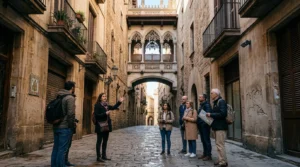
If you prefer to walk the old town with a guide first, the Barcelona Old Town and Gothic Quarter Walking Tour costs EUR 55 per person, takes 3h and has a maximum of 15 people. It meets in central Barcelona, and Santa Caterina is easy to reach on foot afterwards.
Can you do both markets in one morning?
Yes. La Boqueria is just off Las Ramblas, and Santa Caterina is on the other side of the Gothic Quarter. The walk between them goes through the old town streets and does not take long. The easiest order is La Boqueria first, when you are fresh and before it gets busiest, then a slow walk through the Gothic Quarter, then Santa Caterina for a calmer second stop and a sit-down bite. This is also the order the guided market tour uses.
How the guided market tour runs through both markets
The La Boqueria and Santa Caterina Markets with Food and Tapas Small Group tour is a walking tour. It meets in central Barcelona and uses no vehicle and no hotel pick-up. It costs EUR 135 per person, lasts 4 hours, and has a maximum of 15 people.
The tour runs in this order:
- Meet your guide in central Barcelona. A short introduction to how Barcelona eats.
- La Boqueria Market. A guided walk through the stalls of fruit, seafood, jamon and produce.
- Pintxos bar. A stop for three pintxos, the northern Spanish small bites served on bread.
- Santa Caterina Market. The second, quieter market, under the wave-shaped roof.
- Final restaurant stop near Santa Caterina. Spanish and Catalan dishes and drinks, eaten with the group.
What is included, and what is not
Included:
- A guided walk through both markets, and the old town walk between stops
- 3 pintxos
- Traditional Spanish tapas
- A traditional dessert
- Tastings with local wine, beer or soft drinks
- A local guide, and a small group of up to 15 people
Not included:
- Hotel pick-up or drop-off
- Extra food or drinks beyond what is listed
- Tips, which are optional
Between the market tastings, the pintxos, the tapas and the restaurant stop, most guests finish the tour comfortably full, so plan it as a meal rather than a snack.
Dietary needs
Tell your guide about any allergy or dietary need before the tour starts, so tastings can be adjusted at each stop where possible. Both markets and the final restaurant have vegetarian options, and the guide can steer tastings towards them if you mention it at the start.
Going on your own or with a tour?
Both work. It depends on what you want out of the morning.
Go on your own if you mainly want to see the roof, buy a few things, and set your own pace. Santa Caterina is free to walk into, and you can eat at the counters for whatever you choose to spend. It suits travellers who already know Spanish food, who are happy to point and ask, and who do not mind missing the stories behind the stalls.
Take the guided tour if you want the tastings planned for you, you want to understand what you are eating, and you want to see both markets without working out the route. A guide also knows which stalls are worth stopping at and handles the ordering. It suits first-time visitors, food lovers who want context, and solo travellers who prefer eating with a small group.
If you are deciding between a daytime market tasting and an evening of tapas, our comparison of a market tasting or tapas and flamenco sets the two side by side. The evening option, the Barcelona Old Town Walking tour with Tapas and Flamenco Show, costs EUR 105 per person, takes 3h, has a maximum of 8 people, and ends at a live flamenco show in a tablao.
Practical notes before you go
- Timing: go in the morning for the fullest stalls. Avoid Sundays, when the market is closed.
- Hours: check the market's official website, as hours vary by day and season.
- Getting there: walk from the Cathedral, El Born or the Gothic Quarter. The market is in the middle of the old town, so walking is the simplest way.
- What to bring: a small amount of cash, a reusable bag if you plan to buy food, and comfortable shoes for the old town streets.
- On a rainy day: the market is a good choice, since it is covered and the walk from the Cathedral is short.
Booking and cancelling the guided tour
If you book the market tour, you can cancel for free or change your date up to 96 hours before the tour starts. Refunds go back to the original payment method within a few business days. A no-show is not refunded. The full terms are on the cancellation policy page.
Conclusion
Santa Caterina Market is worth the short walk from the Cathedral or El Born: a working market under a striking ceramic roof, with convent remains inside and bar counters where locals eat. Go on a morning that is not a Sunday, eat something at the counter, and combine it with La Boqueria if you have time for both.
If you would like a guide to plan the tastings and walk you through both markets, see the La Boqueria and Santa Caterina Markets with Food and Tapas Small Group tour, or browse all tours. For questions, message us on WhatsApp at +34 632 93 79 41 or email [email protected].