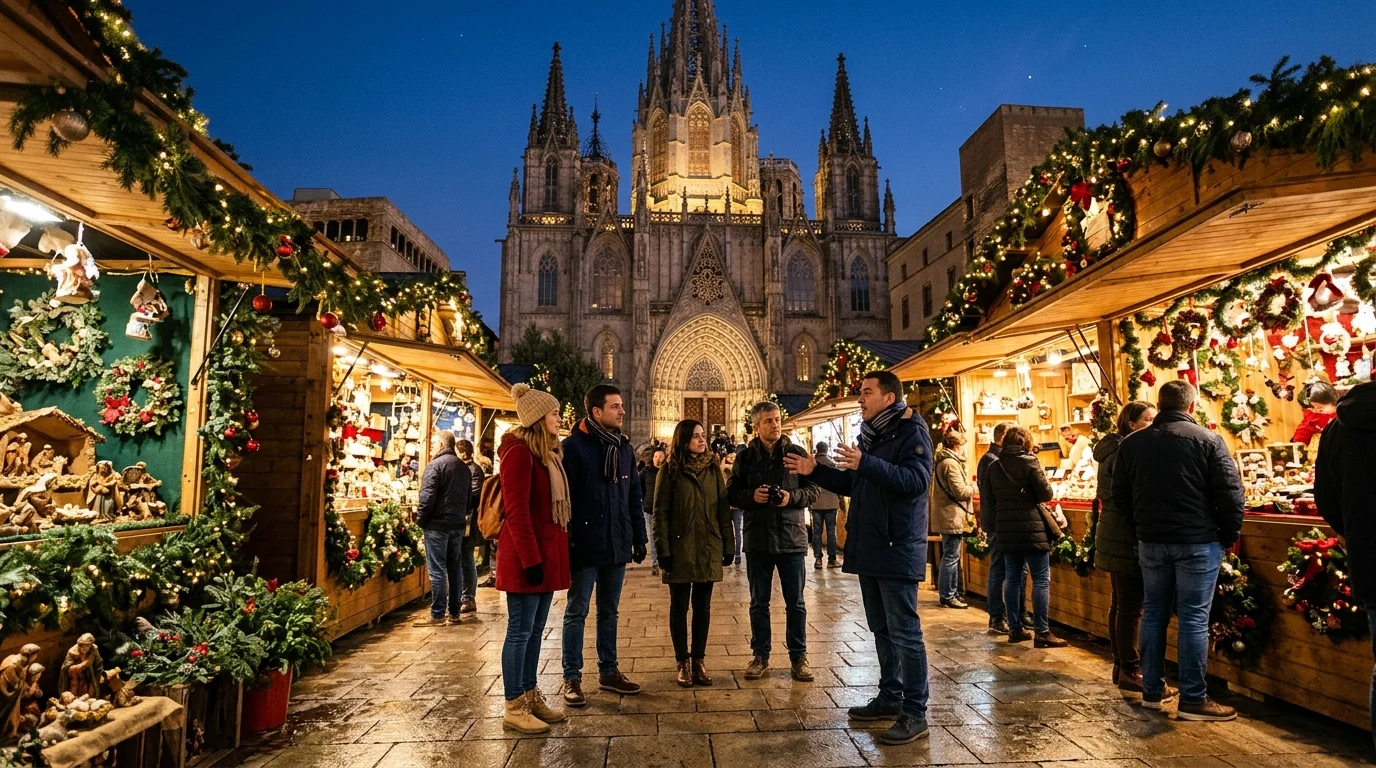
Christmas in Barcelona is best seen on foot. The Fira de Santa Llúcia fills the square in front of Barcelona Cathedral, a nativity scene goes up in Plaça de Sant Jaume, lights hang over the old streets, and the markets sell seasonal sweets. A 3 to 4 hour guided walk through the Gothic Quarter passes most of it.
Key takeaways
- The Barcelona Old Town and Gothic Quarter Walking Tour (€55 per person, 3h, max 15) passes Barcelona Cathedral and Plaça de Sant Jaume, the two squares at the centre of the city's Christmas.
- The Barcelona Old Town Walking tour with Tapas and Flamenco Show (€105 per person, 3h, max 8) walks the lit streets of the Gothic Quarter and La Rambla, then ends indoors at a live flamenco show.
- The La Boqueria and Santa Caterina Markets with Food and Tapas Small Group tour (€135 per person, 4h, max 15) is the food side of December: 3 pintxos, tapas, a dessert and drinks with the tastings.
- Barcelona Highlights and Gothic Quarter (€115 per person, 5h, max 8) adds hotel pick-up in an air-conditioned vehicle and ends at Hospital de Sant Pau.
- Fair dates, light displays and the Magic Fountain shows are set by the organisers and the city council each year. Check the official listings before you fix a day.
- Every tour can be cancelled or moved to another date free of charge up to 96 hours before it starts.
What makes Christmas in Barcelona different?
Barcelona does not do Christmas the way Vienna or Cologne does. There is no single giant market with mulled wine stalls in every square. Instead the season is spread across the old town in smaller pieces: a craft fair that has stood beside the Cathedral for generations, a nativity scene set up by the city in front of the town hall, lights strung over shopping streets and old lanes, and a calendar of Catalan traditions that run from early December to the Three Kings in January.
That spread is the reason a walking route works so well here. The festive sights sit a few minutes apart inside the Barri Gòtic, and a guide can link them in one loop while explaining what you are looking at. Without that context, the most Catalan parts of the season, the Tió and the Caganer, can look baffling on a market stall.
The weather helps too. December in Barcelona is mild by northern European standards, so walking outdoors for three hours is comfortable in a coat. Days are short, though, which shapes how you plan (see the section on daylight below).
Which Catalan Christmas traditions will you see?
The Tió de Nadal
The Tió is a small log with a painted face, a red hat and a blanket over its back. Families "feed" it through December, and on Christmas Eve or Christmas Day the children beat it with sticks while singing a song, after which it "gives" sweets hidden under the blanket. You will see Tiós in every size on the stalls of the Santa Llúcia fair.
The Caganer
The Caganer is a figure crouching with his trousers down, tucked into a corner of the traditional nativity scene. Nobody agrees on exactly where the custom comes from, but it is an old one, and modern versions show footballers, politicians and celebrities. Stalls sell them alongside the shepherds and the stable.
Nativity scenes and turrón
Catalan homes and churches build a pessebre, a nativity scene, often with moss, cork bark and tiny figures. Plaça de Sant Jaume hosts a large public one each year, with a different design every season. In the food shops, turrón (torró in Catalan), the almond nougat eaten at Christmas, takes over the shelves, along with neules, thin rolled wafers.
The Three Kings
In Catalonia the main day for presents is traditionally 6 January, when the Three Kings bring them. The evening before, a parade called the Cavalcada de Reis winds through the city. Routes and times change every year and are published by Barcelona City Council, so check the official programme rather than relying on last year's.
Where are the Christmas markets and fairs?
Fira de Santa Llúcia, by Barcelona Cathedral
The Fira de Santa Llúcia is the oldest Christmas fair in Barcelona and the one most visitors mean when they ask about Christmas markets. Its stalls fill the square in front of the Cathedral and the streets around it, selling nativity figures, moss and cork for building scenes, Tiós, Caganers, mistletoe and handmade gifts.
It runs for several weeks in the run-up to Christmas and closes before the holiday itself. The exact opening and closing days are announced each season, so check them on the fair's own website or on Barcelona City Council's official agenda before you travel.
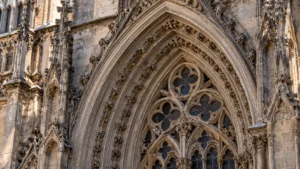
The Cathedral square is a stop on both the Barcelona Old Town and Gothic Quarter Walking Tour and the Barcelona Old Town Port and Boat trip. Our guide to what you see at Barcelona Cathedral and which tours pass it covers the building itself.
The Sagrada Familia fair
A second seasonal fair is usually set up near the Sagrada Familia, in the squares around the basilica. It is smaller and more local in feel. Like the Cathedral fair, its dates are set each year, so check before you plan around it.
Port Vell and the waterfront
The harbour at Port Vell often has seasonal stalls and activity in December. Whether you catch any depends on the year's programme, but the waterfront itself, with the boats, the Columbus Monument and the long promenade, makes a calm break from the crowded old town in any season.
Where are the best Christmas lights in Barcelona?
The city lights its main shopping avenues and many neighbourhood streets for the holidays. Passeig de Gràcia, Portal de l'Àngel and the streets of the Eixample usually get the largest displays, and the smaller lanes of the Gothic Quarter and El Born are hung with their own decorations by local shop associations.
The switch-on date and the nightly hours are decided by the city council each year. Check the official listings rather than a date from a previous season.
A few patterns hold every year:
- The old town looks its best just after dark, when the lights come on and the lanes are still busy.
- Passeig de Gràcia is wide and easy to walk, and runs past Casa Batlló and La Pedrera.
- Hospital de Sant Pau has hosted an evening light installation in some recent seasons. It is ticketed separately and its dates vary, so check its own programme.
Which walking tours pass the festive sights?
Here is how the city's Christmas sights line up with the routes of the tours on this site.
| Festive sight | Tour route that passes it | Duration and group | Price basis |
|---|---|---|---|
| Fira de Santa Llúcia, Cathedral square | Barcelona Old Town and Gothic Quarter Walking Tour | 3h, max 15 | €55 per person |
| Nativity scene, Plaça de Sant Jaume | Barcelona Old Town and Gothic Quarter Walking Tour | 3h, max 15 | €55 per person |
| Lit lanes of the Gothic Quarter and La Rambla | Barcelona Old Town Walking tour with Tapas and Flamenco Show | 3h, max 8 | €105 per person |
| Seasonal food at La Boqueria and Santa Caterina | La Boqueria and Santa Caterina Markets with Food and Tapas Small Group | 4h, max 15 | €135 per person |
| Cathedral, Las Ramblas and the harbour | Barcelona Old Town Port and Boat trip | 4h, max 15 | €80 per person |
| Port Vell, Gothic Quarter and Hospital de Sant Pau (by day) | Barcelona Highlights and Gothic Quarter | 5h, max 8, hotel pick-up | €115 per person |
All of these are priced per person. The walking tours meet in central Barcelona and use no vehicle. Barcelona Highlights and Gothic Quarter is a small-group tour with hotel pick-up and drop-off in an air-conditioned vehicle.
The Gothic Quarter walking tour
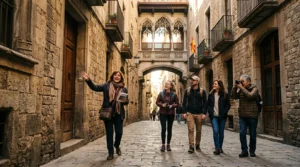
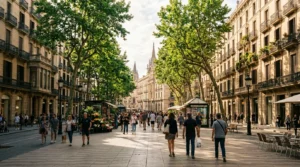
The Barcelona Old Town and Gothic Quarter Walking Tour is the closest thing to a Christmas walk on the list. It starts in the quiet lanes of the Barri Gòtic, then passes Plaça del Rei, Barcelona Cathedral, the Roman walls and Plaça de Sant Jaume before coming out onto Las Ramblas and finishing near La Boqueria.
In December that route takes you past the Santa Llúcia fair and the public nativity scene on the same morning or afternoon, with a guide to explain the Tió, the Caganer and the pessebre tradition as you go. It costs €55 per person, lasts 3 hours and takes a maximum of 15 people. Food and drinks are not included.
The tapas and flamenco evening
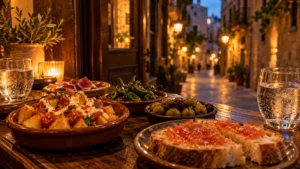
The Barcelona Old Town Walking tour with Tapas and Flamenco Show walks the Gothic Quarter and La Rambla, stops at tapas bars and ends at a live flamenco show in a tablao. It costs €105 per person, lasts 3 hours and takes a maximum of 8.
In winter it has a practical advantage: the walking part is short, and the evening ends indoors. If you want to see the lit streets and finish somewhere warm, this is the one to look at.
The Old Town Port and Boat trip
The Barcelona Old Town Port and Boat trip walks the Gothic Quarter and Las Ramblas, passing the Cathedral and Plaça del Rei, then takes a harbour cruise to Moll de Llevant and back. It costs €80 per person, lasts 4 hours and takes up to 15. It is the route that links the old town's festive squares with the waterfront at Port Vell.
Christmas food: what the market tour covers
December is when Barcelona's markets are at their busiest. Stalls stock up for Christmas Eve dinner and the long lunch on 25 and 26 December, when many Catalan families eat escudella i carn d'olla, a hearty meat and vegetable stew, and canelons made from the leftovers.
The La Boqueria and Santa Caterina Markets with Food and Tapas Small Group tour takes you through both markets with a guide. La Boqueria is the famous one just off La Rambla. Santa Caterina, under its wave-shaped tiled roof, is smaller and more local. Between the two you get 3 pintxos, traditional tapas, a dessert and drinks with the tastings, and the tour finishes at a restaurant near Santa Caterina.
It costs €135 per person, lasts 4 hours and takes a maximum of 15. There is no hotel pick-up.
Market opening hours change around the holidays, and the stalls themselves close on some public holidays. That is one more reason to fix your date well ahead and confirm it.
Day or evening: which works better in December?
December days in Barcelona are the shortest of the year. That matters more than the temperature. A tour that starts in the morning has the best light for photos of the Cathedral and the fair. A tour that starts late in the afternoon walks into the lights as they come on.
A simple way to plan:
- Morning: the Gothic Quarter walking tour or the market tour. The fair stalls are open, the markets are at their liveliest, and you have the afternoon free.
- Afternoon into evening: the tapas and flamenco tour, which ends indoors, or your own walk down Passeig de Gràcia after dark.
- A full half day with transport: Barcelona Highlights and Gothic Quarter, which covers Montjuïc, the Olympic Ring, Port Vell, the Gothic Quarter and Passeig de Gràcia, and ends at Hospital de Sant Pau. It runs by day, so it shows Sant Pau's modernist buildings in daylight, not any evening light display.
Does the Magic Fountain run at Christmas?
The Magic Fountain of Montjuïc has run special festive shows in some past seasons, but the fountain is operated by the city council. Its programme is seasonal and it can be paused for maintenance or wind.
The Barcelona Old Town, Montjuic Castle and Cable Car tour has a version that ends with the Magic Fountain show: €105 per person for 6 hours, against €95 per person for the 4 hour version without the fountain. Both take up to 15. If the council has not scheduled a show for your date, or pauses it, the rest of the tour goes ahead. Do not book the fountain version for December on the assumption that a show will run. Check the city council's Magic Fountain listing first, and send a message if you are unsure.
Sagrada Familia during the holiday weeks
The weeks around Christmas and New Year are a busy time at the Sagrada Familia, and tickets go quickly. Two pick-up tours include a ticket: Barcelona Highlights and Sagrada Familia Half Day Tour (€150 per person, 5h, max 8) and Barcelona in One Day (€195 per person, 8h, max 18). In both cases the ticket is subject to availability.
If tickets sell out for your date, those tours still go ahead with a guided exterior visit and €26 per person is refunded. Booking early is the only real way to improve your chances. Barcelona Highlights and Gothic Quarter (€115 per person) has no Sagrada Familia stop at all, which makes it a good pick if you plan to visit the basilica on your own another day.
A December day trip: Montserrat in the short daylight
If you have a spare day, a half day suits winter better than a long trip. The Montserrat Half Day Tour with Monastery Entrance costs €135 per person, lasts 5 hours, takes a maximum of 8 and includes hotel pick-up and the monastery entrance. It brings you back to Barcelona in good time to see the city lights the same evening.
Longer trips of 10 to 12 hours still run in winter, but much of the return drive will be in the dark.
Is Barcelona busy at Christmas?
Barcelona is quieter in early December than in summer, then gets busy again from the days before Christmas through New Year and the Three Kings. The old town fills up most in the late afternoon and evening, when locals come out to shop and see the lights. Mornings are calmer.
Crowds are one reason small groups suit the season. The walking tours above take 15 people at most, and the tapas evening only 8, so the group can actually stop and gather around the guide in a busy square.
What is open in Barcelona on Christmas Eve and Christmas Day?
This varies by venue and changes from year to year. Many shops, markets and some attractions close early on 24 December and stay closed on 25 and 26 December, which are both public holidays in Catalonia. Restaurants that open on those days usually take bookings only.
For the tours, do not assume a date will run. Before you book 24, 25, 26 or 31 December, or 1 or 6 January, send a message on WhatsApp and ask whether your chosen tour runs that day.
What if the weather turns?
December rain in Barcelona tends to come in short spells. Wear shoes with grip, because the old town's stone paving gets slippery when wet, and carry a light umbrella.
If the forecast looks poor, the cancellation terms give you room. Every Barcelona tour and Catalonia day trip can be cancelled or moved to another date free of charge up to 96 hours before it starts. Refunds go back to the original payment method within a few business days. A no-show is not refunded. For tour ideas when it does rain, see our guide to Barcelona rainy day tours.
Practical notes before you book
- Book the date first, then the extras. Fair dates, light hours and Magic Fountain shows are confirmed by the organisers. Fix your tour, then check the official listings for that week.
- Pick the meeting format. Walking tours meet in central Barcelona with no vehicle. If you would rather be collected, Barcelona Highlights and Gothic Quarter includes hotel pick-up and drop-off.
- Mind the price basis. All the tours in this guide are priced per person. Private tours, by contrast, are priced per group of up to 6, so never compare the two figures directly.
- Layer up. Mornings and evenings feel cool in the narrow lanes, even when the afternoon is mild.
- Leave room for the market. If you plan Christmas Eve dinner or gifts, the market tour is a good way to learn what to buy and where.
Conclusion
Christmas in Barcelona is a walking season: the fair by the Cathedral, the nativity scene in Plaça de Sant Jaume, the lit lanes of the Gothic Quarter and the busy December markets all sit within a short loop of the old town. Pick a morning walk for the fair, an evening tapas and flamenco tour for the lights, or the market tour for the food, and check the official listings for the year's dates.
To ask whether a tour runs on your chosen holiday date, message City Tour in Barcelona on WhatsApp at +34 632 93 79 41 or write to info@citytourinbarcelona.com. You can then book directly from the tour page.