Plaça d'Espanya in Barcelona is the large roundabout square at the foot of Montjuïc, laid out for the 1929 International Exhibition. From it you see the Venetian Towers, the Las Arenas former bullring and the long avenue that climbs to the Magic Fountain and the Palau Nacional. Allow one to two hours on foot, more if you continue up Montjuïc.
Key takeaways
- Plaça d'Espanya is a traffic square first and a sight second: the reason to come is what starts there, the axis of fountains, steps and exhibition buildings that runs up to the Palau Nacional.
- The main things to see are the central fountain, the two Venetian Towers, Las Arenas (now a shopping centre with a rooftop walkway), Avinguda de la Reina Maria Cristina, the Magic Fountain, the Palau Nacional, the Barcelona Pavilion, CaixaForum and Poble Espanyol.
- Walking from the square to the terrace in front of the Palau Nacional takes most people 15 to 25 minutes with photo stops. Outdoor escalators run beside parts of the steps.
- The Magic Fountain show is run by the city council. It is seasonal and can be paused for maintenance or wind, so it is not on every night.
- Two hotel pick-up tours start their route at Plaça Espanya and Montjuïc: the Barcelona Highlights and Sagrada Familia Guided Exterior Half Day Tour (EUR 124 per person) and the Barcelona Highlights and Sagrada Familia Half Day Tour (EUR 150 per person).
- The Barcelona Old Town, Montjuic Castle, Cable Car and Magic Fountain show tour (EUR 105 per person, 6h) ends at the fountain, at the top of the same avenue.
What is Plaça d'Espanya, and why is it there?
Plaça d'Espanya sits where several of Barcelona's big roads meet: the Gran Via de les Corts Catalanes, Avinguda del Paral·lel, Carrer de la Creu Coberta and Carrer de Tarragona all feed into it.
The square took its present shape for the 1929 International Exhibition. The organisers needed a grand entrance to the exhibition grounds on the slopes of Montjuïc, so they built a monumental circle at the bottom, a straight avenue running uphill from it, and a palace at the top to close the view. Almost everything you see from the square belongs to that one plan.
The exhibition left Barcelona a whole district: exhibition halls that are still used by the Fira de Barcelona trade fair, the Palau Nacional, the Magic Fountain, the Barcelona Pavilion and Poble Espanyol. Sixty-three years later the 1992 Olympic Games reused the hill above it, which is why the Olympic Ring is only a short walk further up.
What to see at Plaça d'Espanya, stop by stop
The easiest way to see the area is to start in the square and walk uphill in a straight line, then decide how far to keep climbing. Here is what you pass, in order.
The central fountain
In the middle of the roundabout stands a large monumental fountain, designed by Josep Maria Jujol, who worked with Gaudí on several of his buildings. Its sculpture groups are allegories of the rivers and the virtues of Spain. Because it is ringed by traffic, you see it from the edges of the square.
The Venetian Towers
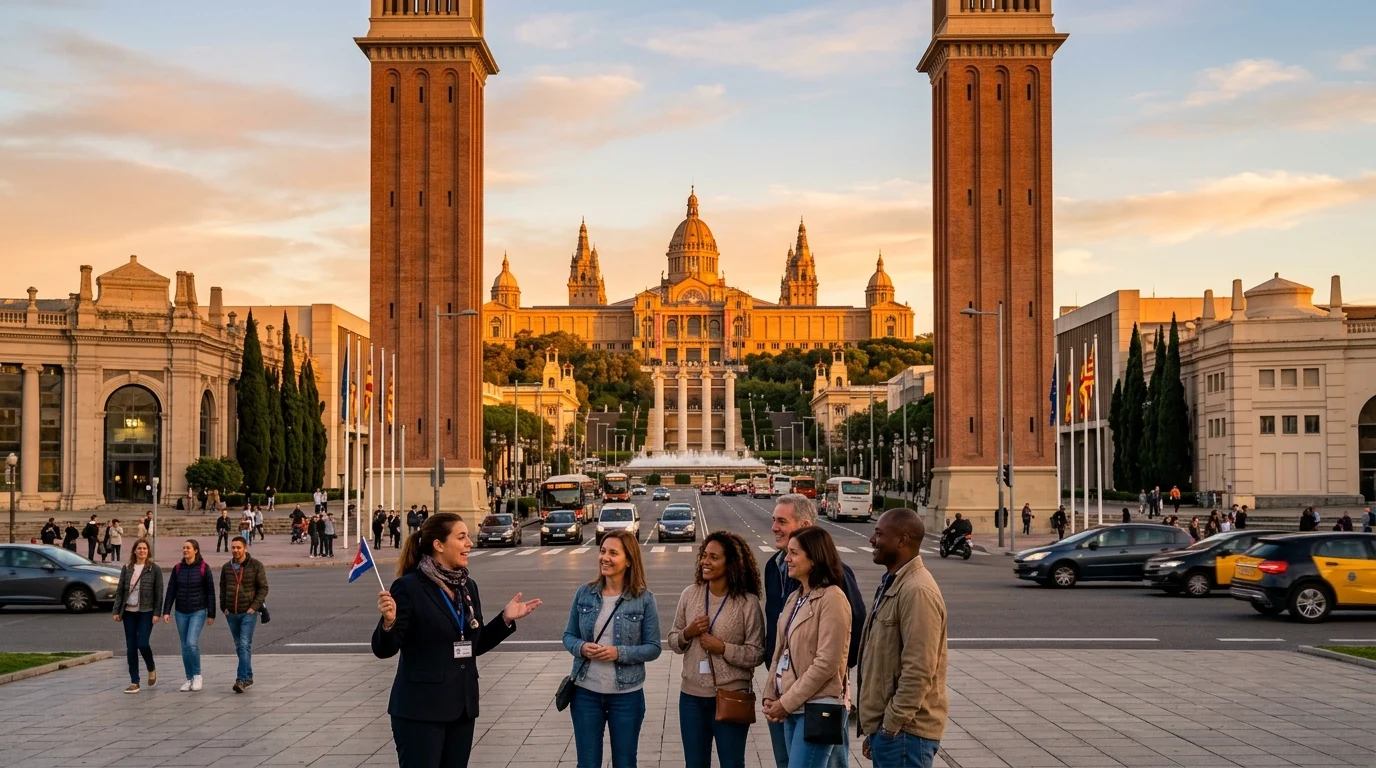
The two tall red-brick towers on the south side of the square are the Venetian Towers, built for the 1929 exhibition and modelled on the bell tower of St Mark's in Venice. They frame the start of Avinguda de la Reina Maria Cristina like a gateway. This is the classic photograph of Plaça d'Espanya: stand between the towers and look up the avenue to the Palau Nacional on the hill.
Las Arenas
On the north side of the square is the round brick building of Las Arenas (Arenas de Barcelona in Catalan and Spanish signs). It opened as a bullring at the start of the twentieth century. Bullfighting ended in Barcelona, and the building was converted into a shopping and leisure centre, keeping the original facade wrapped around a new structure.
Can you go up Las Arenas?
Yes. Las Arenas has a rooftop walkway that circles the dome, and it is an easy place to look down on Plaça d'Espanya and across to Montjuïc. You reach it from inside the centre, and there is also an external lift on the facade. Opening times and any charge for the lift are set by the centre, so check them on the day.
Avinguda de la Reina Maria Cristina
Between the towers the wide avenue of Reina Maria Cristina runs uphill, lined with the exhibition halls of the Fira de Barcelona and with rows of fountains down its centre. The walk up it is flat until you reach the foot of the hill.
The Magic Fountain
At the top of the avenue is the Magic Fountain of Montjuïc, designed by the engineer Carles Buïgas for the 1929 exhibition. By day it is a wide stone basin. In season, on show evenings, it becomes a display of water, light and music that draws large crowds onto the steps around it.
The show is run by Barcelona's city council. It is seasonal, and it can be paused for maintenance or when the wind is too strong. Check the city council's own information for your dates rather than assuming it is on every night.
The steps and escalators up to the Palau Nacional
Behind the Magic Fountain a series of terraces, cascades and staircases climbs to the Palau Nacional. Outdoor escalators run alongside parts of the climb, which helps a lot in summer heat. From the top terrace you get a wide, open view back over the fountain, the avenue, the Venetian Towers and Plaça d'Espanya, with the city beyond.
The Palau Nacional itself is the domed palace built as the main exhibition building in 1929. Today it houses the Museu Nacional d'Art de Catalunya (MNAC), Catalonia's national art museum, known for its Romanesque murals. The terrace in front of it is open space.
The Barcelona Pavilion
To one side of the Magic Fountain, on the right as you face the Palau Nacional, is the Barcelona Pavilion, designed by Ludwig Mies van der Rohe and Lilly Reich as Germany's pavilion for the 1929 exhibition. It was taken down after the exhibition and rebuilt on the same site in the 1980s. Its flat roof, marble and onyx walls and shallow pools are a landmark of modern architecture.
CaixaForum
Across the road from the Pavilion is CaixaForum, a cultural centre inside the former Casaramona textile factory, a red-brick modernist building by Josep Puig i Cadafalch. It hosts changing exhibitions. Its brick towers are worth a look even from the street.
Poble Espanyol
Further up the slope, to the right of the Palau Nacional, is Poble Espanyol, an open-air complex built for the same exhibition with copies of buildings and streets from regions across Spain. It is a separate, ticketed attraction with its own hours, so plan it as a visit in itself rather than something to look at in passing.
How long do you need at Plaça d'Espanya?
How long you spend depends on how far up the hill you go.
- 30 to 45 minutes: the square, the Venetian Towers, a look at Las Arenas from outside and a walk up the avenue to the Magic Fountain.
- One to two hours: add the steps up to the Palau Nacional terrace, the Barcelona Pavilion from outside, a look at CaixaForum and the Las Arenas rooftop.
- Half a day: add a museum (MNAC or CaixaForum) or Poble Espanyol, or carry on uphill to the Olympic Ring.
- A full day: combine the area with Montjuïc Castle and the cable car, finishing at the Magic Fountain show if it is running.
How to get from Plaça d'Espanya to Montjuïc
Plaça d'Espanya is the most common way into Montjuïc from the city side, and the route is simple.
- Square to the Magic Fountain: walk between the Venetian Towers and straight up Avinguda de la Reina Maria Cristina. It is flat and takes around 10 minutes.
- Magic Fountain to the Palau Nacional: climb the steps behind the fountain, using the outdoor escalators where they run. Allow 10 to 15 minutes.
- Palau Nacional to the Olympic Ring: continue uphill behind and to the side of the palace. The Olympic Stadium and Palau Sant Jordi are a further walk of around 15 to 20 minutes, with more escalators on parts of the way.
- On to Montjuïc Castle: the castle sits at the summit, on the far side of the hill. It is a long uphill walk from the Olympic Ring, so most people take a bus or come up from the other side using the funicular and the cable car.
Espanya metro station is under the square, served by metro lines L1 and L3 and by FGC trains, so you can arrive by public transport and walk up. Our guides to the Montjuïc Olympic Ring and to Montjuïc Castle cover the upper part of the hill in more detail.
Is the Magic Fountain on every night?
No. The show is seasonal and runs only on certain evenings, set by Barcelona's city council. It can also be paused for maintenance or in strong wind.
If seeing the show matters to you, build some flexibility into your week. On the Barcelona Old Town, Montjuic Castle, Cable Car and Magic Fountain show tour, the fountain is the finale. If the city pauses the show on your date, the rest of the tour (Old Town, El Raval, funicular, cable car, the castle and the Olympic Ring) still goes ahead. Our Barcelona night tour guide compares evening options if the fountain is your main reason to stay out late.
Day or evening: when should you visit?
Both work, but they give different experiences.
By day, the architecture is the point. Morning light falls well on the Palau Nacional, the avenue is quieter, and the Barcelona Pavilion and CaixaForum are easier to combine. Bear in mind that the steps and terraces face open sky with little shade, so in summer the middle of the day is hot.
In the evening, the area changes. The Palau Nacional is lit up, the terrace is a popular place to watch the sun go down over the city, and on show nights the steps around the Magic Fountain fill with people. Keep an eye on bags and phones in the crowd.
A good compromise is late afternoon: walk up in daylight, watch the light change from the Palau Nacional terrace, and come back down to the fountain as it gets dark.
Plaça d'Espanya vs Plaça de Catalunya
Visitors often mix up the two big squares (Plaza España and Plaza Cataluña in Spanish). They are in different parts of the city and do different jobs.
| Plaça d'Espanya | Plaça de Catalunya | |
|---|---|---|
| Where | West side of the centre, at the foot of Montjuïc | The middle of the city, between the Old Town and the Eixample |
| What it is | A monumental roundabout from the 1929 International Exhibition | A large open square with gardens, fountains and statues |
| What you see from it | Venetian Towers, Las Arenas, the avenue up to the Magic Fountain and the Palau Nacional | The top of La Rambla, the start of Passeig de Gràcia, big department stores |
| Good for | The walk up Montjuïc, the Magic Fountain, museums, the Olympic Ring | Starting a walk down La Rambla or into the Gothic Quarter, shopping |
| Metro | Espanya (L1, L3, FGC) | Catalunya (L1, L3, FGC and regional trains) |
| On our tours | Route start on the EUR 124 and EUR 150 half days | Transit point on the EUR 150 half day |
The short answer: Plaça de Catalunya is the hub you pass through, Plaça d'Espanya is the gateway to Montjuïc. If you are planning a day on the hill, start at Plaça d'Espanya.
Which tours start at Plaça d'Espanya, or end near it?
Several of our tours use the Plaça d'Espanya and Montjuïc area. The price basis differs: walking and small-group pick-up tours are priced per person, private tours per group of up to 6.
| Tour | How it uses the area | Duration | Group size | Price |
|---|---|---|---|---|
| Barcelona Highlights and Sagrada Familia Guided Exterior Half Day Tour | Route begins at Plaça Espanya and Montjuïc Hill after hotel pick-up | 5h | Max 8 | EUR 124 per person |
| Barcelona Highlights and Sagrada Familia Half Day Tour | Sets off from Plaça Espanya after hotel pick-up | 5h | Max 8 | EUR 150 per person |
| Barcelona Old Town, Montjuic Castle, Cable Car and Magic Fountain show | Ends with the Magic Fountain show (seasonal) | 6h | Max 15 | EUR 105 per person |
| Barcelona Old Town, Montjuic Castle and Cable Car | Montjuïc by funicular and cable car, no fountain | 4h | Max 15 | EUR 95 per person |
| The Essence of Barcelona: Discover its Icons on an Exclusive Tour | Passes Plaça d'Espanya, stops at the Barcelona Pavilion and the National Palace | 5h | Private, up to 6 | EUR 549 per group |
The two hotel pick-up half days
Both half-day tours collect you from your hotel in an air-conditioned vehicle and begin on the Plaça Espanya and Montjuïc side of the city, before a viewpoint stop on Montjuïc, the waterfront, the Gothic Quarter, Passeig de Gràcia and the Sagrada Familia.
The difference is the Sagrada Familia. The EUR 124 tour is a guided exterior visit only, and the interior ticket is not included. The EUR 150 tour includes a Sagrada Familia ticket, subject to availability. If tickets sell out for your date, the tour still goes ahead with a guided exterior visit and EUR 26 per person is refunded.
Does a hotel pick-up tour stop for photos at Plaça d'Espanya?
On these routes Plaça Espanya is where the sightseeing begins, as the vehicle heads up Montjuïc. How long the group pauses in the square itself depends on traffic and the day's timings, so if a photo between the Venetian Towers matters to you, mention it to your guide at pick-up. The longer viewpoint stop comes higher up on Montjuïc, where the whole city is laid out below.
The Magic Fountain evening tour
The Barcelona Old Town, Montjuic Castle, Cable Car and Magic Fountain show tour is a walking tour: it meets in central Barcelona, with no hotel pick-up. It walks La Rambla, La Boqueria, the Liceu, Palau Güell, El Raval and Botero's Cat, then takes the funicular and cable car up to Montjuïc Castle, passes the Olympic Stadium and Palau Sant Jordi, stops for tapas and a drink, and ends at the Magic Fountain show. It costs EUR 105 per person for 6 hours, with a maximum of 15 people. The 4-hour version without the fountain is EUR 95 per person.
The private option
The Essence of Barcelona: Discover its Icons on an Exclusive Tour costs EUR 549 for the whole group of up to 6, for 5 hours, with a vehicle and guide for your group only and hotel pick-up and drop-off. Shared by 6 people that is EUR 91.50 each, and shared by 2 it is EUR 274.50 each. Its route includes Montjuïc, the 1992 Olympic sites with Plaça d'Espanya, the Barcelona Pavilion and the National Palace, then the waterfront, the Gothic Quarter, Passeig de Gràcia and Hospital de Sant Pau. Monument entrance tickets are not included.
Is Plaça d'Espanya worth visiting?
Yes, if you treat it as the start of something rather than a destination on its own. The square by itself is a busy roundabout, and ten minutes there is enough. The reward is the walk up: the Venetian Towers, the avenue, the Magic Fountain and the view from the Palau Nacional terrace form a single planned set piece from 1929, and almost all of it is free open space.
If you only have one day in the city and no interest in Montjuïc, the Gothic Quarter and the Eixample will give you more for your time.
Practical notes before you go
- Crossing the square: use the marked crossings. The roundabout carries heavy traffic and there is no safe way across the middle.
- Heat and shade: the avenue and the steps are exposed. In summer go early or late, carry water and use the escalators.
- Fountain nights: check the city council's show information for your date, arrive early for a spot on the steps, and watch your belongings in the crowd.
- Museums and Poble Espanyol: these have their own tickets and hours. Check them directly before you build a day around them.
Cancelling or changing your date
Every Barcelona tour on this site can be cancelled free or moved to another date up to 96 hours before it starts. Refunds go back to the original payment method within a few business days. A no-show is not refunded.
Conclusion
Plaça d'Espanya is the front door to Montjuïc: start between the Venetian Towers, walk up to the Magic Fountain and the Palau Nacional, and decide from the terrace how much of the hill you want to see. If you would rather have a guide and transport, compare the routes on our Barcelona tours page. For questions about pick-up or dates, message us on WhatsApp at +34 632 93 79 41 or email info@citytourinbarcelona.com.