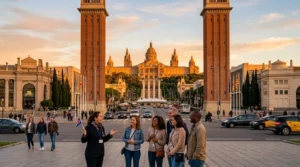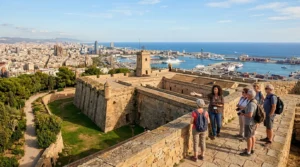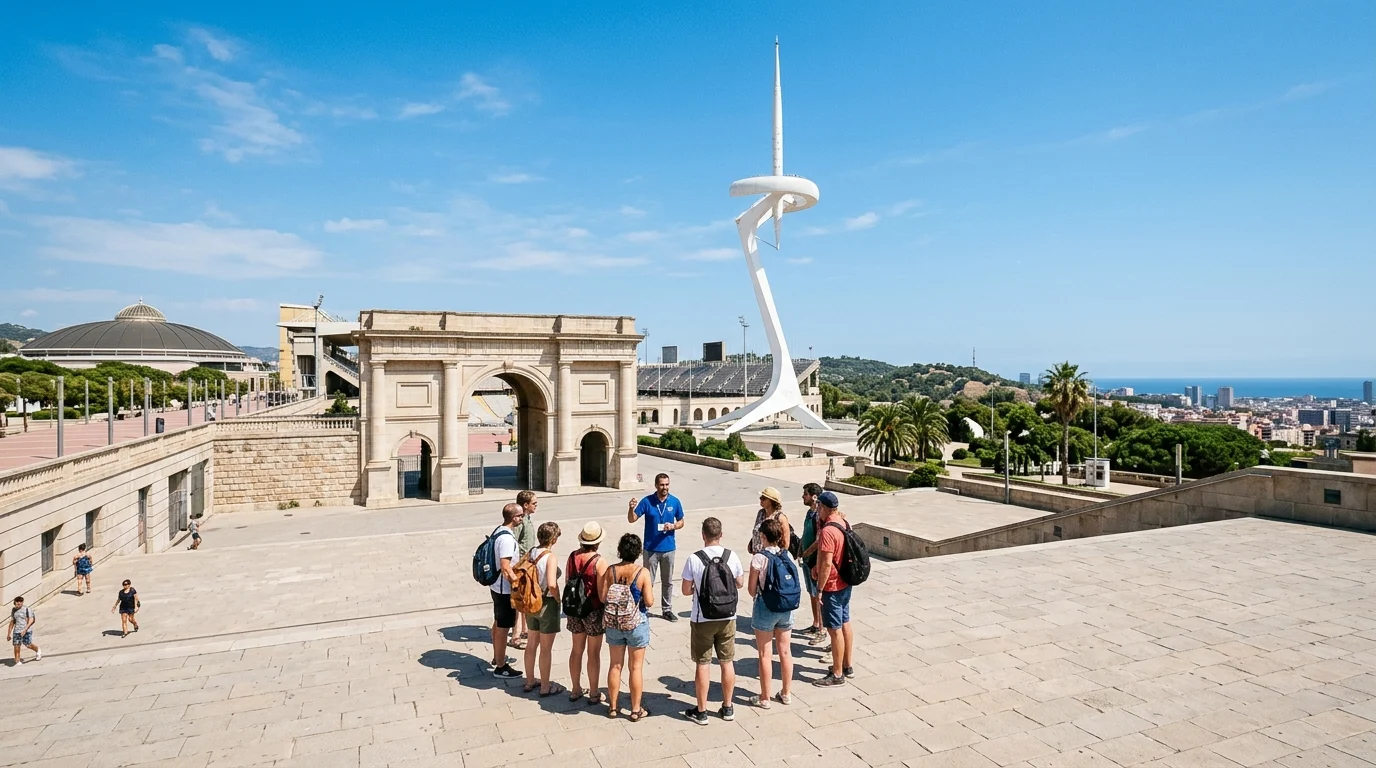
The Montjuic Olympic Ring is the group of 1992 Games venues on Montjuic hill: the Olympic Stadium, Palau Sant Jordi, the Calatrava communications tower, the Bernat Picornell pools and the esplanade joining them. The outdoor areas are public space, so you can see the whole Ring free, on foot or on a guided tour stop.
Key takeaways
- The Ring is a set of buildings around one long esplanade on Montjuic, not a single attraction with a gate.
- You can walk the esplanade and see every exterior for free. Going inside the stadium, the arena or the Olympic museum depends on each venue, so check the official venue site before you plan around it.
- The Calatrava tower is the white, leaning communications tower in the middle of the Ring. It is the landmark most people mean when they search "Barcelona communications tower".
- Six of our Barcelona tours reach the Ring or its view in some form. The clearest stops are on Barcelona Highlights and Gothic Quarter (€115 per person, 5h, hotel pick-up) and on the Magic Fountain version of the Montjuic walking tour (€105 per person, 6h).
- Private tours for up to 6 pass the Olympic sites too. The Essence of Barcelona costs €549 for the whole group of up to 6, which is €91.50 each when 6 people share it.
- The Ring is open and exposed. Bring water and a hat in summer, and pair it with a shaded or indoor stop.
What is the Montjuic Olympic Ring?
The Olympic Ring, or Anella Olímpica in Catalan, is the sports park on the southern side of Montjuic that hosted the main events of the 1992 Games. The hill already held a stadium and open land above the city. The result is a long, straight esplanade with the Olympic Stadium at one end, the Calatrava tower in the middle, Palau Sant Jordi beside it and the swimming pools close by.
It is worth knowing that Montjuic carries two layers of history. The lower slopes, around Plaça d'Espanya, the National Palace and the Magic Fountain, were laid out for the 1929 International Exhibition. The stadium itself also dates from that exhibition. The Olympic Ring sits higher up and was completed for 1992, reusing that older stadium as its centrepiece. On a tour, you usually meet the two layers on the same morning, which makes the hill easier to read.
Which venues can you see at the Olympic Ring?
Olympic Stadium Lluís Companys
The Olympic Stadium is the largest building on the Ring and the one with the most history. It was first built for the 1929 International Exhibition. For the 1992 Games the inside was rebuilt while the old outer facade was kept, so the walls you see today are older than the Games. It held the opening and closing ceremonies and the athletics events. It carries the name of Lluís Companys, a president of the Catalan government.
The stadium is still used for sport and large concerts, which is why access to the stands is not a given. Whether you can go inside on a particular day depends on events and on the stadium's own visitor arrangements. Check the official stadium site for that. From the esplanade you can still see the classical facade, the main gates and the statues around the entrance.
Palau Sant Jordi
Palau Sant Jordi is the indoor arena next to the stadium, designed by the Japanese architect Arata Isozaki. Its low, curved roof was built to sit quietly against the hill rather than compete with the stadium. It held the gymnastics events during the Games and is now one of the city's main venues for concerts and indoor sport. On Barcelona Highlights and Gothic Quarter, the stadium and Palau Sant Jordi are the two buildings the guide shows you up close.
The Calatrava tower
The Torre de Comunicacions de Montjuic, usually called the Calatrava tower, is the white tower that leans out over the esplanade. Santiago Calatrava designed it to carry the television and radio signals for the Games. Its shape is often described as an athlete holding up the Olympic torch, and it reads that way best when you stand at the foot of the esplanade and look along it.
If you searched for "Barcelona communications tower", this is almost certainly the one you mean. The city has a second tall telecom tower on the Collserola hills, but the Calatrava tower is the one on Montjuic, and it is the best photo point on the esplanade.
Bernat Picornell pools
The Bernat Picornell pools sit just behind the stadium. They held the swimming events in 1992 and now work as a public sports centre. They are the least visible part of the Ring from the esplanade, so most visitors simply note where they are. For entry rules and times, check the official site of the sports centre.
The esplanade and Plaça d'Europa
The esplanade is the open spine of the Ring. It runs from the stadium area down past the Calatrava tower to Plaça d'Europa, a semicircular square with columns at its lower end. The sports university building by Ricardo Bofill stands nearby. This open stretch is where you get the clearest view of the tower and the arena together, and it is also where the sun hits hardest in summer.
Olympic and Sports Museum
The Olympic and Sports Museum Joan Antoni Samaranch stands opposite the stadium. It is the only part of the Ring built around exhibits, and it is ticketed. For opening times and prices, check the museum's official site. None of our tours include entry to the museum.
Can you see the Olympic Ring without a ticket?
Yes. The esplanade, Plaça d'Europa and the outside of every venue are public space, so you can walk the length of the Ring and see the stadium, Palau Sant Jordi and the Calatrava tower without paying anything. This is how the Barcelona Highlights and Gothic Quarter tour uses it: the vehicle brings you up the hill, you step out, and the guide explains the venues from outside.
What does need a ticket or a booking is going inside. The Olympic museum is ticketed, the pools have their own entry rules, and the stadium and arena open their interiors on their own terms. If seeing inside the stadium is the point of your trip, plan that visit directly with the venue. If you want the Ring as part of a wider view of Barcelona, a viewing stop covers it.
Which of our tours stop at the Olympic Ring?
Six Barcelona tours on this site reach the Ring or include it in their Montjuic view. They do it in different ways, so the table below separates a real stop from a drive-past or a view from higher up.
| Tour | Format | Price | Duration and group | How it uses the Olympic Ring |
|---|---|---|---|---|
| Barcelona Highlights and Gothic Quarter | Small group, hotel pick-up | €115 per person | 5h, max 8 | A viewing stop at the Olympic Stadium and Palau Sant Jordi |
| Barcelona Highlights and Sagrada Familia Guided Exterior Half Day Tour | Small group, hotel pick-up | €124 per person | 5h, max 8 | Drives past the Olympic venues on the way to the waterfront |
| Barcelona in One Day: Sagrada Familia, Park Guell and Old Town | Small group, hotel pick-up | €195 per person | 8h, max 18 | A panoramic stop on Montjuic that takes in the Olympic Ring from above |
| Barcelona Old Town, Montjuic Castle, Cable Car and Magic Fountain show | Walking, meets in central Barcelona | €105 per person | 6h, max 15 | A viewing stop at the Olympic Stadium and Palau Sant Jordi after the castle |
| The Essence of Barcelona: Discover its Icons on an Exclusive Tour | Private, hotel pick-up | €549 per group of up to 6 | 5h | Passes the Olympic Stadium, Palau Sant Jordi and Plaça d'Espanya |
| Barcelona Highlights and Park Guell | Private, hotel pick-up | €799 per group of up to 6 | 5h | A Montjuic panorama stop with views over the Olympic Ring |
Walking and small-group tours are priced per person. The two private tours are priced for the whole group of up to 6, so compare them on that basis rather than against the per-person prices above them.
How long do the tours stop at the Ring?
On Barcelona Highlights and Gothic Quarter the Ring is a viewing stop, not a full tour of the venues. You get enough time to see the stadium and Palau Sant Jordi and hear the story of the Games before the route moves on to Port Vell, the Gothic Quarter, Passeig de Gràcia and Hospital de Sant Pau. The whole tour runs 5 hours with hotel pick-up and drop-off, for €115 per person with a maximum of 8 people.
On the €124 exterior tour, the Olympic venues are a drive-past. The tour spends its long stop at Sagrada Familia instead, with a guided exterior visit. The interior ticket is not included.
On Barcelona in One Day, the Ring is part of the Montjuic panorama rather than its own stop. If standing beside the stadium matters to you, the €115 tour or the Magic Fountain walking tour is the better pick.
Viewing stop or full visit: which do you need?
A viewing stop suits most visitors. You see the buildings, understand why they are there and get your photos of the Calatrava tower, all inside a tour that also covers the old town and the waterfront.
A full visit makes sense if you are a keen sports fan, if you want the Olympic museum, or if you have tickets for an event at the stadium or Palau Sant Jordi. In that case, go on your own on a separate day and give it a morning or an afternoon. Allow time to walk the esplanade end to end, visit the museum and get back down the hill.
Is the Olympic Ring worth it if you are not a sports fan?
For most people, yes, as part of a Montjuic visit rather than as a trip on its own. The reasons are mostly architectural and visual. The Calatrava tower is one of the most photographed modern structures in Barcelona, Isozaki's arena is a clean contrast to the old stadium, and the esplanade gives you a sense of how the 1992 Games changed the city. The views from this side of Montjuic also differ from those at the castle.
If you have only a few hours in Barcelona and no interest in the Games or modern architecture, it is reasonable to skip it and spend the time in the Gothic Quarter or at a Gaudi building instead.
Olympic Ring or Montjuic Castle: which should you choose for one morning?
They are both on Montjuic but they offer different things. The castle is a hilltop fortress with wide views over the port and the sea. The Ring is a modern sports park with the stadium, the arena and the Calatrava tower. Read our guide to Montjuic Castle, its views and history if you are weighing the two.
Pick the castle if views over the harbour and a sense of old military history matter more. Pick the Ring if you want modern architecture and the Games story. To do both in one outing, the Barcelona Old Town, Montjuic Castle, Cable Car and Magic Fountain show tour covers the castle and tower, then a viewing stop at the Olympic Stadium and Palau Sant Jordi, then a tapas and drink break and the Magic Fountain evening show. It costs €105 per person for 6 hours, with a maximum of 15 people. The fountain show is run by the city council, is seasonal and can be paused for maintenance or wind. The rest of the tour still goes ahead.
Be aware that the shorter version, Barcelona Old Town, Montjuic Castle and Cable Car at €95 per person for 4 hours, covers the old town, the cable car and the castle. It does not include the Olympic Ring.
How do you get to the Olympic Ring?
By hotel pick-up tour
This is the simplest option. The small-group and private tours collect you from your hotel in an air-conditioned vehicle and drive up Montjuic, so the climb is not your problem. That matters here, because the Ring sits high on the hill.
On your own
The most common independent route starts at Plaça d'Espanya. From there you walk up the avenue towards the National Palace, where outdoor escalators help with much of the climb, and continue uphill to the Ring. Another route uses the Montjuic funicular from the Paral·lel side, followed by a walk. City buses also run up the hill. Lines and timetables change, so check the city transport operator's official site on the day.
Is the Ring step-free?
The esplanade itself is broad and open, which makes it one of the easier parts of Montjuic to move around once you are there. Getting up the hill is the harder part. A pick-up tour removes most of that climb. If step-free access inside a specific venue matters to you, check that venue's official site before your visit.
How to pair the Ring with Sagrada Familia, or skip it
If Sagrada Familia is a must, the Barcelona Highlights and Sagrada Familia Guided Exterior Half Day Tour gives you Montjuic views, a drive past the Olympic venues and a guided exterior visit of the basilica in 5 hours, at €124 per person with a maximum of 8. If you want to go inside, the Barcelona Highlights and Sagrada Familia Half Day Tour at €150 per person includes a Sagrada Familia ticket, subject to availability.
If you have seen Sagrada Familia already, or you plan to visit it separately, the €115 Barcelona Highlights and Gothic Quarter tour leaves it out and spends its time on the Ring, the waterfront, the Gothic Quarter and Hospital de Sant Pau instead. This is the tour with the clearest Olympic Ring stop.
Private routes for a group of up to 6
A private tour gives you the vehicle and guide for your group only, and collects you from your hotel.
The Essence of Barcelona: Discover its Icons on an Exclusive Tour is the private route that leans hardest on Montjuic. In 5 hours it takes in the Mirador de l'Alcalde viewpoint, the 1992 Olympic sites, the Barcelona Pavilion and the National Palace from the 1929 International Exhibition, the waterfront, a private walk through the Gothic Quarter, Passeig de Gràcia and Hospital de Sant Pau. The price is €549 for the whole group of up to 6. Shared by 6, that is €91.50 each. Shared by 2, it is €274.50 each. Monument entrance tickets are not included.
Barcelona Highlights and Park Guell is also private, for €799 per group of up to 6, or €133.17 each when 6 share it. It starts with a Montjuic panorama that looks over the Olympic Ring, then adds skip-the-line entry to Park Guell and a Gothic Quarter walk. Choose it if Park Guell matters more to you than standing beside the stadium.
Practical tips: heat, shade and timing
- Heat. The esplanade is wide, pale and open. On a summer day it gets hot quickly, and there is little shade along the central stretch. Bring water and a hat, and wear sunscreen.
- Time of day. A morning visit is usually more comfortable in warm months. Several of our half-day pick-up tours open with Montjuic.
- Light for photos. The Calatrava tower is white, so it photographs well against a blue sky. Stand at the lower end of the esplanade to fit the tower and Palau Sant Jordi in one frame.
- Events. On concert or match days the area around the stadium and arena gets busy. If your date falls on a big event, expect crowds near the gates.
- How long to allow on your own. For the outdoor walk alone, give yourself a relaxed hour or two on top of the trip up the hill. Add more time for the museum.
- Pair it with shade. Follow the Ring with something shaded or indoors, such as the narrow streets of the Gothic Quarter.
Cancelling or changing your date
Every Barcelona tour on this site can be cancelled free of charge, or moved to another date, up to 96 hours before it starts. Refunds go back to the original payment method within a few business days. A no-show is not refunded. The full terms are on our cancellation policy page.
Conclusion
The Montjuic Olympic Ring is free to see from outside, easy to fit into a half day and most rewarding when you see the stadium, Palau Sant Jordi and the Calatrava tower together from the esplanade. For a guided stop with hotel pick-up, Barcelona Highlights and Gothic Quarter is the clearest choice. For a group of up to 6, the Essence of Barcelona private tour covers the Olympic sites and the 1929 Exhibition buildings in 5 hours.
To book or ask a question, call or send a WhatsApp message to +34 632 93 79 41, or write to info@citytourinbarcelona.com. You can also browse every tour and book online from our tours page.