You can see Joan Miró in Barcelona in five places: the Fundació Joan Miró on Montjuic, the Pla de l'Os mosaic on La Rambla, the Dona i Ocell sculpture near Plaça d'Espanya, his birthplace in the Gothic Quarter and a ceramic mural at the airport. Four of the five are free to see.
Key takeaways
- The Fundació Joan Miró on Montjuic is the one place with a large collection of his paintings, sculptures and textiles. It is a paid museum; check the Fundació Joan Miró official website for tickets and opening hours.
- The Pla de l'Os mosaic is set into the pavement of La Rambla, close to La Boqueria market. Most people walk over it without noticing.
- Dona i Ocell (Woman and Bird) is a tall tiled sculpture in Parc de Joan Miró, a short walk from Plaça d'Espanya.
- Miró was born in Passatge del Crèdit, a small arcade in the Gothic Quarter. A plaque marks the building.
- No tour on this site includes entry to the Fundació Joan Miró or stops there. Several walking tours pass close to the outdoor works, and the Montjuic tours go up the same hill as the museum.
- A self-guided Miró half day fits easily alongside a guided walking tour.
Where can you see Joan Miró in Barcelona?
Barcelona was Miró's home city, and he gave it a set of public works meant to greet people arriving by air, by land and by sea. The airport mural greets people arriving by air, the Pla de l'Os mosaic on La Rambla greets those coming up from the port, and Dona i Ocell stands near the old arrival routes into the city by road and rail. Add the Fundació he founded on Montjuic and the arcade where he was born, and you have a compact route through the city.
Here is each site, what it is and how it relates to the tours you can book.
The Fundació Joan Miró on Montjuic
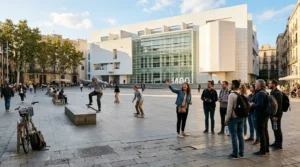
The Fundació Joan Miró is a museum and study centre that Miró set up himself. The white building, designed by his friend the architect Josep Lluís Sert, sits on the slope of Montjuic among gardens and terraces with views over the city. Inside are paintings, drawings, sculptures and large tapestries spanning his whole career, plus a sculpture terrace on the roof and temporary exhibitions by other artists.
It is the only place in Barcelona where you can follow how his style changed, from early landscapes to the bold black lines, stars, moons and birds he is known for. If you want to understand Miró rather than just spot him, this is where to go.
Practical points: tickets, opening hours, closing days and accessibility details all change, so take them from the Fundació Joan Miró official website rather than from a blog. The official site is also the right place to check step-free access and wheelchair routes through the building.
The Pla de l'Os mosaic on La Rambla
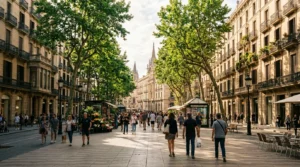
The Pla de l'Os mosaic is a large round pavement work set into La Rambla, roughly halfway down the boulevard, close to La Boqueria market and the Liceu opera house. It uses Miró's familiar primary colours, red, blue, yellow and black, in loose curving shapes. It was designed to be walked on, so it sits flush with the paving and thousands of people cross it every day.
Look for one tile that carries his signature. The best way to see the whole circle is to stand at the edge for a minute when the crowd thins, rather than trying to look down while walking.
For more on what else lines the boulevard, see our guide to what to see on La Rambla and which tours walk it.
Dona i Ocell in Parc de Joan Miró
Dona i Ocell, which means Woman and Bird, is a tall sculpture of about 22 metres rising from a shallow pool in Parc de Joan Miró. The park was once the city's slaughterhouse grounds, which is why locals also call it Parc de l'Escorxador. The sculpture is covered in broken ceramic tiles in red, yellow, blue and green, the same trencadís technique Gaudí used. The tilework was done with the ceramicist Joan Gardy Artigas. Miró did not live to see it unveiled.
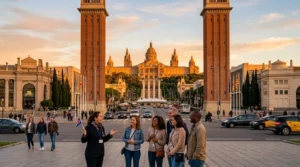
The park is a short walk from Plaça d'Espanya and the old bullring that is now the Arenas shopping centre. If you are already around Plaça d'Espanya for the Venetian towers or the Magic Fountain, it takes only a few extra minutes. Our guide to Plaça d'Espanya, its towers and the way up to Montjuic covers that area in detail.
Miró's birthplace in Passatge del Crèdit
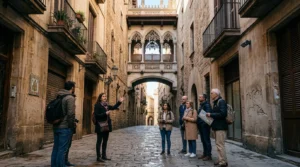
Joan Miró was born in Passatge del Crèdit, a short covered passage off Carrer de Ferran in the Gothic Quarter, a few steps from Plaça de Sant Jaume. His father was a goldsmith and watchmaker with a workshop nearby. A plaque on the building marks the spot. There is nothing to visit inside; it is a two-minute stop to stand where the story started.
The young Miró studied art in the same part of town, so this corner of the Gothic Quarter is his home ground. It is a good moment to remember that the painter of stars and birds grew up in these narrow medieval streets.
The airport mural
A large ceramic mural by Miró, also made with Joan Gardy Artigas, sits at Barcelona airport, in the Terminal 2 building. It is roughly 9 metres wide and 5 metres high. You only see it if your flight uses that terminal or you make the trip on purpose, so treat it as a bonus rather than part of a city route.
Which tours pass Joan Miró's works?
To be clear from the start: no tour on this site includes entry to the Fundació Joan Miró, and none stops there. If the museum is a priority, plan it as your own visit. What the tours do is walk the streets where the outdoor works are, which makes it easy to add a Miró stop before or after.
| Miró site | Area | Tour that passes nearby | Price and duration | Entry included? |
|---|---|---|---|---|
| Pla de l'Os mosaic | La Rambla | Barcelona Old Town Port and Boat trip | EUR 80 per person, 4h, max 15 | Free outdoor work |
| Pla de l'Os mosaic | La Rambla | Barcelona Old Town Walking tour with Tapas and Flamenco Show | EUR 105 per person, 3h, max 8 | Free outdoor work |
| Birthplace, Passatge del Crèdit | Gothic Quarter | Barcelona Old Town and Gothic Quarter Walking Tour | EUR 55 per person, 3h, max 15 | Free, plaque only |
| Pla de l'Os mosaic | La Rambla | Barcelona Old Town and Gothic Quarter Walking Tour (ends near La Boqueria) | EUR 55 per person, 3h, max 15 | Free outdoor work |
| Fundació Joan Miró | Montjuic | Barcelona Old Town, Montjuic Castle and Cable Car | EUR 95 per person, 4h, max 15 | No, the tour does not stop there |
| Fundació Joan Miró | Montjuic | Same tour with the Magic Fountain show | EUR 105 per person, 6h, max 15 | No, the tour does not stop there |
| Dona i Ocell | Near Plaça d'Espanya | None directly; a short walk from the Montjuic area | Self-guided | Free outdoor work |
| Airport mural | Terminal 2 | None | Self-guided | Free, airport access |
La Rambla: the mosaic on two walking tours
The Barcelona Old Town Port and Boat trip walks the Gothic Quarter and Las Ramblas, then takes a harbour cruise to Moll de Llevant and back. It costs EUR 80 per person, lasts 4 hours and takes up to 15 people. The mosaic sits on the stretch of La Rambla that runs down towards the port, so it fits the route naturally. The boat leg also matters for the Miró story: the mosaic was placed to greet people arriving from the sea.
The Barcelona Old Town Walking tour with Tapas and Flamenco Show walks the Gothic Quarter and La Rambla, stops at tapas bars and ends at a live flamenco show in a tablao. It costs EUR 105 per person, lasts 3 hours and takes up to 8 people. Because it is only 3 hours, it fits on the same day as a morning at the Fundació.
On either tour, the mosaic is not a scheduled stop with a talk. Ask the guide to point it out, or look for it yourself between the Liceu and La Boqueria.
The Gothic Quarter: where Miró was born
The Barcelona Old Town and Gothic Quarter Walking Tour costs EUR 55 per person, lasts 3 hours and takes up to 15 people. Its route includes Plaça de Sant Jaume, a few steps from Passatge del Crèdit, and it finishes near La Boqueria on Las Ramblas, close to the Pla de l'Os mosaic. The passage is not a fixed stop, so walk back to it on your own afterwards.
Montjuic: the hill where the Fundació stands
The Barcelona Old Town, Montjuic Castle and Cable Car tour goes up Montjuic, the hill that holds the Fundació, the castle and the Olympic area. It costs EUR 95 per person for 4 hours, or EUR 105 per person for 6 hours in the version that ends with the Magic Fountain show. Both take up to 15 people. The Magic Fountain show is run by the city council, so it is seasonal and can be paused for maintenance or wind; the rest of the tour goes ahead either way.
The tour does not enter or stop at the Fundació. What it gives you is the lie of the land: once you have seen Montjuic from the castle and the cable car, getting back to the museum on another day is straightforward.
Is the Miró museum worth it?
For most visitors with an interest in modern art, yes. The Fundació Joan Miró is the only place in Barcelona that shows his work in depth, the building itself is part of the experience, and the terraces look out over the city. It is also quieter than the big Gaudí sites, which makes it a calm half day.
It is less worth it if you have no feel for abstract art and only two days in the city. In that case the free outdoor works give you a taste of Miró in under an hour, and you can spend the museum time on the sights that drew you to Barcelona in the first place.
How long do you need at the Fundació Joan Miró?
Plan on about two hours inside for the permanent collection and the roof terrace at a steady pace. Add time for a temporary exhibition, the gardens around the building and the trip up and down the hill. A morning or an afternoon is a comfortable block.
Is it good with kids?
Miró's bright colours and simple shapes tend to work well with children, who often spot the stars, eyes and birds before adults do. The Fundació has open galleries and outdoor space, which helps with younger visitors. For family tickets, activities and any rules on pushchairs, check the Fundació Joan Miró official website. The outdoor works are easy family stops: the mosaic takes a minute, and Parc de Joan Miró has room to run around.
A self-guided Joan Miró half day
If you want all the city sites in one go, this order keeps walking and backtracking low. Times are rough guides for looking, not including travel between stops.
| Stop | What you see | Time to allow |
|---|---|---|
| Passatge del Crèdit | Birthplace plaque in the Gothic Quarter | 10 minutes |
| Pla de l'Os, La Rambla | Pavement mosaic near La Boqueria | 10 to 15 minutes |
| Parc de Joan Miró | Dona i Ocell sculpture | 20 to 30 minutes |
| Fundació Joan Miró, Montjuic | Museum, terrace and gardens | About 2 hours |
Start in the Gothic Quarter at Passatge del Crèdit, then walk a few minutes to La Rambla and the Pla de l'Os mosaic. From there take the metro towards Plaça d'Espanya and walk to Parc de Joan Miró for Dona i Ocell. Finish by going up Montjuic to the Fundació, either on foot past the Magic Fountain and the National Palace or with public transport. Check TMB, the city's transport operator, for the current lines.
You can also run it the other way round: morning at the Fundació while you are fresh, then down the hill to Dona i Ocell, and end on La Rambla and in the Gothic Quarter in the evening, perhaps on a walking tour.
Miró or Gaudí on a short trip?
They are very different experiences, and on a short trip Gaudí usually comes first. Gaudí's buildings are the city's skyline: Sagrada Familia, Casa Batlló, Casa Milà and Park Guell. Miró is a painter and sculptor, and most of his Barcelona work is either inside one museum or set into public space.
If you only have one or two days, see Gaudí as the main event and fit Miró into the gaps. The mosaic on La Rambla and Dona i Ocell cost you almost no time. With three or more days, the Fundació earns its own half day.
There is also a link between the two. Dona i Ocell is covered in trencadís, the broken-tile mosaic that Gaudí made famous, so seeing it after a Gaudí walk shows how the Catalan craft carried on. If Gaudí is on your list, the Gaudi's Modernist Legacy Walking Tour costs EUR 50 per person, lasts 3 hours and takes up to 15 people. It looks at the facades from outside; monument entry tickets are not included.
Miró or the Picasso Museum?
This depends on what you enjoy. The Picasso Museum, in the El Born area next to the Gothic Quarter, is strongest on Picasso's early years and his time in Barcelona, including work from his student days. It is inside medieval palaces on a narrow street, close to the Old Town walking routes.
The Fundació Joan Miró covers Miró's whole working life and was set up by the artist himself, so it feels more personal and complete. It is also more spacious and open, with gardens and views, but it is up on Montjuic rather than in the Old Town.
| Fundació Joan Miró | Picasso Museum | |
|---|---|---|
| Location | Montjuic hillside | El Born, beside the Gothic Quarter |
| Focus | Miró's whole career | Mostly Picasso's early years |
| Setting | Modern building, terraces, gardens | Medieval palaces on a narrow street |
| Close to which tours | Montjuic tours go up the hill, no stop | Old Town walking routes pass the area, no stop |
| Tickets | Official website | Official website |
If you can only do one, choose the Picasso Museum if you are spending your time in the Old Town and want a famous name in a short visit. Choose the Fundació if you like colour, abstraction and space, and are pairing it with Montjuic. Neither is included on any tour on this site.
Can you combine Miró with Montjuic Castle?
Yes, and it is the most natural pairing in the city. The Fundació, the cable car and Montjuic Castle all sit on the same hill, so you can visit the museum in the morning and spend the afternoon higher up.
There are two ways to do it. You can go up on your own and see the castle as well. Or you can visit the Fundació on one day and join the Montjuic Castle and Cable Car tour on another, so the guided part covers the castle, the cable car and the Old Town while the museum stays a separate, unhurried visit. Booking them on different days also avoids a long day on your feet.
Planning notes before you go
- Tickets and hours: take all museum ticket, opening and accessibility details from the Fundació Joan Miró official website. No price or opening time is given here on purpose.
- Wheelchair access: the outdoor works on La Rambla and in Parc de Joan Miró are at street level. For the museum, check the official website for step-free routes.
- Weather: the indoor galleries make the Fundació a sensible choice on a grey day, while the outdoor works are best in dry weather.
- Crowds: La Rambla is busy most of the day. The mosaic is easier to see early in the morning.
- Changing plans: every tour on this site can be cancelled free of charge, or moved to another date free of charge, up to 96 hours before it starts. Refunds go back to the original payment method within a few business days. A no-show is not refunded.
Conclusion
Joan Miró in Barcelona means one museum, three free outdoor works and the arcade where he was born. The Fundació on Montjuic needs a half day of its own, while the mosaic on La Rambla, Dona i Ocell and Passatge del Crèdit fit around a walking tour that covers the same streets.
To pair your Miró day with a guided walk of the Old Town, a harbour boat trip or Montjuic by cable car, browse all tours. If you are not sure which one fits your dates, send a message on WhatsApp or call +34 632 93 79 41, or write to [email protected].