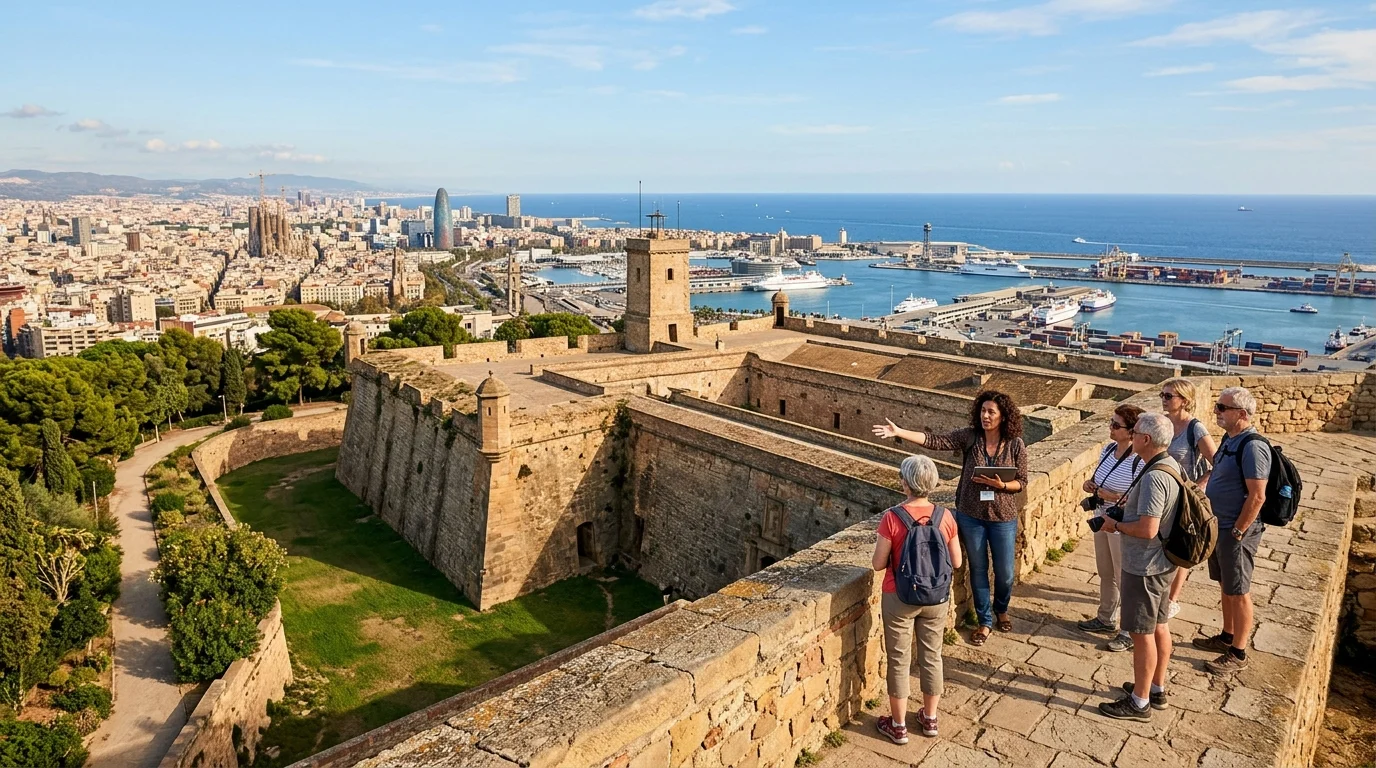
Montjuic Castle is a hilltop fortress on the south side of Barcelona, above the port. It is worth visiting for the full circle of views from its tower and walls, and for a history tied closely to the city below. Most visitors ride the funicular and then the cable car up, and allow one to two hours at the top.
Key takeaways
- Montjuic Castle (in Catalan, Castell de Montjuïc) sits at the top of Montjuic hill, between the Old Town and the port, with views over the city, the harbour and the sea.
- The usual way up is the Montjuic funicular from the Paral·lel area, then the Montjuic cable car to the castle. That leaves very little climbing on foot.
- Castle opening hours and ticket prices change by season, so check the castle's official website, run by Barcelona City Council, before you go.
- City Tour in Barcelona runs two walking tours that end at the castle: Barcelona Old Town, Montjuic Castle and Cable Car (EUR 95 per person, 4 hours) and a 6-hour version that finishes at the Magic Fountain show (EUR 105 per person).
- Both are walking tours for up to 15 people. They meet in central Barcelona and use no vehicle or hotel pick-up.
- Every tour can be cancelled or moved to another date free of charge up to 96 hours before it starts.
What is Montjuic Castle?
Montjuic Castle is a military fortress on the summit of Montjuic, the hill that rises straight out of the sea at the southern edge of central Barcelona. Seen from the port or from the end of La Rambla, it is the low line of walls on the skyline above the cranes and the cable car pylons.
Today the castle is a public space owned by the city. Visitors walk the ramparts, cross the parade ground, look down into the dry moat and climb to the tower terrace for the view. It hosts exhibitions and events through the year, but most people come for two things: the panorama and the story of the place.
The name of the hill is often written Montjuic in English and Montjuïc in Catalan. Both refer to the same place, and you will see both spellings on signs, maps and tour pages.
A short history of Montjuic Castle
The castle's history is long and, in places, dark. The outline below sticks to what is widely documented.
A fortress built to watch the city and the sea
The first fort on the summit went up in the 17th century, during the Catalan revolt known as the Reapers' War. The hill was the obvious place for it: from the top you can see every ship approaching the port and every street in the old walled city.
After the War of the Spanish Succession in the early 18th century, the old fort was rebuilt as the larger star-shaped fortress you visit now, with bastions, a deep moat and thick walls. Its guns covered the harbour, but they also pointed at Barcelona itself.
Guns turned on Barcelona
That second purpose is the part locals remember. In the 19th century the castle's artillery was used more than once to fire on the city during political uprisings. For many people in Barcelona, the fortress became a symbol of control from above rather than protection.
Prison and executions
The castle also served as a military prison for long periods, holding political prisoners across the 19th and 20th centuries. During and after the Spanish Civil War it was a place of detention and execution.
The event most often recalled is the execution of Lluís Companys, President of the Generalitat of Catalonia, who was shot inside the castle grounds in 1940. A memorial marks the spot, and it is one of the reasons the castle carries such weight in Catalan memory.
The metre, measured from Montjuic
A lighter chapter: in the 1790s the French astronomer Pierre Méchain used Montjuic as one of the survey points for measuring the meridian arc that was used to define the metre. The castle's position, high and open to the sea, made it a natural station.
From military site to public space
For much of the 20th century the castle housed a military museum. In more recent times it passed to the city and was opened as a civic and cultural space, which is how visitors find it now.
Is Montjuic Castle worth visiting?
For most visitors, yes, with one condition: go for the views and the setting, not for rich interiors. The castle is mostly open stone, walls and courtyards. If you want painted ceilings and furniture, Barcelona has better places for that.
What it does well is this:
- The view in every direction. From the tower terrace you see the port and the container docks on one side, the sea in front, and the whole grid of the city running back towards the hills on the other.
- The sense of place. Standing on the walls, you understand why the fortress was built here and why the city below had reason to fear it.
- The way up. The funicular and cable car ride is part of the visit, with the harbour opening up under the cabin.
- The space. Compared with the busiest Gaudi sites, the castle grounds feel open, with room to walk and take photos.
It suits people who like viewpoints, history and photography. It is less suited to visitors with only one day in Barcelona who have not yet seen Sagrada Familia or the Gothic Quarter.
Montjuic Castle or Park Guell for views?
Both give a wide view over Barcelona, but they are different visits.
| Montjuic Castle | Park Guell | |
|---|---|---|
| Where it sits | Summit of Montjuic, above the port | Hillside above the Gracia district |
| What you look at | Port, open sea, Old Town and the whole city grid | Rooftops, Sagrada Familia and the sea in the distance |
| What else you see | Fortress walls, moat, tower terrace | Gaudi's mosaic terrace, buildings and paths |
| How you get up | Funicular and cable car, with short walks | Steep streets or escalators, then walking inside the park |
| Mood | Open, quiet, historical | Busy, colourful, architectural |
If you can only do one, Park Guell is the Gaudi visit and Montjuic Castle is the view of the sea and port. Many visitors do both on different days.
How do you get to Montjuic Castle?
There are three common ways up the hill.
Funicular, then cable car
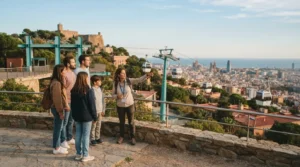
This is the route most visitors take. The Montjuic funicular is an underground railway that starts near Paral·lel and climbs inside the hill to a station in the Montjuic parkland. From there, the Montjuic cable car carries you higher, in small cabins, up to the castle.
The funicular is quick and enclosed. The cable car is the slower, more scenic leg, with the city and harbour spreading out below. Together they do almost all of the climbing.
Cable car or funicular: which matters more?
They are two legs of the same journey, not alternatives. The funicular gets you up the lower, steeper part of the hill. The cable car covers the upper part and is where the views are. If you are deciding where to spend your time, the cable car is the one to ride both ways in good weather.
For a closer look at how different tour routes use the cable car, see our guide on how to choose a Montjuic cable car tour route.
Can you walk up to Montjuic Castle?
Yes. Footpaths and stairways climb through the parks on the hill, and some visitors walk up from the Poble-sec side or along the slope above the port. It is a steady uphill walk with little shade in places, so it suits fit walkers on a cool day more than anyone short on time or energy. City buses also run up the hill.
How long do you need at Montjuic Castle?
Allow one to two hours at the castle itself. That gives time to walk the ramparts, look into the moat, climb to the tower terrace and take your photos without rushing.
Add the time to get there and back. With the funicular and cable car, plus a short walk at each end, the trip from the Old Town up to the castle and back takes a large part of a half day. That is why the castle fits well into a half-day walking route that starts in the centre of Barcelona.
Visiting Montjuic Castle with a guided walking tour
City Tour in Barcelona runs two walking tours that combine the Old Town with Montjuic Castle. Both meet in central Barcelona and travel on foot, by funicular and by cable car, with no vehicle and no hotel pick-up. Both are priced per person, with a maximum of 15 people.
What the walk adds before you go up the hill
Most castle guides start at the funicular. These tours start lower down, so you see the streets the fortress was built to watch. The day version follows this route:
- Las Ramblas, the long promenade through the Old Town, where the tour opens.
- La Boqueria Market, a brief stop at the entrance as you pass.
- Gran Teatre del Liceu, the opera house facade on La Rambla.
- Palau Güell, an early Gaudi building on a narrow street just off Las Ramblas.
- El Raval, a mixed, lived-in neighbourhood that shows a different side of the Old Town from the Gothic Quarter.
- Montjuic funicular, the first leg up the hill.
- Montjuic cable car, the second leg, with the harbour below.
- Montjuic Castle, time at the fortress on the summit.
- Castle tower, for the 360-degree view over the city and the sea.
- Cable car back down, which closes the tour.
The order matters. You walk the Old Town first, then see the same streets from the tower an hour or two later, which makes the view far easier to read. Your guide can point out La Rambla, the port and the Raval rooftops you have just walked.
The 4-hour day tour or the 6-hour Magic Fountain tour?
The two versions share the Old Town walk, the funicular, the cable car and the castle. The longer one carries on into the evening.
| Barcelona Old Town, Montjuic Castle and Cable Car | Barcelona Old Town, Montjuic Castle, Cable Car and Magic Fountain show | |
|---|---|---|
| Price | EUR 95 per person | EUR 105 per person |
| Duration | 4 hours | 6 hours |
| Maximum group | 15 people | 15 people |
| Format | Walking tour, meets in central Barcelona | Walking tour, meets in central Barcelona |
| Extra stops | None beyond the castle and tower | Botero's Cat in El Raval, Olympic Stadium and Palau Sant Jordi |
| What ends the tour | Cable car ride back down | Magic Fountain evening show |
The 4-hour Montjuic Castle and cable car tour suits visitors who want the castle and the Old Town in one half day, with the evening free. The 6-hour version with the Magic Fountain show suits those who want to stay on the hill into the evening and see the fountain's water, light and music show at the foot of Montjuic.
What if the Magic Fountain show is not running?
The Magic Fountain show that ends the EUR 105 tour is run by the city council, not by the tour. It is seasonal, and it can be paused for maintenance or because of wind. If the show is not on for your date, the rest of the tour goes ahead: the Old Town walk, the funicular, the cable car, the castle and the Olympic stops.
If the fountain is the main reason you are booking, check the city's published fountain schedule for your dates, and consider the 4-hour tour if the show is not running in that period. Our article on a Barcelona night tour with tapas, flamenco and the Magic Fountain compares the evening options.
What is included, and what to check separately
Both tours include a local guide and the walking route described above, with the funicular and cable car ride as part of the way up. For castle admission and cable car or funicular tickets, check the tour page and your booking details before you travel, and do not assume a ticket is covered unless your booking says so. Food and drinks are not part of the 4-hour tour, so bring water, especially in summer.
Montjuic Castle on your own or with a guided half day?
You can visit the castle independently. It is a straightforward trip if you are comfortable with public transport and have time to plan around the castle's hours.
| On your own | Guided walking tour | |
|---|---|---|
| Who it suits | Independent travellers with time to plan | Visitors who want the Old Town and the castle in one route |
| Getting up | You plan the funicular, cable car, walk or bus | The guide leads the group up the hill |
| Old Town context | Only if you walk it yourself | Las Ramblas, La Boqueria, the Liceu, Palau Güell and El Raval first |
| History | Signs and your own reading | Explained on the walls and the tower |
| Planning load | Hours, tickets, transport and timing are yours | Meet, walk, ride and listen |
The independent option gives you full control over pace. The guided option is useful if this is your first time in Barcelona and you want the castle explained in the context of the streets you have just walked.
Is Montjuic Castle easy for seniors and families?
It is easier than many people expect. The funicular and cable car do almost all of the climbing, so the walking is mostly level ground around the castle grounds, plus the steps up to the tower terrace. The Old Town section is on flat streets.
For older travellers, the main effort on the 4-hour tour is time on your feet rather than hills. Wear comfortable shoes, bring a hat in summer, and tell the team about any mobility concerns before you book. Our guide to Barcelona tours for seniors compares formats that keep the walking down.
For families, the cable car ride is usually the part children remember, and the fortress walls and moat give them space to look around. The 6-hour evening version is a long day for small children, so the 4-hour version is often the better fit for families with young kids.
When is the best time to visit Montjuic Castle?
- Clear days give the widest view, with the sea and the line of the coast sharp on the horizon. The port and rooftops still look good under cloud.
- Windy days matter on Montjuic. Strong wind can affect the cable car and can pause the Magic Fountain show, so check the forecast the day before.
- Summer afternoons are hot on the open walls, with little shade. Bring water and sun cover.
- Late afternoon light is warm over the port and the city, which is one reason the 6-hour version heads into the evening.
If the forecast looks poor, you can cancel or move your tour to another date free of charge up to 96 hours before it starts. Refunds go back to the original payment method within a few business days. A no-show is not refunded.
How Montjuic Castle fits a Barcelona itinerary
The castle is a good half-day plan once the main Gaudi sights are covered.
- Two days in Barcelona: put Sagrada Familia and Park Guell on day one and the Gothic Quarter on day two. Add Montjuic Castle only if day two has a free afternoon.
- Three days: a Gaudi day, a day trip out of the city, then an Old Town and Montjuic day works well. Our three-day Barcelona itinerary lays out that pattern.
- Four days or more: give Montjuic its own afternoon, or take the 6-hour version and end the day at the fountain.
Practical notes before you go
- Check the castle's hours and prices on its official website, run by Barcelona City Council. They change by season and for events.
- Wear good shoes. The castle grounds are stone and gravel, and the tower involves steps.
- Bring water and sun protection. The walls are exposed, and summer heat on the hill is strong.
- Watch the wind. Cable cars and the fountain show can both be affected.
- Know the price basis. Both Montjuic walking tours are priced per person. Walking tours in central Barcelona range from EUR 50 to 135 per person.
Conclusion
Montjuic Castle rewards a visit with wide views over the port, the sea and the city, and with a history that explains a good deal about Barcelona. Ride the funicular and cable car up, allow one to two hours at the top, and check the official castle website for hours before you go. If you would like a guide to connect the Old Town streets with the view from the tower, see the two Montjuic tour pages linked above, or message us on WhatsApp at +34 632 93 79 41 to ask about dates.