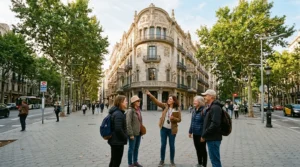
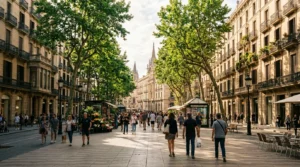
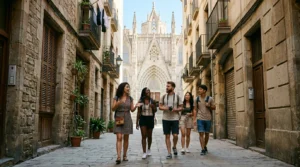
Passeig de Gràcia is the wide Eixample avenue running from Plaça de Catalunya to Avinguda Diagonal. It is famous for Modernista buildings: Gaudí's Casa Batlló and Casa Milà (La Pedrera), Casa Amatller, Casa Lleó i Morera, plus the hexagonal pavement tiles and lamp-benches. You can see it all from the street, free, in about an hour.
Key takeaways
- Passeig de Gràcia links the old city at Plaça de Catalunya with the former village of Gràcia, and the best stretch for architecture sits between Gran Via and Diagonal.
- The four houses most people come for are Casa Lleó i Morera, Casa Amatller, Casa Batlló and Casa Milà. The first three stand on one block, often called the Block of Discord.
- Every facade can be seen from the pavement without a ticket. Interiors need separate tickets, which no tour on this site includes.
- Walking the avenue end to end at an easy pace with stops for photos takes roughly an hour. Without stops it is a short walk.
- Gaudi's Modernist Legacy Walking Tour (€50 per person, 3h, max 15) walks the avenue with a guide. Several hotel pick-up tours pass along it by vehicle instead.
- The avenue is flat, wide and lined with benches, which makes it one of the easiest walks in central Barcelona.
What is Passeig de Gràcia famous for?
Passeig de Gràcia is famous for one thing above all: the densest run of Modernista architecture in Barcelona, set along a broad, tree-lined avenue that the city built as its showpiece street. When the medieval walls came down in the 19th century and the Eixample grid was laid out, the old road to the village of Gràcia became the address that wealthy families wanted. They commissioned the leading architects of the day to outdo one another, and the results still line the pavement.
Today it is also a shopping street, with fashion brands and design shops on the ground floors. Above the shop windows, the balconies, carved stone and mosaics are what make the walk worth doing.
Three architects dominate. Antoni Gaudí designed Casa Batlló and Casa Milà. Lluís Domènech i Montaner, the architect of the Palau de la Música Catalana and Hospital de Sant Pau, designed Casa Lleó i Morera. Josep Puig i Cadafalch designed Casa Amatller. Seeing their work a few doors apart shows that Modernisme was a shared movement.
How long does it take to walk Passeig de Gràcia?
The avenue is a little over a kilometre long between Plaça de Catalunya and Diagonal, so the walk itself is short. What takes time is stopping. A realistic plan looks like this:
- A quick look: walk straight up from Plaça de Catalunya to Casa Milà, pausing at the main facades. Allow around 30 minutes.
- An easy hour: the same route with time to read each facade, cross the road for the better views and take photos. This suits most first-time visitors.
- A half day: add a ticketed visit inside one house, a coffee and some shopping. Plan this around your interior ticket time, since the slot fixes your day.
If you only have a short window, do the stretch between Gran Via and Carrer de Provença. That covers all four headline houses.
A walking route, block by block
The most logical direction is uphill, from Plaça de Catalunya towards Diagonal. The slope is gentle, the buildings appear in a sensible order, and you finish near the metro at Diagonal.
Plaça de Catalunya to Gran Via
Start at Plaça de Catalunya, where the old city ends and the Eixample begins. The first block is mostly commercial, but notice the width of the avenue: central lanes, side lanes and generous pavements. It was designed as a promenade and still works as one.
As you cross Gran Via de les Corts Catalanes, you are entering the core stretch. The three houses of the Block of Discord stand together on one side of the avenue, and Casa Milà stands on the other side further up, so you will cross at least once.
The Block of Discord: between Consell de Cent and Aragó
This single block, between Carrer del Consell de Cent and Carrer d'Aragó, is the reason many people come to Passeig de Gràcia at all. Three of the most famous Modernista houses stand within a few steps of each other. The name plays on a Catalan pun: the word for a city block and the word for apple are the same (mançana), a nod to the golden apple of discord in Greek myth, with three architects competing for attention.
Casa Lleó i Morera comes first, on the corner of Consell de Cent. Domènech i Montaner's remodelling gave it rounded corner balconies, sculpted floral stonework and rich stained glass. From the street, look up at the corner tower and the carved figures around the windows.
Casa Amatller stands a few doors up. Puig i Cadafalch gave it a stepped gable that recalls northern European town houses, covered in tiles that catch the light. The ground floor and the carved doorway reward a close look.
Casa Batlló is next door. Gaudí reworked an existing building into one of the most recognisable facades in the world: a roof that looks like a dragon's back, balconies often compared to masks or bones, and a front covered in broken ceramic and coloured glass that shifts in tone as the light changes. You can see the whole facade from the opposite pavement, which is the best place to stand.
For photos, cross to the opposite pavement. From there you can frame Casa Amatller and Casa Batlló together and see how different two neighbouring houses can be.
Aragó to Provença: towards La Pedrera
Between Aragó and Provença, look down rather than up.
The pavement is covered in grey hexagonal tiles with sea motifs, such as starfish, shells and seaweed. The design is credited to Gaudí, and the tiles have become a symbol of the avenue. Further along you will also notice the lamp-benches designed by the architect Pere Falqués: curving stone benches covered in broken tile mosaic, each topped by an ornate wrought-iron street lamp. They were made for this avenue, they are still used every day, and they are the best place to sit for five minutes and watch the street.
Casa Milà (La Pedrera) at Provença
Casa Milà stands on the corner of Carrer de Provença. Gaudí's apartment building is known as La Pedrera, the stone quarry, because its undulating stone front looks carved rather than built. There are no straight lines on the facade, and the wrought-iron balconies look like tangled seaweed. From the street you can also glimpse the rooftop chimneys and ventilation towers, which look like helmeted figures.
The best view is from the opposite corner, diagonally across the junction, where you can see both curving fronts at once.
Provença to Diagonal
The final stretch to Avinguda Diagonal has more shops and fewer headline buildings. Beyond Diagonal the streets narrow as you enter Gràcia, the former village that gave the avenue its name.
What you see from the street without a ticket
A common question is whether you need to go inside anything. You do not. The whole avenue is a public street, and the facades are its main attraction. Here is what the pavement gives you at each house:
| Building | Architect | What you see from the street | Inside |
|---|---|---|---|
| Casa Lleó i Morera | Lluís Domènech i Montaner | Rounded corner balconies, carved floral stonework, stained glass | Separate ticket, not on any tour here |
| Casa Amatller | Josep Puig i Cadafalch | Stepped gable, glazed tiles, carved doorway | Separate ticket, not on any tour here |
| Casa Batlló | Antoni Gaudí | Dragon-back roof, mask-like balconies, mosaic facade | Separate ticket, not on any tour here |
| Casa Milà (La Pedrera) | Antoni Gaudí | Rippling stone front, iron balconies, rooftop chimneys glimpsed from below | Separate ticket, not on any tour here |
| Pavement tiles | Design credited to Gaudí | Hexagonal sea-motif tiles along the pavement | Always free |
| Lamp-benches | Pere Falqués | Mosaic benches with wrought-iron lamps | Always free |
If you want to go inside one of the Gaudí houses, the two visits are quite different. Casa Batlló is a family home with a light well and a famous main floor, while Casa Milà is a full apartment building with a rooftop terrace and an attic exhibition. The comparison is set out in Casa Batlló or Casa Milà: which Gaudí house to visit. For ticket times and opening days, check each house's official website before you go.
Which tours walk Passeig de Gràcia, and which drive past?
The avenue appears on most Barcelona city tours on this site, but not always in the same way. Some walk it with a guide, others pass along it in the air-conditioned vehicle. That matters if seeing the facades up close is your priority.
| Tour | Price and basis | Duration and group | On Passeig de Gràcia | House interiors included? |
|---|---|---|---|---|
| Gaudi's Modernist Legacy Walking Tour | €50 per person | 3h, max 15 | Walked with the guide, facades seen from outside | No, monument entry tickets not included |
| Barcelona Highlights and Gothic Quarter | €115 per person | 5h, max 8, hotel pick-up | Passed by vehicle, Casa Batlló and La Pedrera | No |
| Barcelona Highlights and Sagrada Familia Guided Exterior Half Day Tour | €124 per person | 5h, max 8, hotel pick-up | Casa Batlló and La Pedrera seen from the street | No |
| Barcelona Highlights and Sagrada Familia Half Day Tour | €150 per person | 5h, max 8, hotel pick-up | Passed by vehicle, all four houses | No |
| Best of Barcelona | €175 per person | 8h, max 18, hotel pick-up | Walked section | No |
| Barcelona in One Day | €195 per person | 8h, max 18, hotel pick-up | Passed along, Casa Batlló and Casa Milà seen from the street | No |
| Essence of Barcelona | €549 per group of up to 6 | 5h, private | Passed by vehicle | No |
Walking and small-group pick-up tours are priced per person, and the private tour is priced for the whole group of up to 6, so the figures in that table are not on the same basis.
The walking option
Gaudi's Modernist Legacy Walking Tour is the one built around this avenue. It starts in the Eixample and traces Gaudí's career in order along Passeig de Gràcia: Casa Lleó i Morera, Casa Amatller and Casa Batlló on the Block of Discord, then Casa Milà, then on to Puig i Cadafalch's turreted Casa de les Punxes, and it finishes in view of the Sagrada Familia towers. It meets in central Barcelona and uses no vehicle, with no hotel pick-up. The tour covers the facades from outside, and monument entry tickets are not included, so it pairs well with a ticketed interior visit booked separately on the same day or another.
The vehicle options
The half-day hotel pick-up tours use Passeig de Gràcia as one part of a wider route that also covers Montjuïc, the waterfront and the Gothic Quarter. On Barcelona Highlights and Gothic Quarter, the vehicle passes Casa Batlló and La Pedrera and the tour ends at Hospital de Sant Pau, with no Sagrada Familia stop. On the €150 half day, the vehicle passes all four houses on its way to the Sagrada Familia, where the ticket is included subject to availability. The €124 tour visits the Sagrada Familia exterior only.
On the full-day tours, the avenue is one stop among many. Best of Barcelona walks the Passeig de Gràcia section and includes skip-the-line Park Güell entry. Barcelona in One Day also includes skip-the-line Park Güell entry and a Sagrada Familia ticket, subject to availability.
If your main interest is the architecture, choose the walking tour. If you want the avenue as part of a broader first look at Barcelona with transport handled, a pick-up tour fits better.
Passeig de Gràcia or La Rambla: which should you walk?
They are often confused because both start at Plaça de Catalunya, but they go in opposite directions and feel completely different.
Passeig de Gràcia runs uphill into the Eixample. It is wide, orderly and built on a grid, with Modernista facades, high-end shops and plenty of space on the pavement. You come here for architecture.
La Rambla runs downhill through the old city to the port. It is narrower and busier, with a central pedestrian promenade, the Boqueria market, the Liceu opera house and side streets leading into the Gothic Quarter and El Raval. You come here for street life and the old town. For that walk, see La Rambla Barcelona: what to see and which tours walk it.
If you have time for both, walk down La Rambla in the morning, then return to Plaça de Catalunya and walk up Passeig de Gràcia in the afternoon. Together they show the medieval city and the planned city side by side.
Is Passeig de Gràcia worth visiting at night?
Yes, though the experience changes. After dark the shops light up, the lamp-benches and street lamps glow, and some of the facades are lit, which gives Casa Batlló in particular a different look from the daytime. The pavements stay busy into the evening and the avenue feels comfortable to walk.
What you lose at night is detail: mosaic colours and stone carving read far better in daylight. See the facades properly by day and come back for a short evening stroll if you are staying nearby.
Best time of day for light and crowds
The busiest moments are usually around midday and the late afternoon, when shoppers and tour groups overlap in front of Casa Batlló. Early morning is calmer, and the pavement in front of the Block of Discord is easier to stand on.
For light, each house is best seen from across the avenue rather than from directly beneath it, and the stone and tiles look warmest in the later part of the day. Overcast days are not a loss: the mosaics on Casa Batlló show their colours well in soft light, and you will not be squinting into the sun.
In summer, the plane trees give useful shade, but carry water.
Is Passeig de Gràcia easy for older visitors and slow walkers?
It is one of the easiest walks in central Barcelona. The avenue is flat or gently sloping, the pavements are wide and smooth, and the lamp-benches give you a seat every short distance. Crossings are at signalled junctions, and you can stop the walk at any point and pick up the metro.
For visitors who want the sights with less walking overall, a hotel pick-up tour that passes the avenue by vehicle can make sense, since the vehicle handles the longer distances. Options for that are compared in Barcelona tours for seniors: less walking, same sights.
Getting there and moving along the avenue
Metro stations sit at both ends and in the middle. Passeig de Gràcia station, near the Block of Discord, is served by several lines, and Diagonal station sits near the top of the avenue close to Casa Milà. Plaça de Catalunya, at the bottom, is a hub for metro and regional trains. For current lines and service times, check the official TMB (Transports Metropolitans de Barcelona) website.
Walking from the Gothic Quarter takes you straight up through Plaça de Catalunya. From the Sagrada Familia, the walk to Casa Milà runs across the Eixample grid; the wider district and a longer walking route through it are covered in Eixample Barcelona: the grid, the houses and a walking route.
Practical notes before you go
- Pickpockets: like any busy shopping street, keep bags closed and phones in hand, especially in the crowd in front of Casa Batlló.
- Shoes: the walk is easy, but if you add the Gaudí walking tour you will be on your feet for 3 hours, so wear comfortable shoes.
- Interior tickets: if you want to go inside Casa Batlló or Casa Milà, book a time slot directly with the house in advance, and build the rest of the day around it.
- Cancelling a tour: every Barcelona tour on this site can be cancelled free of charge, or moved to another date for free, up to 96 hours before it starts. Refunds go back to the original payment method within a few business days. A no-show is not refunded.
Conclusion
Passeig de Gràcia rewards a slow walk more than a ticket. Start at Plaça de Catalunya, walk up to the Block of Discord, cross over for the views of Casa Amatller and Casa Batlló, look down at the tiles and sit on a lamp-bench, then finish at Casa Milà. Do it on your own in an hour, or with a guide who explains how each house fits Gaudí's career and the movement around him.
To walk it with a guide or add it to a wider day with hotel pick-up, browse all tours and pick the format that suits you. For questions before booking, call or message City Tour in Barcelona on WhatsApp at +34 632 93 79 41, or email [email protected].