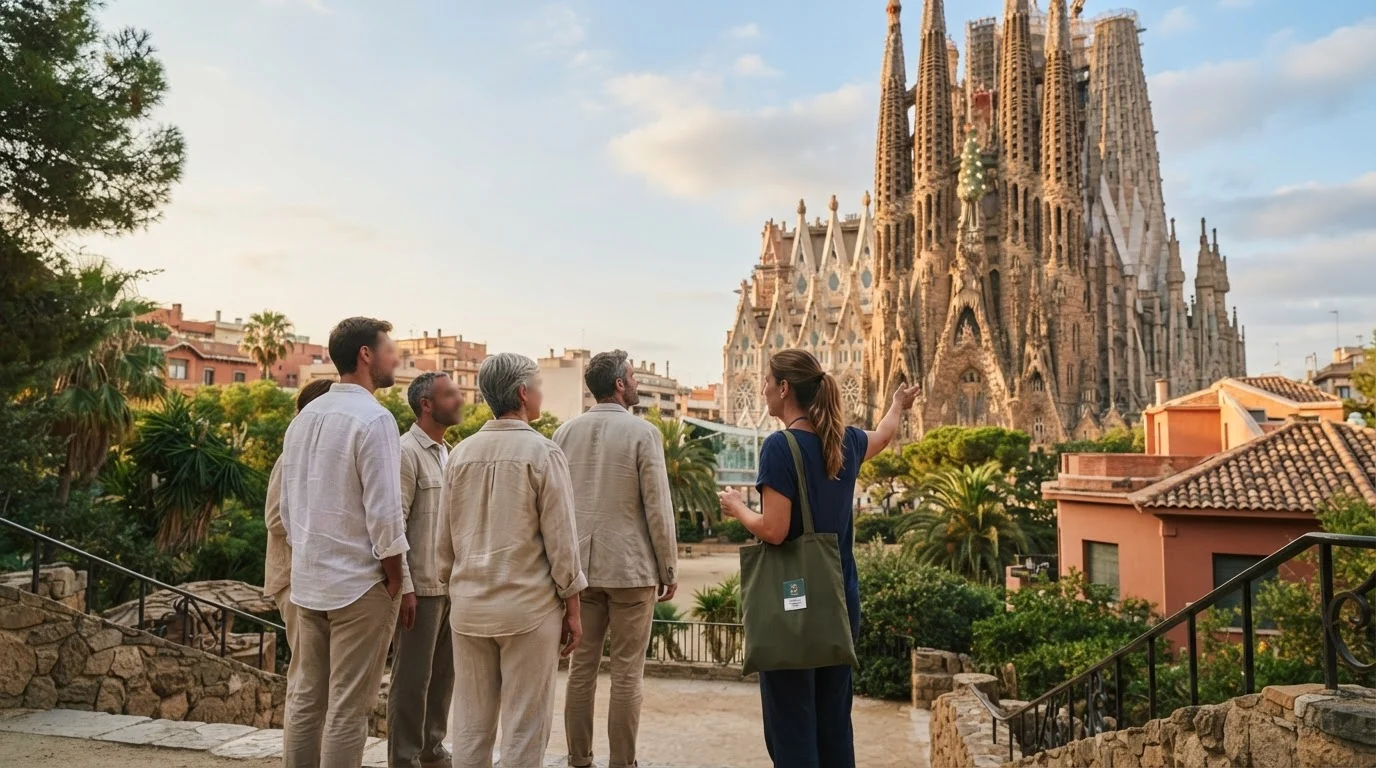
The Sagrada Familia museum sits in the semi-basement of the basilica, below the Passion facade. It holds Gaudí's plaster models, drawings and photographs, a working model workshop and a view down into the crypt where Gaudí is buried. Most visitors reach it at the end of the basilica visit. Allow 30 to 45 minutes for it.
Key takeaways
- The Sagrada Familia museum is under the basilica, on the Passion facade side. It covers how the building was designed and built, from Gaudí's first plans to the work still going on.
- Highlights include plaster models, a reconstruction of Gaudí's hanging-chain model, surviving drawings and a glass-walled workshop where model makers still work.
- From the museum you can look down into the crypt, where Gaudí's tomb lies in the Chapel of Our Lady of Mount Carmel.
- The Sagrada Familia Schools (Escoles) are a small brick building on the same site, designed by Gaudí in 1909 for the children of the workers.
- Standard basilica tickets have generally covered the museum as part of the visit route, but the official Sagrada Familia website is the place to confirm what your ticket includes.
- Four City Tour in Barcelona tours include a Sagrada Familia ticket, always subject to availability: the EUR 150 half day, the EUR 195 Barcelona in One Day, and the private EUR 849 and EUR 879 tours, priced per group of up to 6.
What is the Sagrada Familia museum?
The Sagrada Familia museum is the exhibition space under the basilica. It tells the story of the building's design and construction. The nave shows the finished result. The museum shows how Antoni Gaudí got there, and how the architects who came after him have carried on from the material he left.
It occupies the semi-basement on the Passion facade side of the building, and it has been open to visitors since the early 1960s. In Spanish, people search for it as the "museo de la Sagrada Familia". In Catalan it is the "museu". It is not a separate building, and it does not have its own street entrance for general visitors. For most people it is the last part of the basilica visit.
The museum is not a large art gallery. It is a working record of a building site that has run since 1882, and it makes most sense after you have stood in the nave and seen the columns and vaults that the models describe.
What does the museum show?
The displays cover four main themes.
Plaster models. Gaudí designed in three dimensions. He worked through his ideas in plaster at different scales, from whole facades down to single windows and column capitals. Many originals were broken when the workshop was attacked and set on fire in 1936, during the Spanish Civil War. The fragments were later collected and pieced back together, and several of those restored models are on display.
The hanging-chain model. One of the best-known displays is a reproduction of the polyfunicular model Gaudí used for the church at Colònia Güell. Strings and small weights hang from a frame. Turned upside down, the shapes they form give the lines of arches and vaults that stand in pure compression. The model explains why the columns in the Sagrada Familia nave lean and branch like trees, rather than standing straight with buttresses outside.
Drawings and photographs. Few of Gaudí's own drawings survived the 1936 fire, so the surviving sheets, and the early photographs of the site, carry a lot of weight. Panels show the building at different stages, which helps you see how much was finished in Gaudí's lifetime (mainly the crypt, the apse walls and much of the Nativity facade) and how much came later.
The model workshop. Part of the museum looks into a workshop where model makers still work in plaster for the current construction. You watch through glass. On a weekday you may see people at the benches. On other days it may be quiet. This is a working space, not a show, so what you see varies.
Can you see Gaudí's tomb from the museum?
Yes. The museum has a viewing point over the crypt below the apse. From there you look down into the crypt and can see the Chapel of Our Lady of Mount Carmel, where Gaudí is buried. It is a short stop, usually a minute or two, but many visitors find it the most moving part of the museum.
The Sagrada Familia crypt: where is Gaudí buried?
Gaudí is buried in the crypt of the Sagrada Familia, in the Chapel of Our Lady of Mount Carmel. He died on 10 June 1926, three days after a tram hit him on the Gran Via. He was buried in the crypt of the church he had worked on for more than four decades. 2026 marks one hundred years since his death. The post on the Gaudí centenary and what it means for Sagrada Familia and Park Guell visits covers what that anniversary means for a visit this year.
The crypt is the oldest part of the building. Work began in 1882 to a neo-Gothic design by the architect Francisco de Paula del Villar. Gaudí took over the project in 1883 and changed the crypt as it went up, raising the vault and adding a moat around it to bring in light and air. It was finished in the late 1880s. Together with the Nativity facade, the crypt is part of the UNESCO World Heritage listing for Gaudí's works.
Can you go inside the crypt?
The crypt is also a working parish church. Most visitors see it from the museum viewpoint rather than walking through it, because entry into the crypt itself has generally been tied to religious services held there. The rules are set by the basilica and can change. If standing at Gaudí's tomb matters to you, check the official Sagrada Familia website for current crypt access before your visit.
What are the Sagrada Familia Schools (Escoles)?
The Sagrada Familia Schools, known in Catalan as "Escoles de la Sagrada Familia" and in Spanish as "Escuelas", are a small single-storey building on the same block as the basilica. Gaudí designed them in 1909 as a school for the children of the men working on the church, and for other children from the neighbourhood.
The building was meant to be temporary and cheap, but it is among the cleverest things Gaudí built. Its walls and roof are made of thin layers of Catalan brick laid in waves. The roof undulates so that rain runs off, and the curves make thin brick strong without heavy beams. The architect Le Corbusier sketched it when he visited Barcelona, and architecture students still study it.
Like the workshop, the Escoles were burned in 1936 and rebuilt afterwards. In 2002 the building was taken down and rebuilt in its present position on the site, to make room for the construction. Today it holds a small exhibition about the school and Gaudí's way of teaching and working. It also includes a reconstruction of a classroom.
When people search for "escola Sagrada Familia" they sometimes mean this building, and sometimes one of the present-day schools in the Sagrada Familia neighbourhood with similar names. The one on the basilica site is the Gaudí building. It is usually seen as part of a basilica visit rather than on its own.
Is the Sagrada Familia museum included in the ticket?
Standard basilica tickets have generally included the museum. The visit route usually ends by passing through it, so you do not buy a separate museum ticket. The Escoles have generally been part of the same visit too.
Ticket types, and what each one covers, are set by the basilica and change from time to time. A tower visit, for example, is a different product from a basic entry. The safe rule is simple: before you visit, check the official Sagrada Familia website for what your ticket type includes. City Tour in Barcelona does not sell separate museum or tower tickets. What the tours include is listed below.
The question of whether to buy a ticket yourself or take a tour with one is covered in a separate guide: Sagrada Familia tickets, buying direct or choosing a tour.
How long should you allow for the Sagrada Familia and its museum?
There are no fixed times. The figures below are a practical guide for a relaxed visit, not official limits.
- Basilica interior: around an hour gives you time for the nave, the stained glass and both facades from inside.
- Museum: 30 to 45 minutes if you read the panels and stop at the crypt viewpoint. Twenty minutes if you walk through.
- Escoles: 10 to 15 minutes. It is a small building.
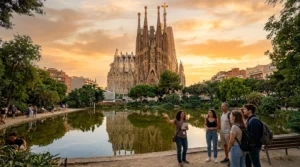
- Outside: another 15 to 20 minutes for the Nativity and Passion facades from the street. Add more if you want the reflection view from the pond in Plaça de Gaudí.
In total, a visitor who wants the museum and the Escoles as well as the nave should think in terms of about two hours on site. Time slots, security checks and how busy the day is will all change that. For the best view of the Nativity facade across the water, see the guide to Plaça de Gaudí and its Sagrada Familia view.
Does a guided tour leave time for the museum?
The guided part of a tour focuses on the facades and the nave, where most of the story is told. Because the museum usually comes at the end of the visit route, visitors on a tour often pass through it as they leave. How long you can linger there depends on the tour's schedule for the day. If the museum matters to you, tell your guide at the start. On a private tour, where the timing is set around your group, it is easier to plan for it.
Which City Tour in Barcelona tours include a Sagrada Familia ticket?
Four tours include a Sagrada Familia ticket. The ticket is always subject to availability. A fifth tour visits the basilica from outside only.
| Tour | Format | Duration | Price | Sagrada Familia |
|---|---|---|---|---|
| Barcelona Highlights and Sagrada Familia Guided Exterior Half Day Tour | Small group with hotel pick-up, max 8 | 5h | EUR 124 per person | Guided exterior visit only, interior ticket not included |
| Barcelona Highlights and Sagrada Familia Half Day Tour | Small group with hotel pick-up, max 8 | 5h | EUR 150 per person | Ticket included, subject to availability |
| Barcelona in One Day | Small group with hotel pick-up, max 18 | 8h | EUR 195 per person | Ticket included, subject to availability, plus skip-the-line Park Guell |
| Private Montserrat and Barcelona tour | Private, vehicle and guide for your group | 10h | EUR 849 per group of up to 6 | Ticket included, subject to availability |
| Private Barcelona in One Day | Private, vehicle and guide for your group | 8h | EUR 879 per group of up to 6 | Ticket included, subject to availability, plus skip-the-line Park Guell |
The half day with a ticket
The Barcelona Highlights and Sagrada Familia Half Day Tour costs EUR 150 per person. It takes 5 hours, with hotel pick-up and drop-off in an air-conditioned vehicle, and a maximum of 8 people. It goes through Montjuic, the waterfront, the Gothic Quarter and Passeig de Gràcia before it ends at the Sagrada Familia with the ticket included, subject to availability. It suits visitors who want the basilica and a first look at the city in one morning or afternoon.
The full day with a ticket
The full-day Barcelona in One Day tour with Sagrada Familia, Park Guell and the Old Town costs EUR 195 per person. It runs for 8 hours with hotel pick-up and up to 18 people. It includes a Sagrada Familia ticket, subject to availability, and skip-the-line entry to Park Guell. If you want Gaudí's basilica and his park on the same day, this is the shared option.
The two private tours
Two private tours include a Sagrada Familia ticket, subject to availability. Both are priced per group of up to 6, not per person:
- Private Montserrat and Barcelona: EUR 849 for the whole group, 10 hours. It combines the mountain monastery of Montserrat with Barcelona and the basilica.
- Private Barcelona in One Day: EUR 879 for the whole group, 8 hours. It includes skip-the-line Park Guell as well. Shared by a group of 6, EUR 879 works out at EUR 146.50 each.
Private tours collect you from your hotel in a vehicle for your group only. The timing is built around your group, so there is more room to ask for extra minutes in the museum. For a closer look at the private routes, read the guide to private Sagrada Familia tours with tickets.
The exterior-only tour
The Barcelona Highlights and Sagrada Familia Guided Exterior Half Day Tour costs EUR 124 per person. It covers the Sagrada Familia from outside, with a guide explaining the facades. The interior ticket is not included, so the museum, the crypt viewpoint and the Escoles are not part of it. It fits visitors who have been inside before, or who prefer to spend their time on the city. The comparison between the two approaches is set out in Sagrada Familia inside or outside: which tour to book.
What happens if Sagrada Familia tickets sell out?
Sagrada Familia tickets are sold by the basilica with timed entry, and on busy dates they sell out. That is why the ticket on every tour above is always subject to availability.
If tickets are not available for your date, the four tours that include a ticket still go ahead. You get a guided exterior visit of the Sagrada Familia instead, and EUR 26 per person is refunded for the unused ticket. In that case the museum, the crypt viewpoint and the Escoles would not be part of the day, since they are inside the visit area.
The best way to reduce that risk is to book early, especially between spring and early autumn and around holidays. Every Barcelona tour can be cancelled or moved to a new date free of charge up to 96 hours before it starts. Booking early therefore costs you little flexibility.
Practical tips for visiting the museum and crypt
Visit the nave first. The museum makes much more sense once you have seen the columns and vaults it explains. The usual route already works this way.
Look for the hanging-chain model. It is the single display that explains the most about the building. Spend a few minutes with it and the leaning columns in the nave will make sense.
Do not skip the crypt viewpoint. It is easy to walk past. Look for the window over the crypt near the end of the museum.
Check the workshop. Model makers are not always there, but when they are, it is a rare chance to see the building still being designed.
Find the Escoles on your way out. The building is small and sits on the edge of the site. Ask your guide to point it out if you are on a tour.
Dress for a church. The Sagrada Familia is a consecrated basilica, so cover shoulders and avoid very short clothing. The crypt is a parish church in active use.
Check the official source. For opening times, ticket types, tower access and crypt entry, use the official Sagrada Familia website. City Tour in Barcelona does not publish those details, because the basilica sets and changes them.
Who should make time for the Sagrada Familia museum?
The museum suits:
- Visitors interested in architecture or engineering. The models explain how the building stands up, which the nave alone does not.
- First-time visitors who want the full story. The museum explains why the building has taken more than a century and why Gaudí is buried there.
- Families with older children. The chain model and the workshop are things children remember.
- Visitors in the centenary year. With 2026 marking one hundred years since Gaudí's death, the crypt viewpoint carries extra meaning.
If time is short, a quick walk through the museum on your way out, plus a stop at the crypt viewpoint, still gives you the main points in about 20 minutes.
Conclusion
The Sagrada Familia museum, the crypt where Gaudí is buried and the Escoles show how the basilica was designed and built. The half day at EUR 150 per person, Barcelona in One Day at EUR 195 per person, and the private tours at EUR 849 and EUR 879 per group of up to 6 all include a ticket, subject to availability. To check a date or ask which tour fits, message City Tour in Barcelona on WhatsApp or call +34 632 93 79 41, or email info@citytourinbarcelona.com.