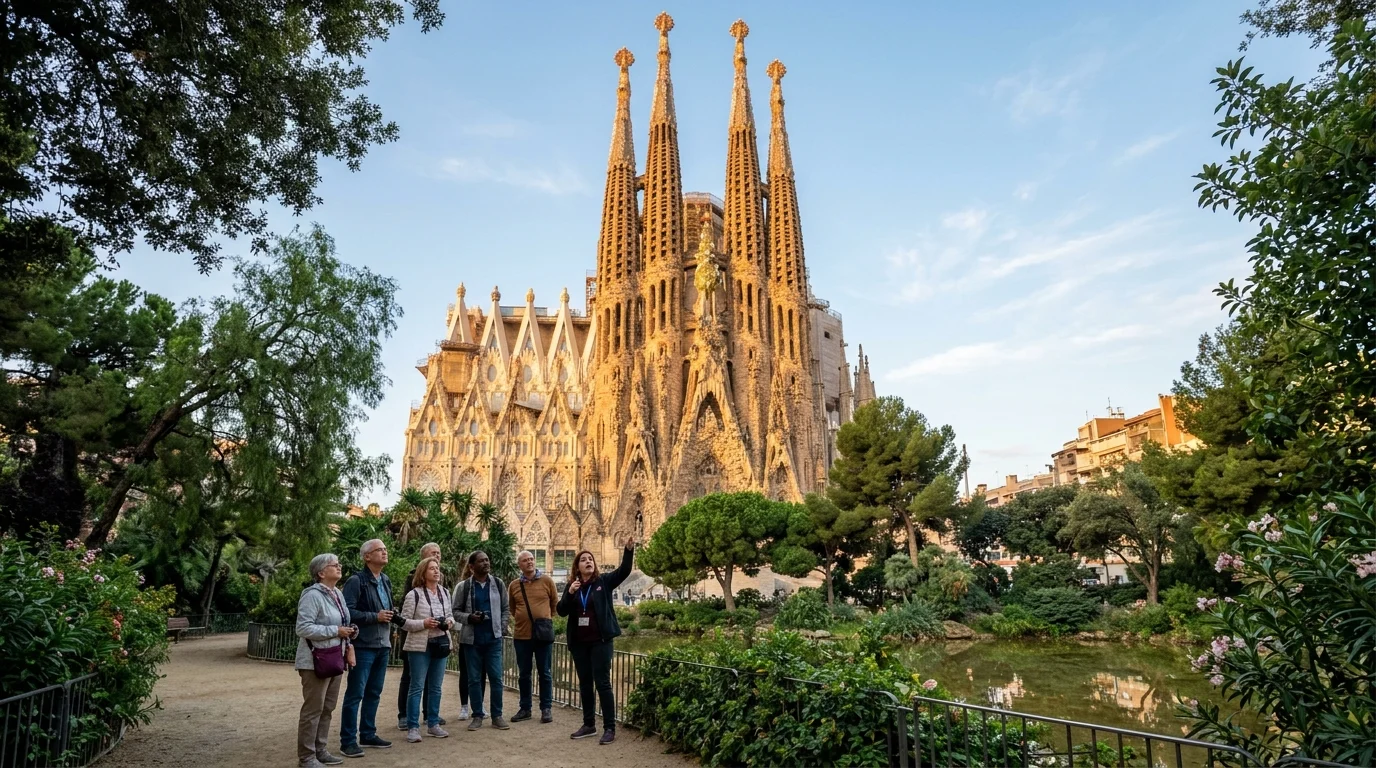
The Sagrada Familia has three facades: the Nativity facade, built under Gaudí's own direction and full of organic detail about the birth of Christ; the Passion facade, with stark, angular sculpture by Josep Maria Subirachs; and the Glory facade, the future main entrance, still under construction. You can see all of them from the street without a ticket.
Key takeaways
- Three facades, three moods. Nativity is soft, crowded with nature and joyful. Passion is bare, sharp and sombre. Glory is the work still in progress on the third side.
- No ticket needed to look. The facades face public streets and squares, so anyone can stand in front of them. A ticket is only needed to go inside.
- A guide changes what you notice. Most of the meaning sits in small carved scenes that are easy to walk past without an explanation.
- The exterior tour is built around the facades. The Barcelona Highlights and Sagrada Familia Guided Exterior Half Day Tour costs €124 per person, runs for 5 hours with hotel pick-up and takes a maximum of 8 people. The interior ticket is not included.
- Want to go inside as well? The Barcelona Highlights and Sagrada Familia Half Day Tour costs €150 per person and includes a Sagrada Familia ticket, subject to availability.
- Sold-out dates have a plan. If Sagrada Familia tickets sell out for your date, the tours that include a ticket still go ahead with a guided exterior visit and €26 per person is refunded.
What are the Sagrada Familia facades?
A facade is the decorated outer face of a building. At the Sagrada Familia, each of the three main facades tells one part of the life of Christ in stone. Gaudí planned them as a sequence you read from one side of the basilica to the other: birth, death and finally glory.
They work like a book carved into the walls. Each facade has its own sculptor's hand, its own mood and its own way of catching the light.
The two finished facades sit on opposite sides of the building. The Nativity facade faces the side where the sun rises. The Passion facade faces the side where it sets. The Glory facade is planned for the third side and will become the main entrance once the work there is complete.
How many facades are there, and which are finished?
There are three main facades. Nativity and Passion are the two you can see in full today. Glory is still being built, so on that side you will see construction work rather than a finished sculpted front. Because building work at the basilica continues, the official Sagrada Familia website is the place to check the current state of the works before your visit.
What does the Nativity facade show?
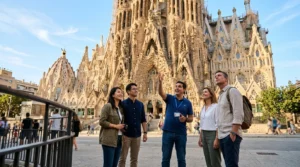
The Nativity facade is the one Gaudí worked on himself, and it shows. It is the most crowded, detailed and organic of the three. The stone seems to drip and grow, with plants, animals and figures spread across almost every surface.
The theme is the birth and early life of Christ. Look for the scenes of the birth itself, the adoration of the shepherds and the kings, and the angels playing instruments. Higher up, a green cypress tree rises at the centre, often read as the tree of life, with white doves resting on its branches.
The three doorways of Nativity
The facade is divided into three doorways, dedicated to Faith, Hope and Charity. Charity, in the centre, is the largest and carries the main nativity scene. Hope and Faith sit on either side with their own stories from the life of the Holy Family.
Details a guide usually points out
- The turtles. At the base of the columns, a land turtle and a sea turtle carry the weight, a quiet nod to the land and the sea.
- The chameleons. Small carved chameleons sit at the corners, symbols of change.
- The plants and animals. Gaudí took his shapes from nature, so you will find leaves, birds and other creatures woven into the stone.
The Nativity facade rewards a slow look. The longer you stand in front of it, the more figures appear.
What does the Passion facade show, and why does it look so different?
The Passion facade tells the story of the last days of Christ: the Last Supper, the betrayal, the trial, the crucifixion and the burial. It is the facade most visitors react to first, because it looks nothing like Nativity.
Gaudí designed the overall idea and wanted this side to be hard and bare, almost like a skeleton, to express suffering and death. The sculpture you see today was carved later by Josep Maria Subirachs, a Catalan sculptor with a very different style. His figures are angular, flat and geometric, with sharp edges instead of soft curves.
How to read the Passion scenes
The scenes are arranged so you follow them in a zigzag, starting low on one side and climbing towards the top. A guide can walk you through the order, which is hard to spot on your own. Key moments include:
- The Last Supper, with the apostles gathered around the table.
- The kiss of Judas, next to a carved grid of numbers that has become one of the most photographed details of the basilica.
- Veronica's veil, where the face of Christ is shown pressed into the cloth while Veronica herself has no face.
- The soldiers, whose helmets echo the shapes of the chimneys Gaudí designed on the roof of La Pedrera.
- The crucifixion at the centre, stark and simple.
Is the Passion facade better than Nativity?
Neither is better; they do different jobs. Nativity is about life and celebration, so it is busy and warm. Passion is about death, so it is stripped back and severe. Many visitors find Nativity more beautiful and Passion more powerful. Seeing both, one after the other, is the point: the contrast is part of the design.
What will the Glory facade be, and is it the main entrance?
The Glory facade is planned as the largest and most important of the three, and it will be the main entrance to the basilica once it is finished. Its theme is the glory of Christ and the path of each person through life, death and what follows, a big subject for a big front.
Today, the Glory side is still under construction. Because the plans and timing of this side are set by the basilica and the city, any date you read for its completion is outside what this guide can confirm. The official Sagrada Familia website is the source to follow.
Which facade is the entrance today?
Until Glory is complete, visitors enter through the entrances the basilica assigns. The entry point for your visit is shown on your ticket, and on a guided visit your guide takes you to the right door. If you only plan to look at the outside, you do not need an entrance at all.
Do you need a ticket to see the Sagrada Familia facades?
No. The Nativity and Passion facades both face public spaces, and you can stand in front of them, photograph them and study them for as long as you like without paying anything. A ticket is only needed to go inside the basilica.
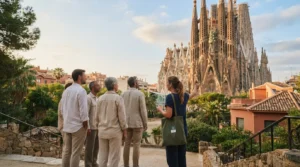
What a ticket does not give you is the story. Without a guide or a good explanation, the facades can feel like a wall of figures. That is the gap a guided exterior visit fills. A local guide stands with you in front of each facade, explains what each scene shows, points out the small details and tells you how the building came to look the way it does.
A guided exterior visit also avoids the security lines at the entrance, since you are not going in. For visitors short on time, or for those who want the meaning of the outside more than the inside, that can be the better use of a morning or afternoon.
Where to stand to see each facade
Where you stand makes a real difference, because the basilica is big and the streets around it are busy.
Nativity facade: Plaça de Gaudí
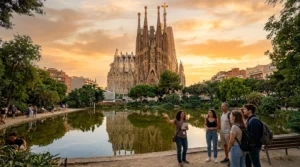
The square in front of the Nativity facade has a pond, and the classic view of the basilica with its reflection in the water is taken from the far side. Standing back here gives you the whole facade in one frame. Walking closer lets you see the turtles, the doorways and the carved scenes. For a full walk through this viewpoint, see the guide to Plaça de Gaudí and its view of the Sagrada Familia.
Passion facade: Plaça de la Sagrada Família
On the opposite side, the square in front of the Passion facade gives you room to step back and take in the Subirachs sculpture. Here the story reads best from a little distance, so you can follow the zigzag order of the scenes.
Glory side
The Glory side faces a busy street and is still under construction, so it is less of a viewpoint for now. Most people spend their time on Nativity and Passion.
What is the best time of day to see the facades?
The light follows the sun around the basilica, so the time of day changes what you see.
- Morning: the Nativity facade faces the rising sun, so the morning is the best time to see its detail lit from the front.
- Afternoon and evening: the Passion facade faces the setting sun, and the late light brings out the hard edges of the Subirachs figures.
- Crowds: the squares are busy for much of the day. Earlier in the day is often calmer around the facades, but this varies with the season.
If you can only visit once, a guide can position you so each facade is seen at its best within the time you have.
How long does it take to see the Sagrada Familia from outside?
Seeing both finished facades properly, with time to read the scenes and walk between the two squares, needs more than a quick photo stop. A guided exterior visit sits within a longer route on the exterior half-day tour, so you do not have to plan the time yourself.
On the Barcelona Highlights and Sagrada Familia Guided Exterior Half Day Tour, the whole tour lasts 5 hours. Beyond the in-depth exterior visit of the Nativity and Passion facades, the route takes in panoramic views from Montjuïc, the modernist facades of Passeig de Gràcia and a guided walk through the Gothic Quarter. Hotel pick-up and drop-off are included in an air-conditioned vehicle.
How to see the facades on a tour, with and without going inside
Several tours include the Sagrada Familia. Some stay outside; others include a ticket, subject to availability. The table below shows the options side by side.
| Tour | Price | Price basis | Duration | Max group | Sagrada Familia |
|---|---|---|---|---|---|
| Barcelona Highlights and Sagrada Familia Guided Exterior Half Day Tour | €124 | per person | 5h | 8 | Guided exterior visit; interior ticket not included |
| Barcelona Highlights and Sagrada Familia Half Day Tour | €150 | per person | 5h | 8 | Ticket included, subject to availability |
| Barcelona in One Day | €195 | per person | 8h | 18 | Ticket included, subject to availability; also skip-the-line Park Guell |
| Private One Day | €879 | per group of up to 6 | 8h | 6 | Ticket included, subject to availability; also skip-the-line Park Guell |
| Private Montserrat and Barcelona | €849 | per group of up to 6 | 10h | 6 | Ticket included, subject to availability |
| Gaudi's Modernist Legacy Walking Tour | €50 | per person | 3h | 15 | Facades seen from outside; monument entry tickets not included |
Two points matter when you compare these. First, the shared tours are priced per person, while the private tours are priced for the whole group of up to 6. They are not on the same basis. Shared by a full group of 6, the private One Day at €879 works out at €146.50 each. Second, only the tours marked with a ticket include a visit inside, and that ticket is always subject to availability.
The exterior half day: built around the facades
The Barcelona Highlights and Sagrada Familia Guided Exterior Half Day Tour is the one designed for this topic. The Sagrada Familia stop is an in-depth guided exterior visit of the Nativity and Passion facades. At €124 per person, with hotel pick-up and a maximum of 8 people, it suits visitors who want the meaning of the facades without the interior queue. You can read the full route on the exterior half day tour page.
The half day with a ticket: facades plus the interior
If you want to see the facades and the inside, the Barcelona Highlights and Sagrada Familia Half Day Tour costs €150 per person for 5 hours, with hotel pick-up and a maximum of 8 people. It includes a Sagrada Familia ticket, subject to availability, plus an exterior guided visit. For a closer look at how the two half days differ, see Sagrada Familia inside or outside.
Full day and private options
Barcelona in One Day, at €195 per person for 8 hours with a maximum of 18 people, adds skip-the-line Park Guell to a Sagrada Familia ticket, subject to availability. For a group that wants its own vehicle and guide, the private One Day is €879 per group of up to 6, and the private Montserrat and Barcelona tour is €849 per group of up to 6.
A walking option on a budget
Gaudi's Modernist Legacy Walking Tour, at €50 per person for 3 hours with a maximum of 15 people, meets in central Barcelona and uses no vehicle. It ends in view of the Sagrada Familia, with the facades seen from outside. Monument entry tickets are not included.
What happens if Sagrada Familia tickets sell out?
Sagrada Familia tickets are always subject to availability, and on busy dates they can sell out. If that happens on the €150 half day, the €195 Barcelona in One Day, or the private €849 and €879 tours (each priced per group of up to 6), the tour still goes ahead with a guided exterior visit and €26 per person is refunded.
In practice, this means the facades are part of every Sagrada Familia tour either way. If the inside is not possible on your date, you still get the guided explanation of Nativity and Passion. The €124 exterior tour is not affected, because it never includes a ticket.
Which facade should you see first?
There is no fixed rule, but there are good reasons to choose an order.
| Question | Nativity first | Passion first |
|---|---|---|
| Story order | Follows the life of Christ from birth | Starts with the end of the story |
| Light | Best in the morning | Best in the afternoon and evening |
| Mood | Opens with detail and colour | Opens with contrast and drama |
| Best viewpoint | Plaça de Gaudí, across the pond | Plaça de la Sagrada Família |
Following the story from birth to death makes the most sense to most people, so Nativity first is a natural choice in the morning. In the afternoon, starting with Passion and ending at Nativity can suit the light better. On a guided visit, your guide chooses the order for the time of day.
Practical notes before you book
- Wear comfortable shoes. Even an exterior visit involves walking between the two squares and standing for a while.
- Look up, then look close. Step back to see the shape of each facade, then walk closer for the small carved scenes.
- Bring a camera with a wide view. The facades are tall, and standing back from Nativity across the pond is the easiest way to fit it in.
- Check what your tour includes. Only some tours include a ticket to go inside, and that ticket is always subject to availability. The €124 exterior tour does not go inside.
- Plan for changes. Every Barcelona tour can be cancelled for free, or moved to a new date for free, up to 96 hours before it starts. Refunds go back to the original payment method within a few business days. A no-show is not refunded. The full terms are on the cancellation policy page.
- Know how you get there. The small-group tours include hotel pick-up and drop-off in an air-conditioned vehicle. Walking tours meet in central Barcelona and use no vehicle. Private tours collect you from your hotel in a vehicle for your group only.
Conclusion
The Sagrada Familia facades are the easiest part of the basilica to visit and the hardest to read alone. Nativity shows Gaudí's love of nature and detail, Passion answers it with the stark, angular work of Subirachs, and Glory is the main entrance still taking shape. You can see them from the street for free, but a guide turns a wall of figures into a story.
To see the facades with a local guide, you can browse all tours and choose the exterior half day at €124 per person or an interior option. For questions about dates or groups, message City Tour in Barcelona on WhatsApp at +34 632 93 79 41 or email info@citytourinbarcelona.com.