Besalú is worth seeing for four things: the fortified Romanesque bridge over the Fluvià river, the old Jewish quarter with its medieval mikveh, the monastery church of Sant Pere and the church of Sant Vicenç. The old town is small, so two to three hours on foot covers it, which is why most visitors pair it with nearby towns.
Key takeaways
- The medieval core is compact. Two to three hours on foot covers the main sights.
- The mikveh is visited through the Besalú tourist office. Check with the office for current visit times before you plan around it.
- The small-group "Besalu and Vic" day trip costs €155 per person, takes about 10 hours, carries a maximum of 8 people and includes hotel pick-up and drop-off in Barcelona.
- That day runs Vic, Santa Pau, Castellfollit de la Roca (a photo stop) and then Besalú. Vic, Santa Pau and Besalú are guided walks. Lunch is not included.
- Free cancellation or a free date change applies up to 96 hours before the tour starts.
What is Besalú and where is it?
Besalú is a medieval town in the comarca of La Garrotxa, in the province of Girona, in the north of Catalonia. It sits where the Fluvià river meets a smaller stream, and that river crossing is the reason the town grew up here. In the 10th and 11th centuries Besalú was the seat of its own county, which explains why such a small place has a monastery, two large Romanesque churches and a royal court building.
The old centre is a protected historic ensemble. Stone houses, arched lanes and small squares keep their medieval layout, so you walk across the bridge and are inside the old town straight away. From Barcelona it is a long drive north, beyond Vic; Girona is the nearest city.
What to see in Besalú, stop by stop
Pont Vell, the fortified bridge
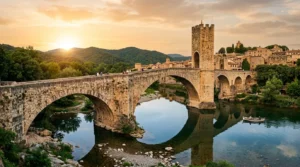
The Pont Vell is the image everyone knows from Besalú. It is a Romanesque bridge built in stone across the Fluvià, and it is not straight: it bends in the middle, following the rock outcrops in the riverbed that its builders used as footings. Halfway across stands a fortified gate tower, where tolls were once collected and where the town could be closed off from the far bank.
What it adds: the clearest sense of Besalú as a defended medieval town. The classic view of the arches and tower is from the riverbank on the far side. The bridge was damaged and rebuilt several times, most recently after the Spanish Civil War, so what you see is a careful restoration on medieval foundations.
The Call, Besalú's Jewish quarter
Below the main streets, close to the river, lies the Call, the area where Besalú's Jewish community lived in the Middle Ages. The community lived here until the expulsion of the Jews from the Spanish kingdoms at the end of the 15th century, and today the Call is a handful of narrow lanes and stone steps running down to the water.
What it adds: a side of medieval Catalonia that many visitors know little about. The excavated remains of the synagogue sit in an open space near the river, in one of the quietest corners of town.
The mikveh: can you visit it?
The mikveh is a medieval Jewish ritual bath, built below ground beside the river so it could be fed by natural water. It was rediscovered in the 20th century and is one of the very few medieval mikvehs that survive in Europe, which is a large part of why Besalú draws visitors interested in Jewish heritage.
What it adds: a rare surviving piece of daily religious life from the medieval Call. Access is not a walk-in affair. Visits to the mikveh are arranged through the Besalú tourist office, so check with the office for current visit times and conditions before you build your day around it. Steps lead down into the vaulted chamber.
Sant Pere, the monastery church
Sant Pere is the church of the Benedictine monastery founded in Besalú in the 10th century. The monastery buildings are largely gone, but the Romanesque church stands on its own square, the Plaça de Sant Pere. The front has a large window flanked by carved stone lions, and inside there is an ambulatory, a walkway that curves round behind the altar, which is unusual for a church of this size.
What it adds: Romanesque architecture at its most solid, with an open square that lets you step back and look. For the interior, ask the tourist office.
Sant Vicenç
Sant Vicenç is the other large Romanesque church, on its own small square higher up in the old town. It was built mainly in the 12th century, with Gothic additions later. Look for the carved doorway and the decorated window on the side wall, which are among the finest stonework in Besalú.
What it adds: a second, more ornate example of Romanesque carving, and a peaceful square away from the bridge crowds.
Cúria Reial and Plaça de la Llibertat
The Plaça de la Llibertat is the main square, lined with arcades. On it stands the Cúria Reial, the building where royal justice was administered once Besalú passed to the Crown. It is a Gothic building and a reminder that Besalú mattered politically long after its days as a county seat.
What it adds: the civic heart of the town. It is the natural place to pause and get your bearings.
Casa Cornellà
Casa Cornellà is a Romanesque townhouse, one of the oldest surviving houses of its kind in Catalonia. Its stone front with paired windows shows how a well-off medieval family lived, in contrast to the churches and defensive works elsewhere in town.
What it adds: a picture of ordinary life in medieval Besalú.
The castle hill
On the high ground above the town are the remains of the castle and the old church of Santa Maria. Little survives, so go for the view over the rooftops if you have spare time and good legs.
A walking order that works
A sensible order saves climbing back and forth. This route starts at the river and finishes in the main square.
| Order | Sight | What it adds | Rough time on the spot |
|---|---|---|---|
| 1 | Pont Vell from the far bank | The classic view of the bridge and town | 10 to 15 minutes |
| 2 | Walk across the bridge | The gate tower and the river from above | 10 minutes |
| 3 | The Call and synagogue remains | Jewish history, quiet lanes by the river | 20 to 30 minutes |
| 4 | Mikveh (if a visit is arranged) | A rare medieval ritual bath | Check with the tourist office |
| 5 | Sant Pere and its square | Romanesque monastery church | 15 to 20 minutes |
| 6 | Casa Cornellà | A Romanesque family house | 5 to 10 minutes |
| 7 | Sant Vicenç | Carved doorway and window | 15 minutes |
| 8 | Plaça de la Llibertat and Cúria Reial | The main square and royal court | 15 to 20 minutes |
The times are a rough guide for someone walking at an easy pace and stopping to look, not a timetable.
How long do you need in Besalú?
For the main sights, two to three hours is enough. If you add a mikveh visit, a long lunch and the castle hill, Besalú can fill half a day.
A full day in Besalú alone is more than most people want: the town is small, and once you have walked its streets there is not much more to do inside the walls.
Is Besalú enough for a full day, or best paired?
Best paired. Besalú works well as one stop in a day that includes other towns of the area: Vic to the south, the volcanic landscape and villages of La Garrotxa to the west, and Girona to the east.
Is Besalú worth visiting?
Yes, if you like medieval towns, Romanesque architecture or Jewish history. Few places in Catalonia keep a medieval bridge, a Jewish quarter with a surviving mikveh and two Romanesque churches within a few minutes' walk of each other.
It is less suited to travellers who want shops, nightlife or big museums; Besalú is about streets, stone and atmosphere. For how it compares with Montserrat, the Costa Brava and other routes, see our guide to the best day trips from Barcelona compared.
How Besalú fits a day with Vic, Santa Pau and Castellfollit de la Roca
The small-group "Besalu and Vic" day trip links four inland towns in one day of about 10 hours. You are picked up at your Barcelona accommodation, the group is a maximum of 8 people, and the price is €155 per person. The order of the day is:
- Vic. A guided walk around Plaça Major, the Casa Comella town hall, the Cathedral with Josep Maria Sert's paintings and the Roman Temple, followed by free time to try local food. Our guide to what to see in Vic covers that stop in detail.
- Santa Pau. A walk through this medieval village inside La Garrotxa Volcanic Zone Natural Park, including its main square with vaulted arcades.
- Castellfollit de la Roca. A photo stop at the village built on the edge of a basalt cliff about 40 m high.
- Besalú. A walking tour of the walled medieval town, covering its Jewish history and its Romanesque bridge.
Then you return to Barcelona for drop-off at your accommodation. Besalú comes last, so you reach the bridge later in the day. The full route, with what each stop includes, is on the Besalu and Vic day trip page, and our longer post on how the Besalú, Vic and medieval villages day runs walks through the day hour by hour.
What does Castellfollit de la Roca add?
Castellfollit de la Roca is a village built right on the edge of a basalt cliff, with houses lined up along the top of the rock. It shows the volcanic geology of La Garrotxa better than any explanation. On the tour it is a short photo stop, not a walk, so think of it as a viewpoint between Santa Pau and Besalú rather than a town visit.
How much of Besalú does a guided day trip show, and what does it leave out?
The Besalú part of the day is a guided walking tour of the walled town that covers its Jewish history and its Romanesque bridge. That means the two things most people come for, the Pont Vell and the story of the Call, are at the centre of the visit.
What it does not include is equally clear. The tour page lists no entry tickets, so plan on seeing the churches and other buildings from the outside unless something else is arranged locally. A mikveh visit is not listed as included. And because Besalú is one of four stops in a day, you will not have the hours needed for the castle hill, a sit-down lunch in Besalú or a slow interior visit to every church. Lunch on this tour is in your free time in Vic, at your own expense.
If seeing inside the mikveh or the churches is your main reason to go, an independent visit planned around the tourist office gives you that control. If you want the bridge and the Jewish quarter explained, plus three other towns without driving, the day trip is simpler.
Can you see Besalú and Vic in one day without a car?
On the small-group day trip, yes: transport between all four towns and hotel pick-up and drop-off are included, so you do not need a car or a timetable.
By public transport it is much harder. Vic is reachable from Barcelona by regional train, and regional coaches run by the operator TEISA link Barcelona and Girona with Besalú. But Vic and Besalú sit on different routes, and adding Santa Pau and Castellfollit de la Roca on the same day is not realistic without a car. Check the current timetables directly with Rodalies de Catalunya and TEISA if you want to try one town at a time.
By public transport, choose one town per day. Girona also works as a single day; our guide to Girona in a day shows how much fits.
Small-group day trip vs going independently
| Besalu and Vic small-group day trip | Going independently | |
|---|---|---|
| Price basis | €155 per person | Your own transport and food costs |
| Getting there | Hotel pick-up and drop-off in Barcelona included | Car, or regional coach and train on your own schedule |
| Towns in one day | Vic, Santa Pau, Castellfollit de la Roca and Besalú | Usually one or two without a car |
| Guide | Professional guide, guided walks in Vic, Santa Pau and Besalú | None, unless you book one locally |
| Group size | Maximum 8 people | Just your party |
| Time in Besalú | Part of a 10-hour day, as the last stop | As long as you like |
| Mikveh and church interiors | Not listed as included | Arrange with the Besalú tourist office |
| Lunch | Not included; free time in Vic | Wherever you choose |
| Changing plans | Free cancellation or date change up to 96 hours before | Depends on what you have booked |
In short: the day trip gives you more towns, no driving and a guide; going independently gives you more time in Besalú and interior visits.
When is the bridge quieter? Season and light
The Pont Vell is busiest in the middle of the day, at weekends and in the summer months, when day visitors and coach groups arrive at the same time. Early morning and late afternoon are usually calmer, and weekdays outside the main holiday periods are calmer still.
The light changes the bridge a lot. In the morning and late afternoon the low sun warms the stone and the reflections in the Fluvià are softer, which is when photographers prefer it. On the day trip, Besalú is the last stop, so you usually see the bridge in the afternoon, often after the busiest part of the day.
Spring and autumn are mild and green. Summer is warm and busier. Winter is quiet and can be cold, since La Garrotxa sits inland and higher than Barcelona.
What to wear on the cobbles
Besalú's lanes are paved with old stone and cobbles, uneven in places and slippery when wet. The Call runs downhill towards the river, with steps in several spots, and the bridge itself has a slight hump and an uneven surface.
- Wear closed shoes with good grip. Thin-soled sandals are uncomfortable on cobbles.
- Bring a light layer, since inland Catalonia is often cooler than Barcelona, especially later in the day.
- Carry water, a hat and sun cream in summer; there is little shade on the bridge.
On the full day trip you walk in Vic, Santa Pau and Besalú, so comfortable shoes matter for all three, not only for the last stop.
Is the Jewish quarter walkable for older visitors?
For most people with steady legs, yes, at a gentle pace. The distances are short. The harder parts are the slopes and steps down towards the river and the uneven stone underfoot, and the mikveh itself is reached by stairs. Take it slowly and skip the castle hill if climbing is hard.
The day trip has three guided walks, so it suits older travellers who are happy on their feet for part of each stop, rather than those who need to keep walking to a minimum. For options with less walking, see our guide to Barcelona tours for seniors.
Who suits the Besalu and Vic day trip
It works well if you:
- enjoy medieval streets, Romanesque churches and history explained on the spot;
- want to see Besalú, Vic, Santa Pau and Castellfollit de la Roca in one day without renting a car;
- prefer a small group of up to 8 people, where you can ask the guide questions as you walk;
- are happy to buy your own lunch during the free time in Vic.
It is less suited to you if your main goal is to go inside the mikveh or the churches, if you want several hours in Besalú alone, or if you need a day with very little walking. In those cases, an independent trip to Besalú or a different route makes more sense.
Whichever you choose, plans can change: you can cancel for free or change your date for free up to 96 hours before the tour starts. Refunds go back to the original payment method within a few business days, and a no-show is not refunded.
Plan your Besalú day
Besalú rewards a slow walk: cross the Pont Vell, go down into the Call, see Sant Pere and Sant Vicenç and finish in the main square. Two to three hours covers it, and pairing it with Vic, Santa Pau and Castellfollit de la Roca makes the long trip from Barcelona worthwhile.
To book, choose a date on the Besalu and Vic day trip page. If you have a question first, send a WhatsApp or call +34 632 93 79 41, or write to [email protected].