Pals is a hilltop medieval village in the Baix Empordà, on the Costa Brava, just inland from the sea. Its Torre de les Hores, Sant Pere church, walls and Josep Pla viewpoint fill one to two hours. Without a car, the simplest visit from Barcelona is a guided day trip pairing Pals with Girona and Calella de Palafrugell.
Key takeaways
- Pals is a compact walled village on a small hill. The main sights are the Torre de les Hores, the church of Sant Pere, the old walls and towers, Carrer Major and the Josep Pla viewpoint.
- The village is not on the beach. It looks out over the Empordà plain and its rice fields towards the sea, and Platja de Pals is the nearby stretch of sand.
- Around one to two hours is enough to walk the old quarter properly. That is why most visitors combine it with other stops in the same day.
- Getting there from Barcelona without a car is slow by public transport, and linking Pals with Girona and the coast on your own is hard in a single day.
- The shared small-group day trip Costa Brava and Medieval Girona costs €145 per person, lasts 10 hours, takes a maximum of 8 people and includes hotel pick-up in an air-conditioned vehicle.
- That day walks Girona first, then Pals, then Calella de Palafrugell, where lunch is eaten. Lunch is not included.
- Free cancellation or a free date change is available up to 96 hours before the tour starts.
What is there to see in Pals?
Pals rewards a slow walk more than a checklist. The old quarter, known locally as El Pedró, sits on top of a low hill, and almost everything worth seeing is a few minutes apart. Many stone doorways and windows still carry their old arches.
The Torre de les Hores
The Torre de les Hores, the Tower of the Hours, is the landmark you see first when you approach Pals. It is a tall, rounded stone tower and the most visible survivor of the old castle that once stood at the top of the hill. It takes its name from the clock it held, which marked the hours for the people working the fields below. Today it is the natural meeting point of any walk through the village and the easiest place to get your bearings.
The church of Sant Pere
Next to the tower stands the church of Sant Pere. Its history runs across several centuries, so you can see different building periods in the same walls, from the older base to later additions. The square in front of it is one of the quietest spots in the village, and the view of the tower and church together is the picture most people take home. Check locally whether the interior is open on the day you visit, since access can vary.
The walls and towers
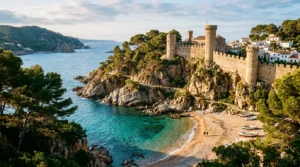
Pals grew up behind defensive walls, and long sections of them remain, along with several towers. Walking the edge of the old quarter, you can follow the line of the walls and see how the village was built to be defended. The walls also explain why Pals feels so compact: the old town was never meant to spread beyond them.
Carrer Major and the lanes around it
Carrer Major is the main street through the old quarter. It climbs gently between stone houses with arched doorways, iron balconies and plants spilling from window boxes. Side lanes branch off it, some with steps, some ending in small squares. This is where comfortable shoes matter: the stones are uneven, and the best corners are found by wandering rather than by following a map.
The Josep Pla viewpoint
At the edge of the village is the viewpoint named after Josep Pla, the Empordà writer who described this landscape in his books. From here you look out over the Empordà plain, across fields and farmland, towards the sea. On a clear day the view gives you the whole geography of the area in one glance: the hills behind, the flat land in front and the coastline beyond. It is the single best reason to make Pals part of a Costa Brava day.
The rice fields of Pals
The plain below the village is one of the few places in Catalonia where rice is grown. The fields are flooded at certain times of year and turn green as the crop grows, which changes the view from the viewpoint through the seasons. Pals rice is a local product you will see on menus and in shops in the area. You do not need to walk into the fields to appreciate them: from the old quarter they spread out below you like a map.
Is Pals on the coast?
No. Pals sits a short way inland, on its hill above the plain. The sea is visible from the viewpoint, but the village itself has no seafront. The nearby beach is Platja de Pals, a long, open stretch of sand facing the Mediterranean, reached by road from the village.
This matters when you plan. If your picture of the Costa Brava is a small harbour with boats pulled up on the sand, Pals will not give you that on its own. It gives you the medieval village and the view. The coastal side of the day comes from a second stop, and on the shared day trip that stop is Calella de Palafrugell.
What is Calella de Palafrugell like?
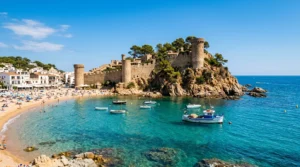
Calella de Palafrugell is a former fishing village on the coast, built around a series of small coves. White houses face the water, fishing boats are drawn up on the sand, and arcades along the seafront give shade on hot days. It is a very different feeling from Pals: open, bright and focused on the sea rather than on stone walls.
The coastal path
The best way to see Calella is on foot along the coastal path, the old route that follows the shoreline above the coves. It runs between pine trees and rocks, with views down into clear water. Even a short stretch is enough to understand why this part of the Costa Brava draws so many visitors. The path has some steps and uneven ground, so it is another reason to wear proper walking shoes rather than sandals.
Why it pairs well with Pals
Pals and Calella de Palafrugell are close enough to share an afternoon and different enough to make a full day feel varied. One is a medieval hilltop village with a view of the plain; the other is a seafront village with coves and a footpath. Together they give you both sides of the Baix Empordà: the inland villages and the coast.
How far is Pals from Barcelona and can you go without a car?
Pals is in the province of Girona, well to the north east of Barcelona. By car it is a comfortable trip for a day, but it is far enough that the journey takes a real part of the morning, and it is not a short hop you can make between other plans.
Public transport
There is no train station in Pals. Regional buses serve the Baix Empordà, but reaching Pals from Barcelona usually means a longer journey with fewer departures than you would expect from the city, and the timetable thins out outside the main summer season. Adding Calella de Palafrugell and Girona to the same day by public transport is difficult, because the three places sit on different routes and the connections between them are not built for day visitors.
Driving yourself
Hiring a car works if you are happy to drive and park in small villages, where streets near the water are narrow and busy in summer. You plan the route and timing yourself, and someone in the group drives all day.
A guided day trip
For most visitors who do not want to drive, a guided day trip is the simplest answer. You are collected from your hotel, the driving and the route are handled, and a guide explains what you are looking at in each place. If you want a broader view of the pros and cons, the post on Costa Brava tours from Barcelona versus travelling on your own goes through the trade-offs in detail.
How long do you need in Pals?
One to two hours covers the old quarter well. That is enough time to walk up to the Torre de les Hores, see the church of Sant Pere, follow Carrer Major and the lanes around it, stand at the Josep Pla viewpoint and stop for a coffee. If you love photography or want to sit in a square and watch the light change, you could stay longer, but there is no need to give Pals a whole day.
Because it is compact, Pals fits naturally into a longer itinerary. On the shared day trip it is the middle stop between Girona and Calella de Palafrugell, which means you arrive after a morning of city walking and leave for the coast after a relaxed visit. That rhythm works well: a busier city in the morning, a quiet village after it, and the sea at the end.
Is Pals worth visiting if you are also seeing Girona?
Yes, because the two places are different in scale and character. Girona is a historic city with a large old quarter. Pals is a small village you can walk across in minutes. Seeing both in a day gives you a sense of how Catalan towns developed at very different sizes.
What Girona adds
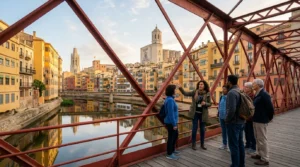
In Girona the day trip walks through the Jewish Quarter, visits the Cathedral, passes the colourful houses along the Onyar river and crosses the Eiffel bridge. It is a fuller, busier walk, with more history packed into the streets. If you want more detail on how that part of the day runs, read what you see in Girona in a day.
What Pals adds
Pals adds quiet, open views and a sense of the countryside. After Girona's lanes, standing at the Josep Pla viewpoint and looking out over the rice fields towards the sea is a change of pace. You see the Empordà landscape itself, not just its towns.
Pals or Girona for a first-time visitor?
If you only have time for one of the two, Girona is the bigger and more varied visit, and it is the easier place to reach from Barcelona on your own. Pals is the more peaceful choice and the better one for views. For a first trip to Catalonia, combining them on a guided day is the most efficient way to avoid choosing, since the route is planned so that each stop gets the right amount of time.
Where do you eat on a Pals day?
On the shared day trip Costa Brava and Medieval Girona, lunch is eaten in Calella de Palafrugell. Lunch is not included in the price, so you choose what and where you eat. Seafront restaurants and simple cafés are both options, and the guide can point you in the right direction. Pals itself has places for a drink or a snack, so the visit there is a good moment for a coffee before the coastal stop.
If you have food preferences or dietary needs, it is worth bringing a small snack for the morning, since the Girona walk comes first and lunch follows later in the day.
When is the best time of year to visit Pals?
Spring and early autumn are the most comfortable seasons for walking in Pals and along the coast at Calella. The weather is usually mild, the villages are calmer than in the height of summer, and the light is good for photographs.
Summer brings long days and the full seaside atmosphere in Calella de Palafrugell, but also more visitors in both villages, so expect busier lanes and seafronts. Winter is quieter still and can be a pleasant time for the medieval streets, although the coast is less lively and some seasonal places close.
What to wear and bring
The day involves three walks: the old quarter of Girona, the stone lanes of Pals and the coastal path in Calella de Palafrugell. A few practical points make it easier.
- Comfortable shoes. This is the most important one. Pals has uneven stone streets and steps, and the coastal path has rocks and stairs.
- Sun protection. A hat, sunglasses and sun cream, especially from late spring to early autumn. The viewpoint and the coast are open to the sun.
- A light layer. Mornings and evenings can be cooler than the middle of the day, and the coast can be breezy.
- Water. A refillable bottle is useful for a 10-hour day.
- Money for lunch. Lunch in Calella is not included, so bring a card or cash for it.
Shared or private: which day trip suits you?
There are three ways to see Girona and the Costa Brava with City Tour in Barcelona, depending on the stops you want and whether you prefer a small shared group or a vehicle for your own group only.
| Day trip | Type | Price | Duration | Group size | Stops (as listed) |
|---|---|---|---|---|---|
| Costa Brava and Medieval Girona | Shared, hotel pick-up | €145 per person | 10h | Max 8 people | Girona, Pals, Calella de Palafrugell |
| Montserrat, Girona and Costa Brava | Shared, hotel pick-up | €155 per person | 11h | Max 8 people | Montserrat, Girona, Costa Brava |
| Girona and Costa Brava (private) | Private, hotel pick-up | €850 per group of up to 6 | 10h | Your group only, up to 6 | Girona, Costa Brava |
The shared Pals day: Costa Brava and Medieval Girona
The Costa Brava and Medieval Girona day trip is the one that includes Pals by name in its route. It costs €145 per person, lasts 10 hours and takes a maximum of 8 people, with hotel pick-up and drop-off in an air-conditioned vehicle. The day walks Girona first, covering the Jewish Quarter, the Cathedral, the Onyar houses and the Eiffel bridge. Then it continues to Pals and its viewpoint over the Empordà plain and the sea, and finishes in Calella de Palafrugell with the coastal path. Lunch is not included and is eaten in Calella.
Adding Montserrat
The Montserrat, Girona and Costa Brava day trip costs €155 per person, lasts 11 hours and also takes a maximum of 8 people with hotel pick-up. As the name says, it combines Montserrat with Girona and the Costa Brava in one long day. Check the tour page for the exact stops before booking, since it covers more ground and the time in each place is shorter.
A private day for your group
The private Girona and Costa Brava tour costs €850 for the whole group of up to 6 people, not per person, and lasts 10 hours. A vehicle collects you from your hotel and is for your group only. It suits families, friends travelling together or anyone who wants the day without other travellers. The tour page lists the full itinerary.
Comparing the price basis
The shared trips are priced per person and the private trip per group, so they are not on the same basis. A couple will usually find the shared trip simpler; a group of up to 6 wanting its own vehicle should compare the group price with the shared fares. All Catalonia day trips are listed on the explore Catalonia page.
A sample day: how Pals fits into the route
This is how the shared Costa Brava and Medieval Girona day is structured, using the order on the tour page.
- Hotel pick-up in Barcelona. You are collected in an air-conditioned vehicle and the small group heads north.
- Girona on foot. A guided walk through the Jewish Quarter, to the Cathedral, past the houses on the Onyar river and over the Eiffel bridge.
- Pals. A walk through the medieval village, ending at the viewpoint over the Empordà plain and the sea.
- Calella de Palafrugell. Lunch at your own expense, then time on the coastal path above the coves.
- Return to Barcelona. Drop-off at your hotel at the end of the day.
The order puts the city first, the village as a calm middle stop and the sea in the afternoon.
Planning your Pals visit
Pals is a small, well-kept medieval village with a big view, and it is at its best as part of a day that also includes Girona and the coast at Calella de Palafrugell. Without a car, a guided small-group day is the simplest way to see all three without spending the day working out bus connections.
You can book the Costa Brava and Medieval Girona day trip on its tour page, with free cancellation or a free date change up to 96 hours before the tour starts. For questions about dates, pick-up or the private option, message us on WhatsApp at +34 632 93 79 41 or email [email protected].